Virginia SOL CE.3.e
The Standard
- CE.3
- The student will apply history and social science skills to analyze how constitutional government functions at the state level by
explaining the principle of separation of powers and the operation of checks and balances at the state level.
Virginia Standards of Learning for History and Social Science · The student will apply history and social science skills to analyze how constitutional government functions at the state level by
Teacher's field guide
What This Standard Means
What Students Need to Do
- Students identify the legislative, executive, and judicial branches of Virginia government and match each with its main powers. They explain how one branch can limit another, using vetoes, veto overrides, and judicial review as examples.
What Mastery Looks Like
- Given a state government scenario, students name the branch acting, describe its power, and identify a check another branch can use. They can explain why shared control prevents one branch from holding all government power.
Common Misconceptions
- Students may think the branches work separately and never affect one another. They often substitute Congress or the president for the General Assembly or governor, or assume the governor alone makes state laws.
How to Assess It
- Exit ticket: The General Assembly passes a bill, and the governor vetoes it. Name both branches involved, then explain one action lawmakers can take next.
Lesson moves
Ways to Teach It
Give groups branch cards and power cards; students sort each power, then draw arrows showing which branch can limit another.
Ask students to write: Why can the governor veto a bill but not permanently block a law alone?
Run a scenario-card game where teams name the acting branch, its power, and the check available to another branch.
Choose a recent Virginia bill and trace its path through the General Assembly, governor's action, and any court challenge.
Free download
Printable CE.3.e Worksheet
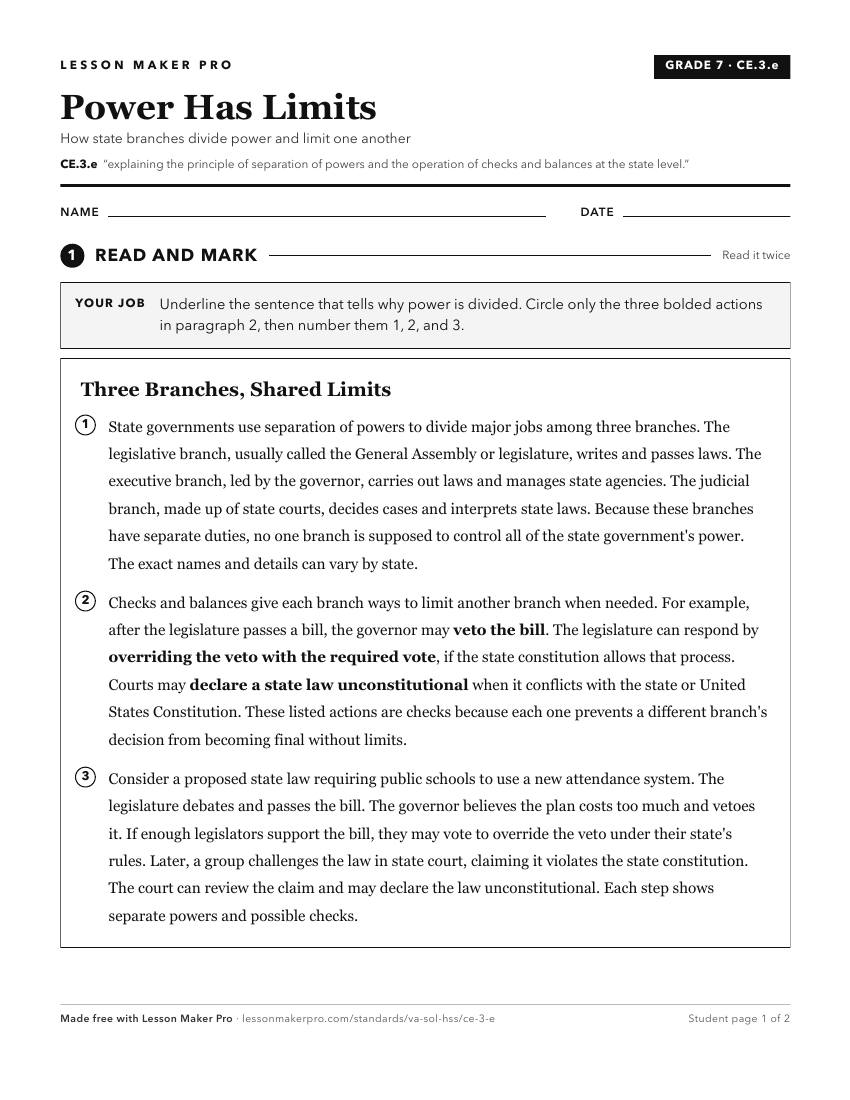
A ready-to-print activity worksheet aligned to CE.3.e, with an answer key for the teacher on its own page. No account needed.
PDF, US Letter, prints cleanly in black and white.
Download the worksheetKeep exploring
Related Standards
- CE.1.a
explaining the fundamental principles of limited government, republicanism, federalism, checks and balances, separation of powers, and popular sovereignty
- CE.3.d
explaining the relationship between state governments and the national government in the federal system, referencing Federalist No.10 and Federalist No. 51
- CE.3.b
explaining the state lawmaking process
- CE.2.e
explaining the principle of separation of powers and the operation of checks and balances.
Turn this exact standard into a lesson
Grade, subject, topic, and the complete standard are prefilled. Create one free, no account needed.
Also for this standard:Make a WorksheetMake a QuizMake a Sub Lesson