Virginia SOL CE.2.e
The Standard
- CE.2
- The student will apply history and social science skills to analyze how American constitutional government functions at the national level by
explaining the principle of separation of powers and the operation of checks and balances.
Virginia Standards of Learning for History and Social Science · The student will apply history and social science skills to analyze how American constitutional government functions at the national level by
Teacher's field guide
What This Standard Means
What Students Need to Do
- Students identify which powers belong to Congress, the president, and the federal courts. They explain how divided powers limit control and how each branch can restrain actions by another branch.
What Mastery Looks Like
- Students correctly sort government actions by branch and name the check involved in each example. Given a new scenario, they explain which branch acts, which branch is limited, and how.
Common Misconceptions
- Students may think the branches work separately and never interact. They often confuse making laws with enforcing laws, or assume courts can create laws. Some think checks and balances means every branch has equal power in every situation.
How to Assess It
- Use this exit ticket: “The president vetoes a bill, but Congress overrides the veto. Name both checks and explain who limits whom.”
Lesson moves
Ways to Teach It
Give groups branch, power, and check cards, then have them build accurate three-card matches on chart paper.
Ask students to write: “What could happen if one branch controlled lawmaking, enforcement, and court decisions?”
Run a scenario relay where teams identify the acting branch, the limited branch, and the check used.
Read a news report about a veto or court ruling, then label the branch action and its effect on another branch.
Free download
Printable CE.2.e Worksheet
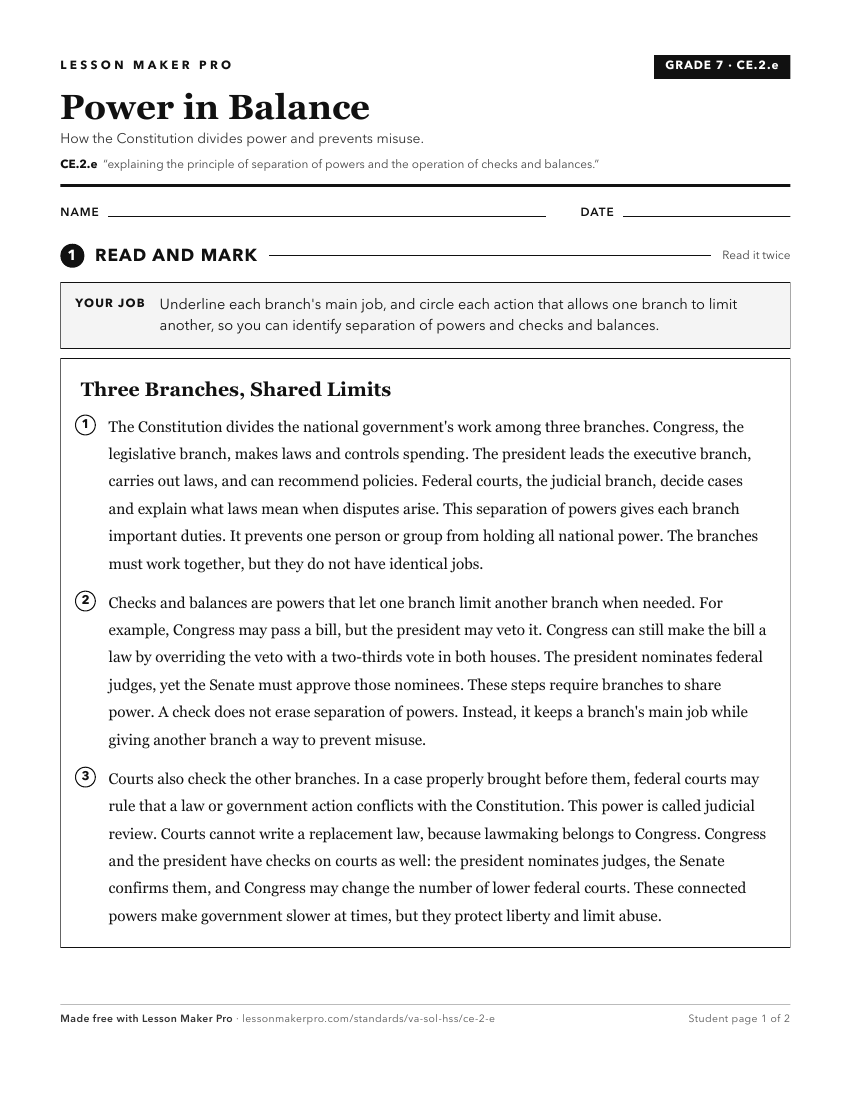
A ready-to-print activity worksheet aligned to CE.2.e, with an answer key for the teacher on its own page. No account needed.
PDF, US Letter, prints cleanly in black and white.
Download the worksheetKeep exploring
Related Standards
- 3.9.b
explaining how the Constitution supports the structure of the United States government
- CE.3.e
explaining the principle of separation of powers and the operation of checks and balances at the state level.
- USI.7.e
examining the three branches of government
- CE.1.a
explaining the fundamental principles of limited government, republicanism, federalism, checks and balances, separation of powers, and popular sovereignty
Turn this exact standard into a lesson
Grade, subject, topic, and the complete standard are prefilled. Create one free, no account needed.
Also for this standard:Make a WorksheetMake a QuizMake a Sub Lesson