Virginia SOL CE.2.b
The Standard
- CE.2
- The student will apply history and social science skills to analyze how American constitutional government functions at the national level by
explaining the legislative branch and the lawmaking process as explained in Article I of the Constitution of the United States
Virginia Standards of Learning for History and Social Science · The student will apply history and social science skills to analyze how American constitutional government functions at the national level by
Teacher's field guide
What This Standard Means
What Students Need to Do
- Students explain how the House of Representatives and Senate are organized and how their roles differ. They trace a bill through committees, both chambers, and presidential action.
What Mastery Looks Like
- Students can put the lawmaking steps in order and explain why both chambers must pass identical language. They can describe a veto and a congressional override.
Common Misconceptions
- Students may think the president writes and passes laws alone, or that approval by one chamber is enough. They may confuse senators with representatives or committees with full chambers.
How to Assess It
- Give students six lawmaking steps to number in order, then ask: Why must the House and Senate pass the same version of a bill?
Lesson moves
Ways to Teach It
Give pairs lawmaking step cards to arrange, then have them defend the order using Article I excerpts.
Ask students to write which chamber better represents population and which better represents states, then support each answer.
Run a bill-to-law relay where teams earn points by correctly naming the next step and possible outcomes.
Use Congress.gov to follow one current bill and record its sponsor, committee, chamber actions, and current status.
Free download
Printable CE.2.b Worksheet
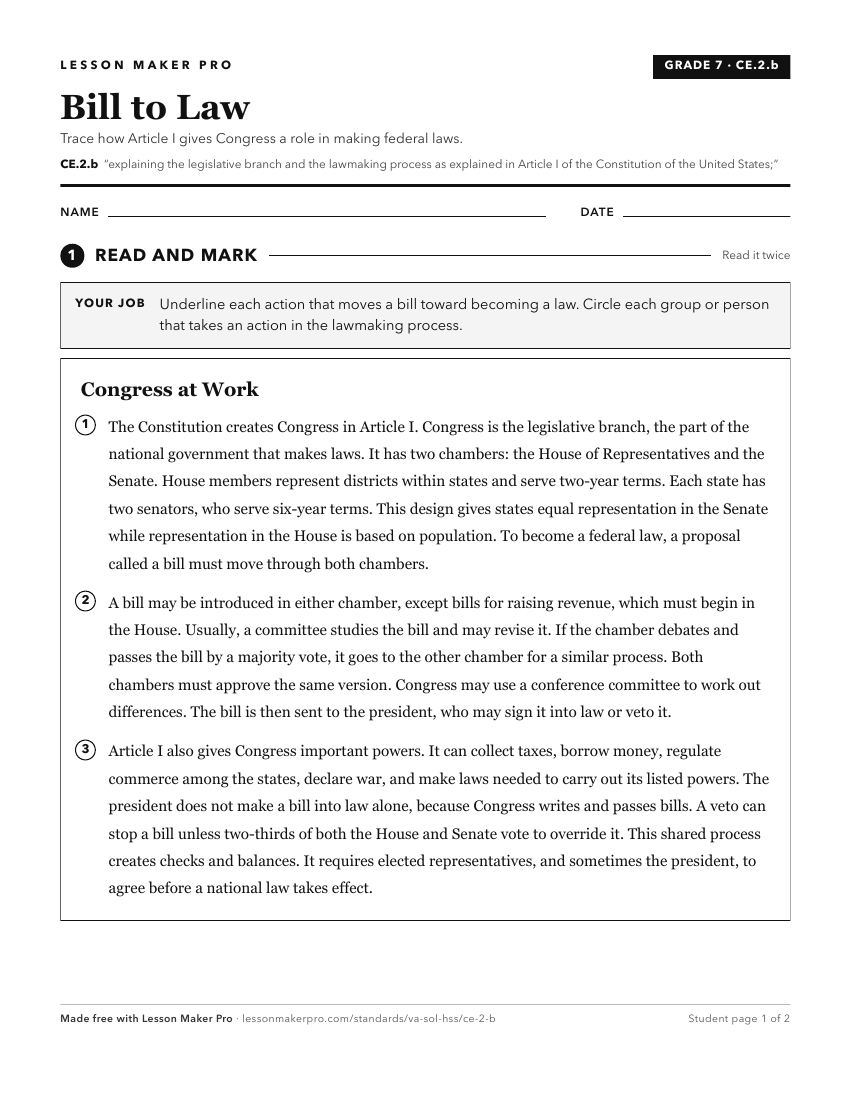
A ready-to-print activity worksheet aligned to CE.2.b, with an answer key for the teacher on its own page. No account needed.
PDF, US Letter, prints cleanly in black and white.
Download the worksheetKeep exploring
Related Standards
- CE.2.c
explaining the particular role and powers of the executive branch as explained in Article II of the Constitution of the United States
- CE.4.a
describing the structure and powers of the local government and explaining the local lawmaking process
- CE.2.d
explaining the particular role and powers of the judicial branch as explained in Article III of the Constitution of the United States
- CE.3.b
explaining the state lawmaking process
Turn this exact standard into a lesson
Grade, subject, topic, and the complete standard are prefilled. Create one free, no account needed.
Also for this standard:Make a WorksheetMake a QuizMake a Sub Lesson