Virginia SOL CE.2.c
The Standard
- CE.2
- The student will apply history and social science skills to analyze how American constitutional government functions at the national level by
explaining the particular role and powers of the executive branch as explained in Article II of the Constitution of the United States
Virginia Standards of Learning for History and Social Science · The student will apply history and social science skills to analyze how American constitutional government functions at the national level by
Teacher's field guide
What This Standard Means
What Students Need to Do
- Students explain how the president leads the executive branch and carries out federal laws. They identify powers such as commanding the military, granting pardons, and nominating officials. They distinguish independent powers from those shared with the Senate.
What Mastery Looks Like
- A student can match an executive action to its constitutional power and explain its purpose. The student knows that treaties and major appointments require Senate consent. The student can explain how Congress and the courts limit presidential action.
Common Misconceptions
- Students often say the president makes laws or can declare war alone. They may assume an executive order can override the Constitution or federal law. Some think appointments and treaties take effect without Senate approval.
How to Assess It
- Exit ticket: For a pardon, an ambassador nomination, and a treaty, name the presidential power and state whether Senate approval is required.
Lesson moves
Ways to Teach It
Have pairs sort action cards into president alone, president with Senate, Congress, and not a federal power, then defend two placements.
Ask students to write: Which presidential power carries the greatest risk of abuse, and which constitutional check limits it?
Play Executive Power Match, with students pairing scenario cards to commander in chief, pardon, appointment, treaty, or law enforcement powers.
Use a recent presidential appointment to trace nomination, Senate hearing, vote, and the official's work after confirmation.
Free download
Printable CE.2.c Worksheet
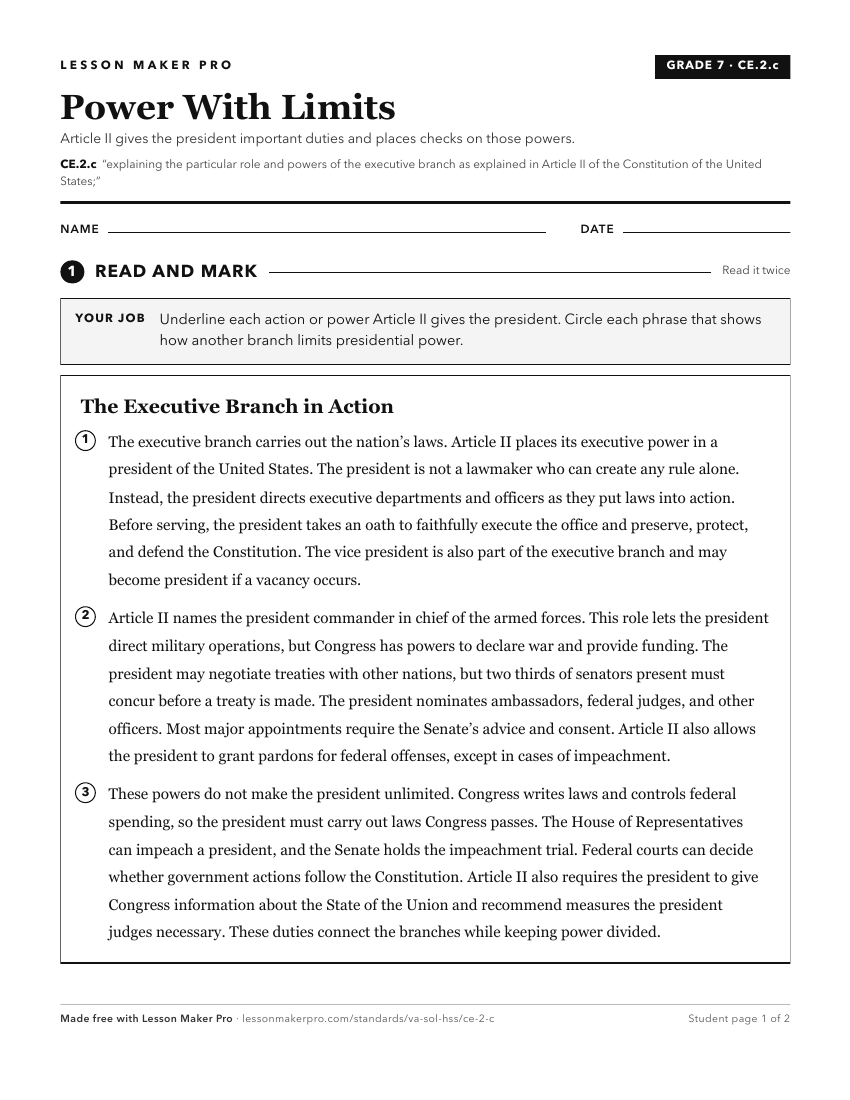
A ready-to-print activity worksheet aligned to CE.2.c, with an answer key for the teacher on its own page. No account needed.
PDF, US Letter, prints cleanly in black and white.
Download the worksheetKeep exploring
Related Standards
- CE.3.c
describing the roles and powers of the executive branch and regulatory boards as they affect states
- CE.2.b
explaining the legislative branch and the lawmaking process as explained in Article I of the Constitution of the United States
- CE.1.e
explaining the fundamental concepts of the U.S. government including, but not limited to due process, equal justice under the law, equal protection, elections a...
- CE.2.d
explaining the particular role and powers of the judicial branch as explained in Article III of the Constitution of the United States
Turn this exact standard into a lesson
Grade, subject, topic, and the complete standard are prefilled. Create one free, no account needed.
Also for this standard:Make a WorksheetMake a QuizMake a Sub Lesson