Virginia SOL CE.1.e
The Standard
- CE.1
- The student will apply history and social science skills to explain the foundations of the American constitutional democracy by
explaining the fundamental concepts of the U.S. government including, but not limited to due process, equal justice under the law, equal protection, elections and a representative government, limited government, right to private property, rule of law, Supremacy Clause, and separation of powers
Virginia Standards of Learning for History and Social Science · The student will apply history and social science skills to explain the foundations of the American constitutional democracy by
Teacher's field guide
What This Standard Means
What Students Need to Do
- Students explain how constitutional principles control government power, protect rights, guide courts, and connect voters to representatives. They apply each idea to a civic situation and justify which principle fits.
What Mastery Looks Like
- A student can match unfamiliar cases to the right principle and explain the connection. The student distinguishes due process from equal protection, and rule of law from limited government. The student also explains how elections, separate branches, and federal supremacy shape decisions.
Common Misconceptions
- Students may think equal protection guarantees identical outcomes, or that due process guarantees a favorable result. They may confuse limited government with weak government, or separation of powers with branches acting alone. Some think federal supremacy puts the president above the law, or that property rights can never be restricted.
How to Assess It
- Exit ticket: A state law conflicts with a valid federal law, and a person loses property without a hearing. Name each principle involved and explain each answer in one sentence.
Lesson moves
Ways to Teach It
Give pairs scenario cards and principle labels, then have them sort each card and defend two placements with a constitutional reason.
Ask students to write: Which principle best protects people from unfair government action, and what example shows how it works?
Play Principle Pictionary: teams draw or act out a civic scenario while classmates name the principle and explain their clue.
Have students examine one school rule, identify the government principle it resembles, and suggest a fair process for enforcing it.
Free download
Printable CE.1.e Worksheet
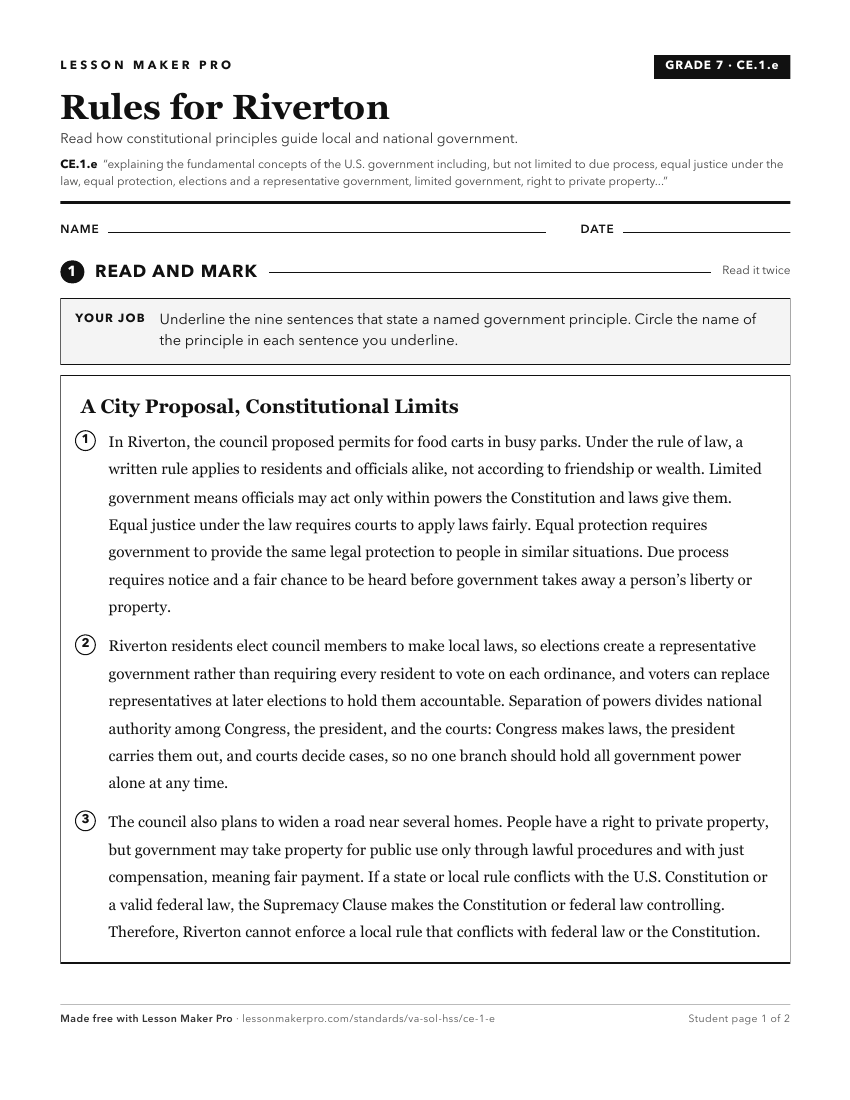
A ready-to-print activity worksheet aligned to CE.1.e, with an answer key for the teacher on its own page. No account needed.
PDF, US Letter, prints cleanly in black and white.
Download the worksheetKeep exploring
Related Standards
- 3.9.b
explaining how the Constitution supports the structure of the United States government
- 3.9.a
explaining the purpose of governments and understanding that other countries have governments similar to and different from that of the United States
- CE.1.a
explaining the fundamental principles of limited government, republicanism, federalism, checks and balances, separation of powers, and popular sovereignty
- 3.9
The student will apply history and social science skills to explain the basic structure of the United States government by
Turn this exact standard into a lesson
Grade, subject, topic, and the complete standard are prefilled. Create one free, no account needed.
Also for this standard:Make a WorksheetMake a QuizMake a Sub Lesson