Virginia SOL CE.3
SOL Standard (Skills Cluster)
The student will apply history and social science skills to analyze how constitutional government functions at the state level by describing the structure and powers of the state government (the three branches of government); explaining the state lawmaking process; describing the roles and powers of the executive branch and regulatory boards as they affect states; explaining the relationship between state governments and the national government in the federal system, referencing Federalist No.10 and Federalist No. 51; and explaining the principle of separation of powers and the operation of checks and balances at the state level.
Virginia Standards of Learning for History and Social Science
Cluster contents
Skills in This Standard
CE.3 is a Standards of Learning history and social science standard. These are the skills expectations under it.
- CE.3.a
describing the structure and powers of the state government (the three branches of government)
- CE.3.b
explaining the state lawmaking process
- CE.3.c
describing the roles and powers of the executive branch and regulatory boards as they affect states
- CE.3.d
explaining the relationship between state governments and the national government in the federal system, referencing Federalist No.10 and Federalist No. 51
- CE.3.e
explaining the principle of separation of powers and the operation of checks and balances at the state level.
Teacher's field guide
What This Cluster Means
What Students Need to Do
- Students trace how a proposal becomes a Virginia law and identify actions taken by each branch. They explain how branches limit one another, how state agencies carry out laws, and how Virginia shares power with the national government. They use ideas from Federalist Nos. 10 and 51 to explain why divided power limits factions and abuse.
What Mastery Looks Like
- Students can analyze a state government scenario, name the branch or agency involved, and explain its legal power. They can trace a bill through passage, veto, and override, then explain when federal authority or state authority applies.
Common Misconceptions
- Students may think the governor can pass laws alone or that regulatory boards create laws without legislative authority. They may assume federal power always overrides state power. They also confuse separation of powers with complete independence, overlooking checks among branches.
How to Assess It
- Give this exit ticket: A Virginia clean-water bill passes both chambers, the governor vetoes it, and a state board must enforce it. Ask students to identify the next legislative option, the board's role, and what happens if the final law conflicts with valid federal law.
Lesson moves
Ways to Teach It
Give groups Virginia government role cards and yarn, then have them build a three-branch map and label each check between branches.
After reading short excerpts from Federalist Nos. 10 and 51, students explain how divided power limits factions and government abuse.
Run a lawmaking relay where teams move a bill card through committees, both chambers, the governor, and a possible override vote.
Examine a current Virginia agency rule, then identify the law behind it, the board enforcing it, and any related federal requirement.
Free download
Printable CE.3 Worksheet
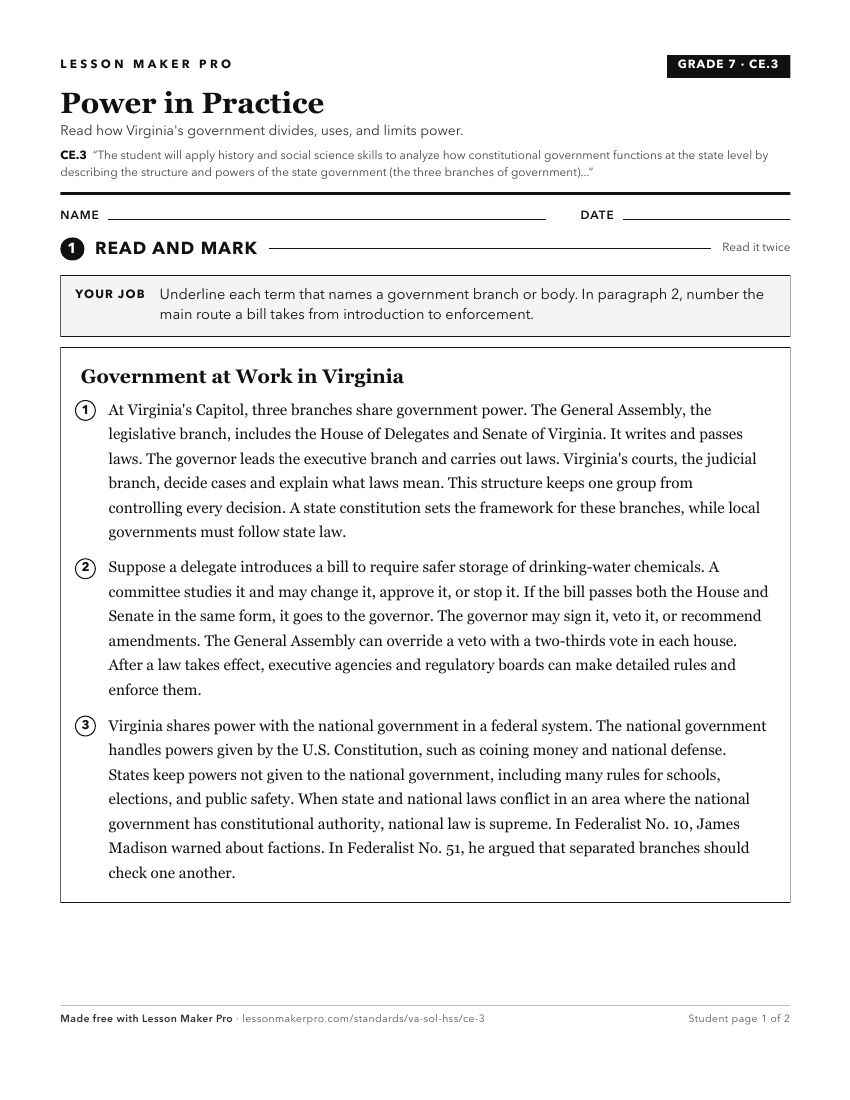
A ready-to-print activity worksheet aligned to CE.3, with an answer key for the teacher on its own page. No account needed.
PDF, US Letter, prints cleanly in black and white.
Download the worksheetKeep exploring
Related Standards
- CE.8
The student will apply history and social science skills to examine the political process at the local, state, and national levels of government by
- CE.4
The student will apply history and social science skills to analyze American constitutional government at the local level by
- 3.9
The student will apply history and social science skills to explain the basic structure of the United States government by
- CE.2
The student will apply history and social science skills to analyze how American constitutional government functions at the national level by
Turn this cluster into a lesson
Grade, subject, topic, and the complete cluster are prefilled. Create one free, no account needed.
Also for this cluster:Make a WorksheetMake a QuizMake a Sub Lesson