Virginia SOL 9.R.1
SOL Standard (Knowledge and Skills Cluster)
Evaluation and Synthesis of Information
Virginia Standards of Learning for English
Cluster contents
Knowledge and Skills in This Standard
9.R.1 is a Standards of Learning standard. These are the knowledge and skills expectations under it.
- 9.R.1.A
Formulate and revise questions about a research topic, broadening or narrowing the inquiry as necessary.
- 9.R.1.B
Gather and organize information from various sources, including internet resources, electronic databases, and other technology.
- 9.R.1.C
Analyze and evaluate the primary and secondary sources gathered for their credibility, reliability, accuracy, and usefulness that includes identifying their mai...
- 9.R.1.D
Synthesize multiple streams of information to support claims and introduce counterclaims.
- 9.R.1.E
Create research products aligned with the demands of the reading and writing standards.
- 9.R.1.F
Cite sources for quoted and paraphrased ideas using a standard method of documentation, such as the Modern Language Association (MLA) or the American Psychologi...
- 9.R.1.G
Define plagiarism's meaning and legal consequences and follow ethical and legal guidelines for gathering and using information.
- 9.R.1.H
Demonstrate ethical and responsible use of all sources, including the Internet, Artificial Intelligence (AI), and new technologies, as they develop.
Teacher's field guide
What This Cluster Means
What Students Need to Do
- Students develop a focused research question and adjust it as they learn more. They gather, organize, compare, and evaluate information from several source types. They combine evidence into claims and counterclaims, cite it correctly, and use sources and AI responsibly.
What Mastery Looks Like
- A student develops a focused question, selects credible sources, and keeps organized notes. The student compares viewpoints, resolves conflicting information, and builds a supported claim with a fair counterclaim. Quoted, paraphrased, and AI-assisted material is documented accurately.
Common Misconceptions
- Students may assume the first search result is reliable or that a biased source is always useless. They may confuse primary and secondary sources or treat conflicting evidence as an error. They may also believe paraphrases and AI-generated material do not need citation.
How to Assess It
- Give students two short sources about school start times. Ask them to write a narrowed research question, choose the stronger source with one reason, and draft a cited claim that acknowledges a counterclaim.
Lesson moves
Ways to Teach It
Give pairs four printed source cards on one topic to rank for credibility, then annotate author, evidence, date, bias, and usefulness.
Ask, “When can a biased source still be useful?” Students defend an answer with details from two contrasting sources.
Run a credibility relay where teams match evidence cards to claims, flag weak support, and earn points for accurate citation corrections.
Have students investigate a school policy question, compare a survey with an official report, and write a recommendation acknowledging a counterclaim.
Free download
Printable 9.R.1 Worksheet
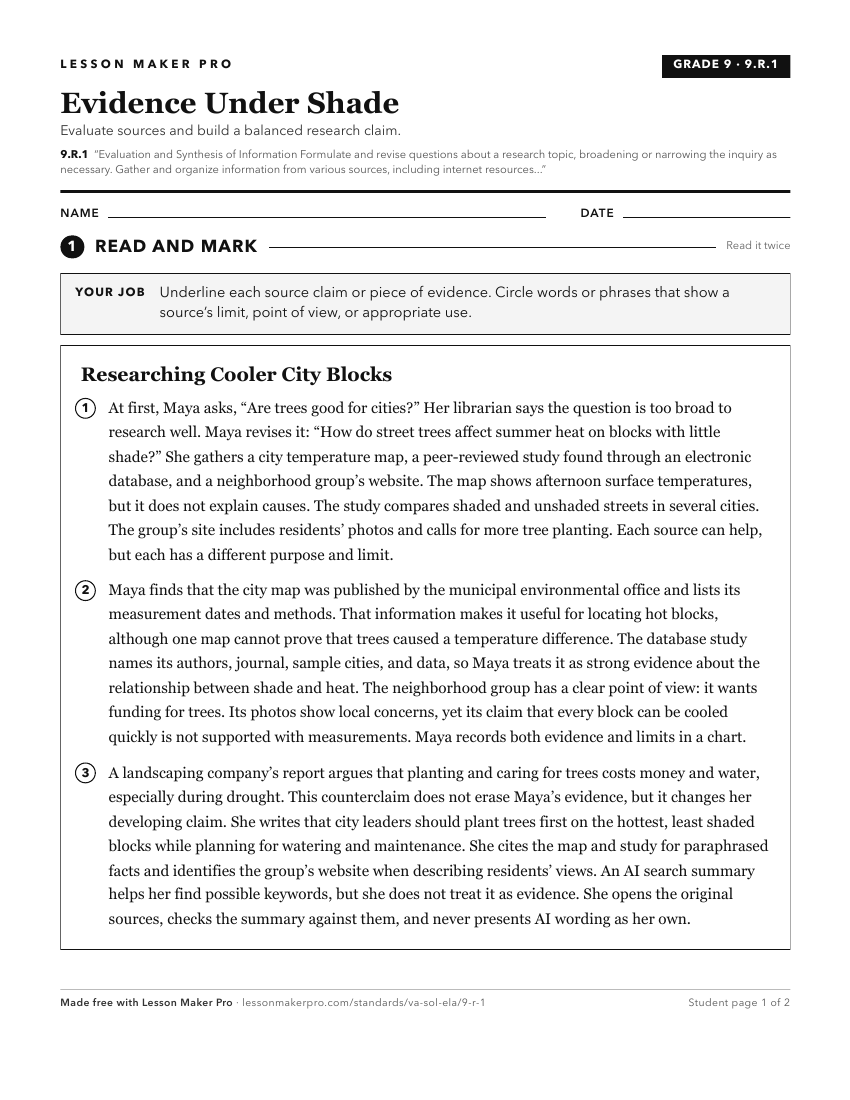
A ready-to-print activity worksheet aligned to 9.R.1, with an answer key for the teacher on its own page. No account needed.
PDF, US Letter, prints cleanly in black and white.
Download the worksheetKeep exploring
Related Standards
Turn this cluster into a lesson
Grade, subject, and topic are prefilled; the lesson picks the standards under this heading. Create one free, no account needed.
Also for this cluster:Make a WorksheetMake a QuizMake a Sub Lesson