Virginia SOL 11.R.1
SOL Standard (Knowledge and Skills Cluster)
Evaluation and Synthesis of Information
Virginia Standards of Learning for English
Cluster contents
Knowledge and Skills in This Standard
11.R.1 is a Standards of Learning standard. These are the knowledge and skills expectations under it.
- 11.R.1.A
Formulate and revise questions about a research topic broadening or narrowing the inquiry as necessary.
- 11.R.1.B
Gather and organize information from various sources.
- 11.R.1.C
Objectively evaluate primary and secondary sources for their credibility, reliability, accuracy, usefulness, and limitations. That includes identifying their ma...
- 11.R.1.D
Synthesize multiple streams of evidence to support claims and acknowledge counterclaims.
- 11.R.1.E
Create research products aligned with the demands of the reading and writing standards.
- 11.R.1.F
Cite primary and secondary sources for quoted and paraphrased ideas using a standard method of documentation such as the Modern Language Association (MLA) or Am...
- 11.R.1.G
Define the meaning and consequences of plagiarism and follow ethical and legal guidelines for gathering and using information.
- 11.R.1.H
Demonstrate ethical and responsible use of all sources, including the Internet, Artificial Intelligence (AI), and new technologies, as they develop.
Teacher's field guide
What This Cluster Means
What Students Need to Do
- Students shape a research question, then adjust it as they learn more. They gather, organize, and compare primary and secondary sources for trustworthiness, usefulness, viewpoint, and limits. They combine evidence into claims, address counterclaims, cite all borrowed material, and use AI and other tools responsibly.
What Mastery Looks Like
- A student can refine a research question when the available evidence is too broad, narrow, or limited. They can explain each source’s strengths, limits, viewpoint, and conflicts with other sources. Their final product connects evidence, addresses a counterclaim, uses consistent citations, and identifies any AI assistance.
Common Misconceptions
- Students may treat the first search result as trustworthy or assume bias makes a source useless. They may summarize sources one at a time instead of connecting evidence. They may also think paraphrases, images, or AI-generated material need no citation.
How to Assess It
- Give students three short sources on one issue. Ask them to revise a research question, rank source credibility, and write one cited claim that addresses a counterclaim.
Lesson moves
Ways to Teach It
Give groups six source cards to sort by credibility, usefulness, bias, and limitations, then require evidence for each placement.
Write: Which source would you trust most on this issue, which least, and what specific features shaped your judgment?
Run a citation relay where teams correct MLA or APA entries, paraphrases, quotations, and missing attributions at four stations.
Compare news, government, nonprofit, and AI-generated answers to a local policy question, then draft a source note for a community briefing.
Free download
Printable 11.R.1 Worksheet
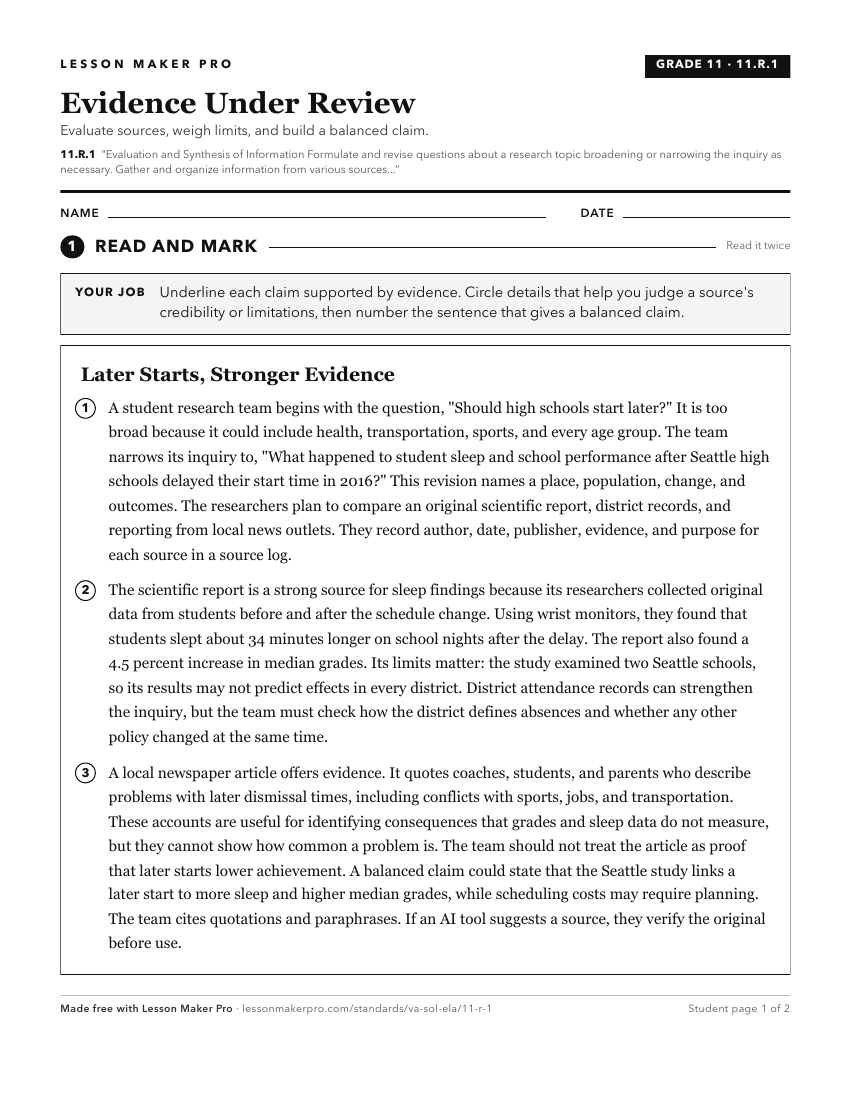
A ready-to-print activity worksheet aligned to 11.R.1, with an answer key for the teacher on its own page. No account needed.
PDF, US Letter, prints cleanly in black and white.
Download the worksheetKeep exploring
Related Standards
Turn this cluster into a lesson
Grade, subject, and topic are prefilled; the lesson picks the standards under this heading. Create one free, no account needed.
Also for this cluster:Make a WorksheetMake a QuizMake a Sub Lesson