Virginia SOL 12.R.1
SOL Standard (Knowledge and Skills Cluster)
Evaluation and Synthesis of Information
Virginia Standards of Learning for English
Cluster contents
Knowledge and Skills in This Standard
12.R.1 is a Standards of Learning standard. These are the knowledge and skills expectations under it.
- 12.R.1.A
Formulate and revise questions about a research topic broadening or narrowing the inquiry as necessary.
- 12.R.1.B
Gather and organize information from various sources.
- 12.R.1.C
Objectively evaluate primary and secondary sources for their credibility, reliability, accuracy, usefulness, and limitations; that includes identifying the main...
- 12.R.1.D
Synthesize multiple streams of evidence to support claims and acknowledge counterclaims.
- 12.R.1.E
Create research products aligned with the demands of the reading and writing standards.
- 12.R.1.F
Cite sources for quoted and paraphrased ideas using a standard method of documentation, such as the Modern Language Association (MLA) or the American Psychologi...
- 12.R.1.G
Define the meaning and consequences of plagiarism and follow ethical and legal guidelines for gathering and using information.
- 12.R.1.H
Demonstrate ethical and responsible use of all sources, including the Internet, Artificial Intelligence (AI), and new technologies, as they develop.
Teacher's field guide
What This Cluster Means
What Students Need to Do
- Students shape a focused research question and adjust it as evidence changes. They gather, organize, and compare sources, then build a claim that addresses conflicting evidence and counterclaims. They cite borrowed ideas and disclose AI or technology use honestly.
What Mastery Looks Like
- A student can explain why each source is credible, useful, and limited. Their research product combines evidence from several primary and secondary sources instead of listing separate summaries. They document quotations, paraphrases, and technology use consistently with MLA or APA.
Common Misconceptions
- Students may treat the first search result, a polished website, or an AI response as automatically trustworthy. They may assume paraphrasing removes the need for citation. They also may ignore evidence that challenges their claim or confuse a counterclaim with weak evidence.
How to Assess It
- Give students two short sources that disagree about school start times. Ask them to revise a broad research question, select the stronger source with two reasons, and write a claim with a cited paraphrase and counterclaim.
Lesson moves
Ways to Teach It
Set up a source-sorting table with news articles, studies, opinion pieces, and AI output; students rank each for credibility, usefulness, and limitations.
Write a response to this prompt: When should conflicting evidence make a researcher revise the question, the claim, or both?
Play Citation Repair Relay using flawed source cards; teams correct missing citations, weak paraphrases, and misleading evidence links.
Investigate a local school policy using board minutes, survey data, news coverage, and interviews, then present a sourced recommendation that addresses objections.
Free download
Printable 12.R.1 Worksheet
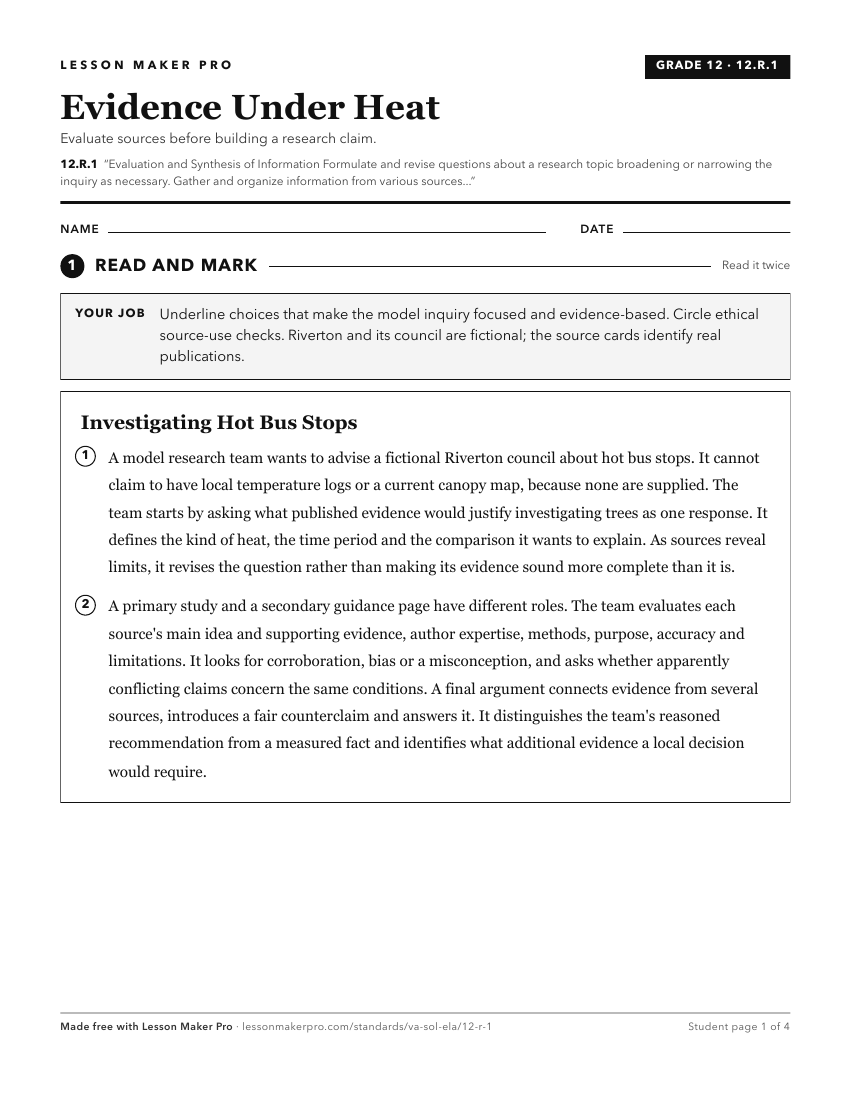
A ready-to-print activity worksheet aligned to 12.R.1, with an answer key for the teacher on its own page. No account needed.
PDF, US Letter, prints cleanly in black and white.
Download the worksheetKeep exploring
Related Standards
Turn this cluster into a lesson
Grade, subject, and topic are prefilled; the lesson picks the standards under this heading. Create one free, no account needed.
Also for this cluster:Make a WorksheetMake a QuizMake a Sub Lesson