Virginia SOL 8.R.1
SOL Standard (Knowledge and Skills Cluster)
Evaluation and Synthesis of Information
Virginia Standards of Learning for English
Cluster contents
Knowledge and Skills in This Standard
8.R.1 is a Standards of Learning standard. These are the knowledge and skills expectations under it.
- 8.R.1.A
Formulate and revise questions about a research topic, broadening or narrowing the inquiry as necessary.
- 8.R.1.B
Collect, organize, and synthesize information from multiple sources using various notetaking formats.
- 8.R.1.C
Evaluate and analyze the relevance, validity, and credibility of sources (primary, secondary, digital, and print) identifying main and supporting ideas, conflic...
- 8.R.1.D
Quote, summarize, and paraphrase research findings from primary and secondary sources, avoiding plagiarism by using own words and following ethical and legal gu...
- 8.R.1.E
Organize and share findings in formal and informal oral or written formats.
- 8.R.1.F
Cite primary and secondary sources using the Modern Language Association (MLA) or American Psychological Association (APA) style.
- 8.R.1.G
Demonstrate ethical and responsible use of all sources, including the Internet, Artificial Intelligence (AI), and new technologies, as they develop.
Teacher's field guide
What This Cluster Means
What Students Need to Do
- Students turn a broad topic into a focused research question and adjust it as evidence changes. They gather notes from several sources, judge trustworthiness and bias, then combine ideas through accurate quotation, paraphrase, summary, and citation. They present findings clearly and disclose any use of AI or other digital tools.
What Mastery Looks Like
- A student can explain why a source is relevant and credible, identify conflicting claims or viewpoints, and distinguish primary from secondary evidence. Their final response connects evidence across sources, uses original wording, labels quotations, and includes consistent MLA or APA citations.
Common Misconceptions
- Students often treat the first search result as reliable, confuse relevance with credibility, or overlook an author’s purpose and bias. They may copy while paraphrasing, list facts without connecting them, cite only URLs, or submit AI-generated wording without checking or disclosure.
How to Assess It
- Give students two short sources on the same issue. Ask: "Write one focused research question, choose the more credible source and explain why, synthesize one point from both sources, and add one MLA citation."
Lesson moves
Ways to Teach It
Place printed source cards on a floor grid labeled source type and credibility, then defend each placement with one visible clue.
Write how your research question changed after reading two sources, and name the evidence that made you narrow or broaden it.
Play Citation Repair Relay: teams correct copied paraphrases, missing quotation marks, and incomplete MLA entries on task cards.
Compare a viral health post with a government report, then recommend whether the school should share the claim.
Free download
Printable 8.R.1 Worksheet
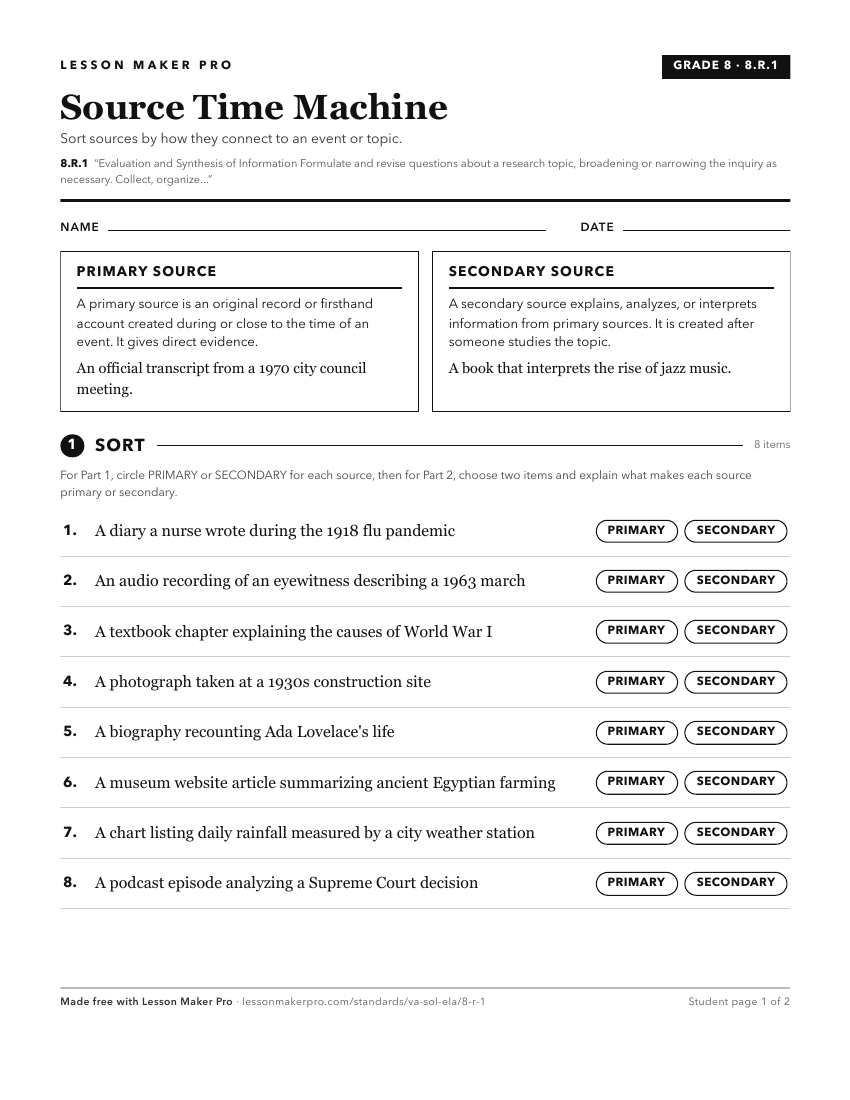
A ready-to-print activity worksheet aligned to 8.R.1, with an answer key for the teacher on its own page. No account needed.
PDF, US Letter, prints cleanly in black and white.
Download the worksheetKeep exploring
Related Standards
Turn this cluster into a lesson
Grade, subject, and topic are prefilled; the lesson picks the standards under this heading. Create one free, no account needed.
Also for this cluster:Make a WorksheetMake a QuizMake a Sub Lesson