Virginia SOL 8.R.1.D
The Standard
Quote, summarize, and paraphrase research findings from primary and secondary sources, avoiding plagiarism by using own words and following ethical and legal guidelines.
Virginia Standards of Learning for English
Teacher's field guide
What This Standard Means
What Students Need to Do
- Students decide when a source's exact wording is worth quoting and when to summarize or paraphrase. They preserve the source's meaning, distinguish primary from secondary evidence, and identify where each idea came from. They use quotation marks, citations, and source material in ways that avoid plagiarism and respect copyright.
What Mastery Looks Like
- Given a short research source, a student can write an accurate quote, summary, and paraphrase, each with clear attribution. The paraphrase changes both wording and sentence structure, while the summary captures only the central findings. The student can explain why copying, patchwriting, or using uncited material is improper.
Common Misconceptions
- Students may think replacing a few words with synonyms creates a paraphrase, or that facts found online need no attribution. They may use quotation marks but omit the source, or cite a source without marking exact language. They also confuse a summary with a shortened paraphrase and may treat a secondary account as a primary source.
How to Assess It
- Give students a 120-word source paragraph. Ask them to write one direct quote, one one-sentence summary, and one two-sentence paraphrase, with attribution and a citation for each.
Lesson moves
Ways to Teach It
Pairs sort printed source cards as primary or secondary, then use highlighters to mark exact words, main findings, and supporting details.
Ask, “When is the exact wording worth quoting?” Students defend a choice using two passages on the same topic.
Run a plagiarism detective game where teams flag copied wording, patchwriting, missing quotation marks, and missing citations in sample research notes.
Compare a news article with its linked study, then write a cited paraphrase showing whether the article represents the study accurately.
Free download
Printable 8.R.1.D Worksheet
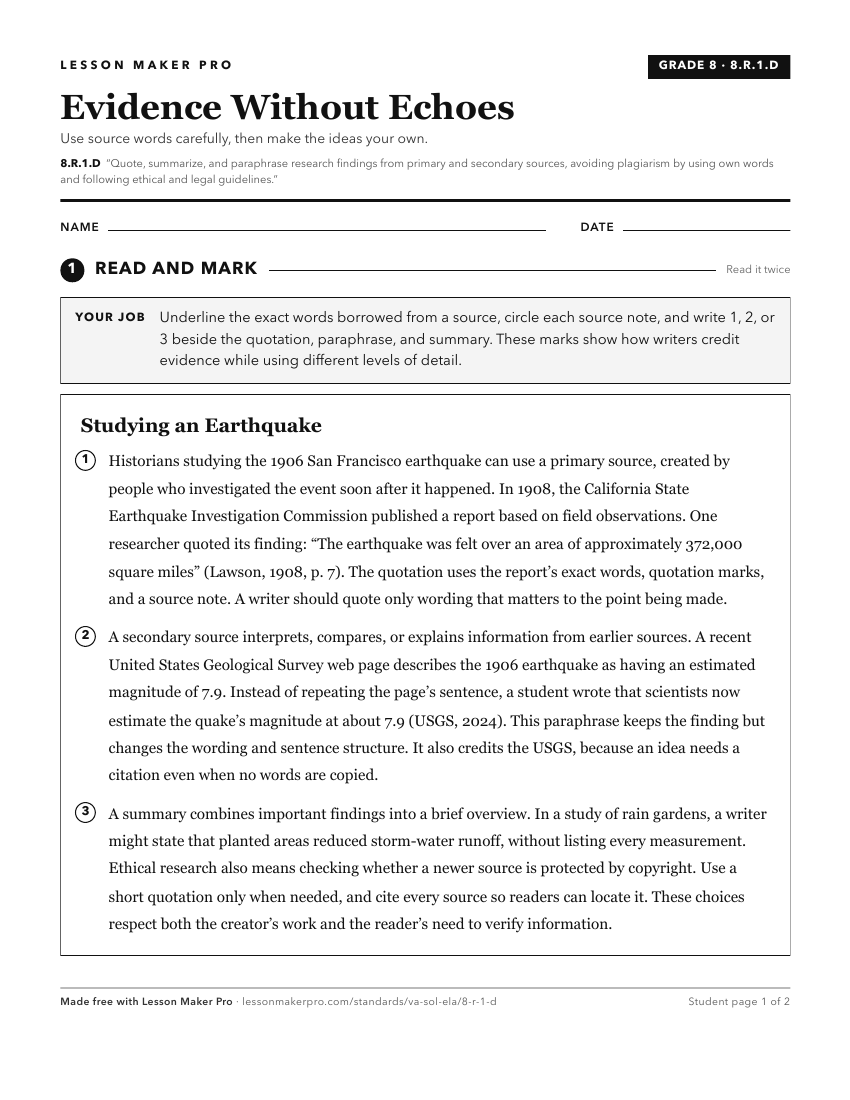
A ready-to-print activity worksheet aligned to 8.R.1.D, with an answer key for the teacher on its own page. No account needed.
PDF, US Letter, prints cleanly in black and white.
Download the worksheetKeep exploring
Related Standards
- 6.R.1.D
Develop notes that include important concepts and summaries, including quoting, summarizing, and paraphrasing research findings, avoiding plagiarism by using ow...
- 11.R.1.G
Define the meaning and consequences of plagiarism and follow ethical and legal guidelines for gathering and using information.
- 12.R.1.G
Define the meaning and consequences of plagiarism and follow ethical and legal guidelines for gathering and using information.
- 7.R.1.D
The 7th Grade version of this standard.
Turn this exact standard into a lesson
Grade, subject, topic, and the complete standard are prefilled. Create one free, no account needed.
Also for this standard:Make a WorksheetMake a QuizMake a Sub Lesson