Virginia SOL 1.RI
SOL Standard (Knowledge and Skills Cluster)
The student will use textual evidence to demonstrate comprehension and build knowledge from a variety of informational texts heard or read
Virginia Standards of Learning for English
Cluster contents
Knowledge and Skills in This Standard
1.RI is a Standards of Learning standard. These are the knowledge and skills expectations under it.
- 1.RI.1
Key Ideas and Confirming Details
- 1.RI.1.A
Ask and answer literal (who, what, when, where) and inferential (why, how) questions about what is read, including demonstrating an understanding of the main to...
- 1.RI.1.B
Identify the main idea and supporting details of a text.
- 1.RI.1.C
Explain the difference between facts and opinions in a text.
- 1.RI.2
Craft and Style
- 1.RI.2.A
Identify and use common text features to gain information: table of contents, headings, bolded words, and pictures, captions, and diagrams.
- 1.RI.2.B
Distinguish between information provided by pictures or other illustrations and information provided by the words in a text.
- 1.RI.3
Integration of Concepts
- 1.RI.3.A
Identify basic similarities in and differences between two texts on the same topic.
- 1.RI.3.B
Describe the connection between two individuals, events, ideas, or pieces of information in a text.
Teacher's field guide
What This Cluster Means
What Students Need to Do
- Students ask and answer questions about informational texts, then use details to explain the topic and main idea. They identify facts, opinions, text features, and information shown in words or pictures. They compare texts and explain how people, events, ideas, or facts connect.
What Mastery Looks Like
- Students answer who, what, when, where, why, and how questions using words or pictures from the text. They state the main idea, name supporting details, and separate facts from opinions. They use text features, explain connections, and compare two texts about the same topic.
Common Misconceptions
- Students may choose an interesting detail as the main idea or answer why questions with a guess not supported by the text. They may treat every sentence as a fact or assume pictures and words always give the same information. They may name two details without explaining how people, events, ideas, or texts are connected.
How to Assess It
- Give students a short passage with a heading, caption, and picture. Ask them to state the main idea, cite one supporting detail, answer one why question, and tell what the picture adds.
Lesson moves
Ways to Teach It
Give pairs a short article cut into heading, paragraph, caption, and diagram pieces, then have them rebuild it and explain each feature.
Read two pages about frogs, then ask students to write, What is the main idea, and which detail proves it?
Play Fact or Opinion Corners by reading statements from a class text and having students move to a labeled corner and explain their choice.
Use a school lunch menu and calendar to answer who, what, when, where, why, and how questions with evidence.
Free download
Printable 1.RI Worksheet
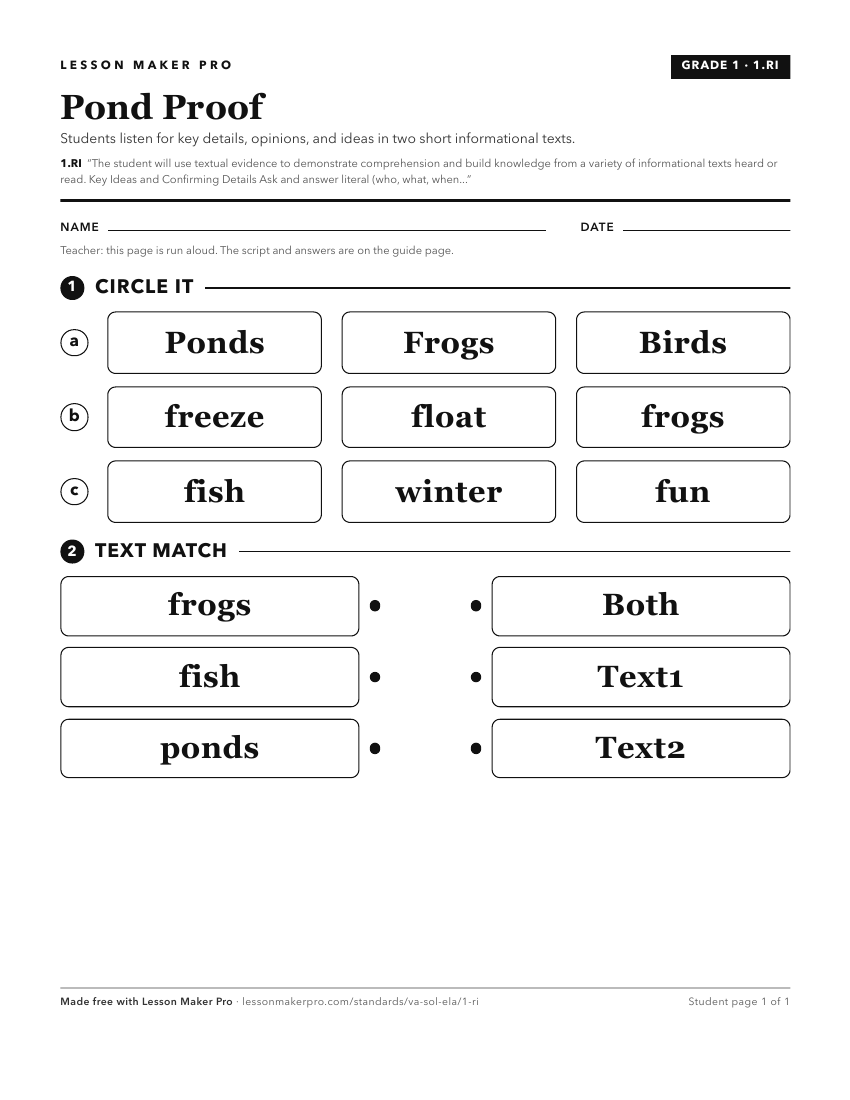
A ready-to-print activity worksheet aligned to 1.RI, with an answer key for the teacher on its own page. No account needed.
PDF, US Letter, prints cleanly in black and white.
Download the worksheetKeep exploring
Related Standards
- K.RI
The student will use textual evidence to demonstrate comprehension and build knowledge from a variety of informational texts heard.
- 12.RI
The student will use textual evidence to demonstrate comprehension and build knowledge from grade-level complex informational texts read.
- 10.RI
The student will use textual evidence to demonstrate comprehension and build knowledge from grade-level complex informational texts read.
- 11.RI
The student will use textual evidence to demonstrate comprehension and build knowledge from grade-level complex informational texts read.
Turn this cluster into a lesson
Grade, subject, topic, and the complete cluster are prefilled. Create one free, no account needed.
Also for this cluster:Make a WorksheetMake a QuizMake a Sub Lesson