Virginia SOL K.RI
SOL Standard (Knowledge and Skills Cluster)
The student will use textual evidence to demonstrate comprehension and build knowledge from a variety of informational texts heard.
Virginia Standards of Learning for English
Cluster contents
Knowledge and Skills in This Standard
K.RI is a Standards of Learning standard. These are the knowledge and skills expectations under it.
- K.RI.1
Key Ideas and Confirming Details
- K.RI.1.A
With prompting and support, ask and answer literal (who, what, when, where) or inferential (why, how) questions about what is read
- K.RI.1.B
With prompting and support, identify the main topic and key details of a text
- K.RI.2
Craft and Style
- K.RI.2.A
With prompting and support, identify the purpose of common text features: table of contents, headings, bolded words, and pictures
- K.RI.3
Integration of Concepts
- K.RI.3.A
With prompting and support, identify basic similarities in and differences between two texts on the same topic
- K.RI.3.B
With prompting and support, describe the connection between two individuals, events, ideas, or pieces of information in a text
Teacher's field guide
What This Cluster Means
What Students Need to Do
- Students listen to informational texts and ask or answer who, what, when, where, why, and how questions using words or pictures as evidence. They name the main topic, recall supporting details, and explain simple connections among people, events, and ideas. They use common text features and compare two texts about the same subject.
What Mastery Looks Like
- After a read-aloud, a student can ask a relevant question and answer questions using a matching fact, picture, or detail. The student can state what the text is mostly about and give two details. With a prompt, the student explains a text feature, compares paired texts, and describes a connection between ideas or events.
Common Misconceptions
- Students may give personal knowledge instead of evidence from the text, or guess at why and how answers without naming a clue. They often confuse the topic with one detail and treat pictures as decoration. When comparing texts, they may retell each one without stating a specific similarity or difference.
How to Assess It
- Read aloud a short animal page with a heading, bold word, and picture. Ask the student to name the topic, give one supporting detail, explain one text feature, and compare it with a second page.
Lesson moves
Ways to Teach It
Give pairs a short nonfiction page and sticky notes to mark the heading, bold word, picture, topic, and one supporting detail.
After a read-aloud, ask, “Why did this happen, and what words or picture helped you know?”
Play Same or Different with facts from two animal books; students hold up matching or different cards and explain each choice.
Use a classroom plant guide to identify what the plant needs, then connect each direction to caring for the class plant.
Free download
Printable K.RI Worksheet
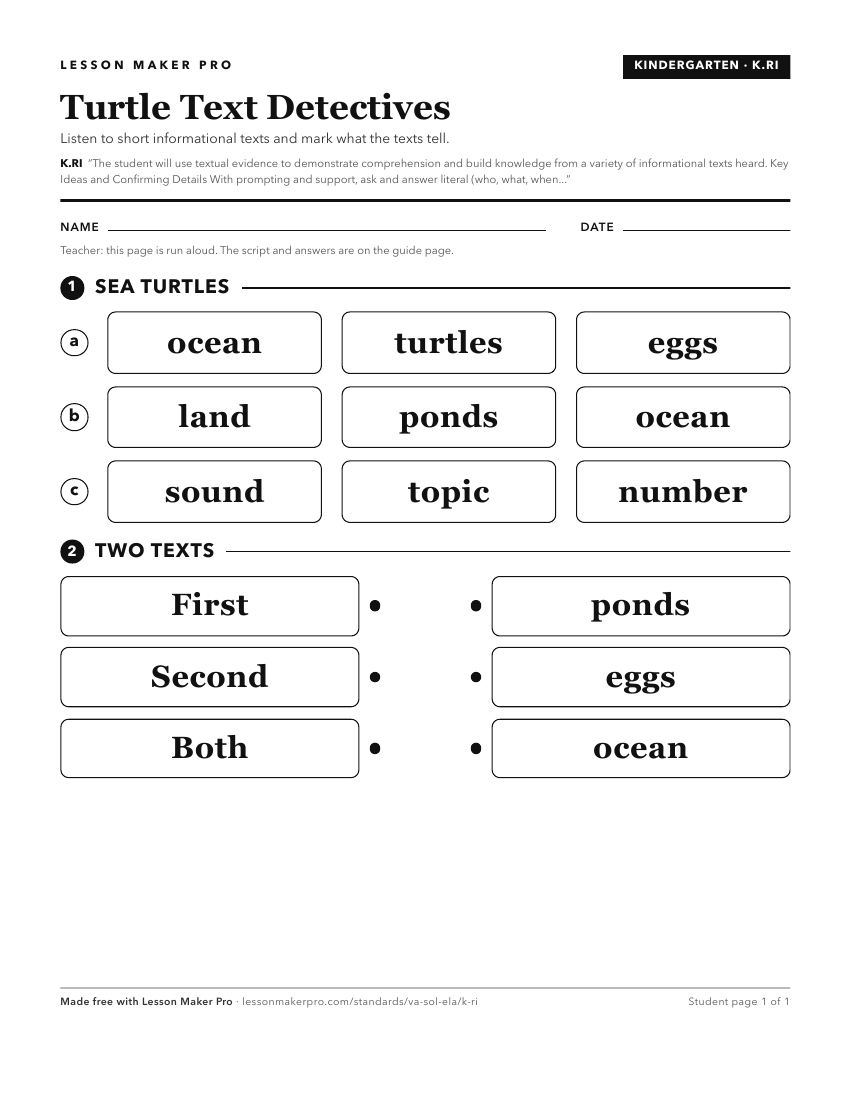
A ready-to-print activity worksheet aligned to K.RI, with an answer key for the teacher on its own page. No account needed.
PDF, US Letter, prints cleanly in black and white.
Download the worksheetKeep exploring
Related Standards
- 1.RI
The student will use textual evidence to demonstrate comprehension and build knowledge from a variety of informational texts heard or read
- 12.RI
The student will use textual evidence to demonstrate comprehension and build knowledge from grade-level complex informational texts read.
- 5.RI
The student will use textual evidence to demonstrate comprehension and build knowledge from grade-level complex informational texts read.
- 11.RI
The student will use textual evidence to demonstrate comprehension and build knowledge from grade-level complex informational texts read.
Turn this cluster into a lesson
Grade, subject, topic, and the complete cluster are prefilled. Create one free, no account needed.
Also for this cluster:Make a WorksheetMake a QuizMake a Sub Lesson