Texas TEKS 8.29.D
The Standard
- 8.29
- Social studies skills. The student applies critical-thinking skills to organize and use information acquired through established research methodologies from a variety of valid sources, including technology. The student is expected to:
identify bias and points of view created by the historical context surrounding an event
Texas Essential Knowledge and Skills for Social Studies
Teacher's field guide
What This Standard Means
What Students Need to Do
- Students examine who created a source, when and where it was created, and what was happening at the time. They use that context to identify the creator’s viewpoint and possible bias.
What Mastery Looks Like
- Students can point to specific words, images, omissions, or claims that reveal a viewpoint. They can explain how the creator’s time, audience, role, or interests shaped the source.
Common Misconceptions
- Students may treat any strong opinion as unreliable or assume bias means a source is false. They may name a viewpoint without connecting it to evidence or historical conditions.
How to Assess It
- Give students two short accounts of the same event from different participants. Ask them to identify each viewpoint and explain one contextual reason for the difference.
Lesson moves
Ways to Teach It
Give pairs source cards and context cards, then have them match each source to the setting most likely to shape its viewpoint.
Ask students to write: How might a Patriot and a Loyalist describe the Boston Tea Party differently, and why?
Play Context Clue Challenge, where teams underline loaded words and earn points by linking each word to audience, time, or purpose.
Compare two current headlines about the same local issue, then discuss how audience and publisher goals may shape each account.
Free download
Printable 8.29.D Worksheet
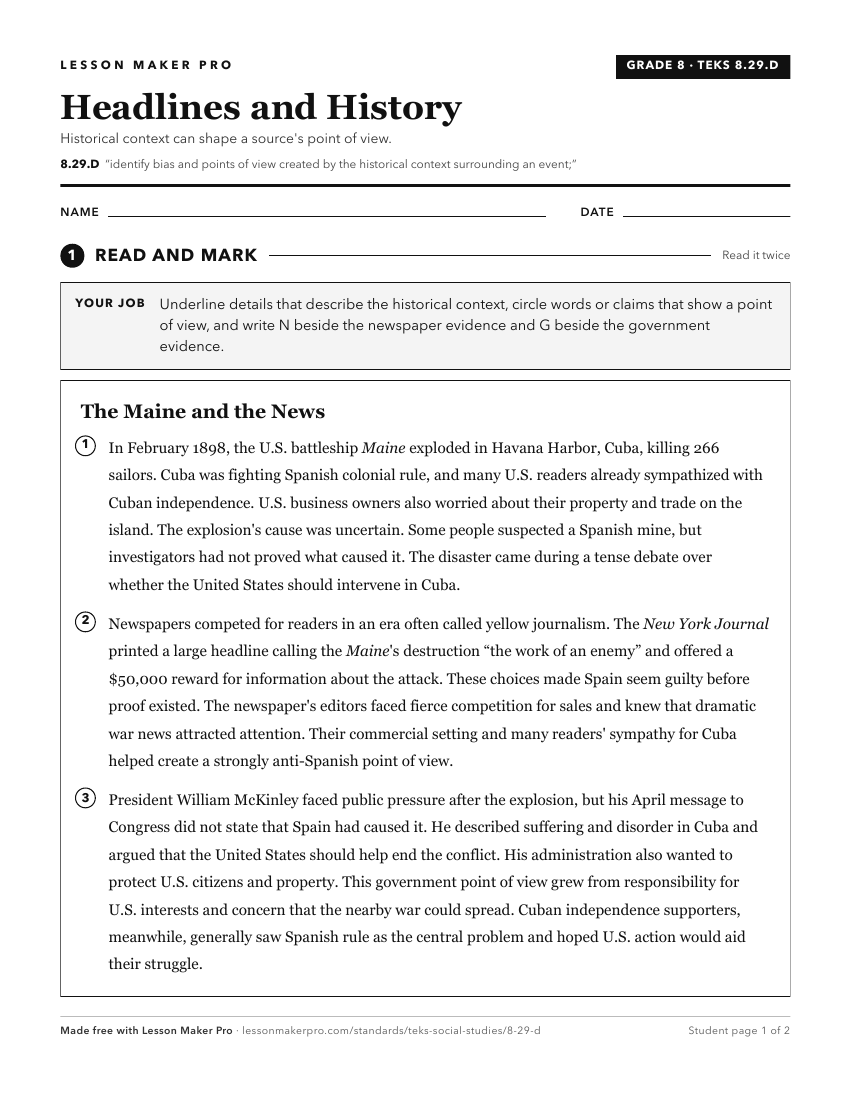
A ready-to-print activity worksheet aligned to 8.29.D, with an answer key for the teacher on its own page. No account needed.
PDF, US Letter, prints cleanly in black and white.
Download the worksheetKeep exploring
Related Standards
- 5.23.E
identify different points of view about an issue, topic, historical event, or current event
- 5.23.F
identify the historical context of an event
- 7.20.D
identify bias and points of view from the historical context surrounding an event that influenced the participants
- 4.19.E
identify different points of view about an issue, topic, historical event, or current event
Turn this exact standard into a lesson
Grade, subject, topic, and the complete standard are prefilled. Create one free, no account needed.
Also for this standard:Make a WorksheetMake a QuizMake a Sub Lesson