Texas TEKS 8.29.B
The Standard
- 8.29
- Social studies skills. The student applies critical-thinking skills to organize and use information acquired through established research methodologies from a variety of valid sources, including technology. The student is expected to:
analyze information by applying absolute and relative chronology through sequencing, categorizing, identifying cause-and-effect relationships, comparing, contrasting, finding the main idea, summarizing, making generalizations and predictions, and drawing inferences and conclusions
Texas Essential Knowledge and Skills for Social Studies
Teacher's field guide
What This Standard Means
What Students Need to Do
- Students place events by date and describe their order using terms such as before, after, and during. They sort evidence, trace causes and effects, compare accounts, and identify central ideas. They summarize information and use evidence to make generalizations, predictions, inferences, and conclusions.
What Mastery Looks Like
- Given a short passage and several sources, a student builds an accurate timeline and groups evidence by a clear rule. The student explains cause and effect, identifies the central idea, and writes a concise summary. Inferences, predictions, and conclusions are supported with specific evidence.
Common Misconceptions
- Students often treat events that happened close together as proof that one caused the other. They may confuse a summary with a list of details or add opinions not found in the source. Broad generalizations and predictions are often based on one example or unsupported assumptions.
How to Assess It
- Exit ticket: Give students four shuffled, dated statements about the Boston Tea Party and its aftermath. Ask them to order the events, name one cause-and-effect link, state the main idea, and support one inference with evidence.
Lesson moves
Ways to Teach It
Give pairs dated event cards from the American Revolution; students build a timeline, then connect causes to effects with labeled yarn.
Have students write a claim answering which mattered more, taxation or colonial resistance, then cite two facts and address one counterexample.
Play a source-sort relay where teams classify statements as main idea, detail, inference, generalization, prediction, or conclusion.
Give students three local news updates about a road closure; they sequence developments, compare accounts, and predict what happens next.
Free download
Printable 8.29.B Worksheet
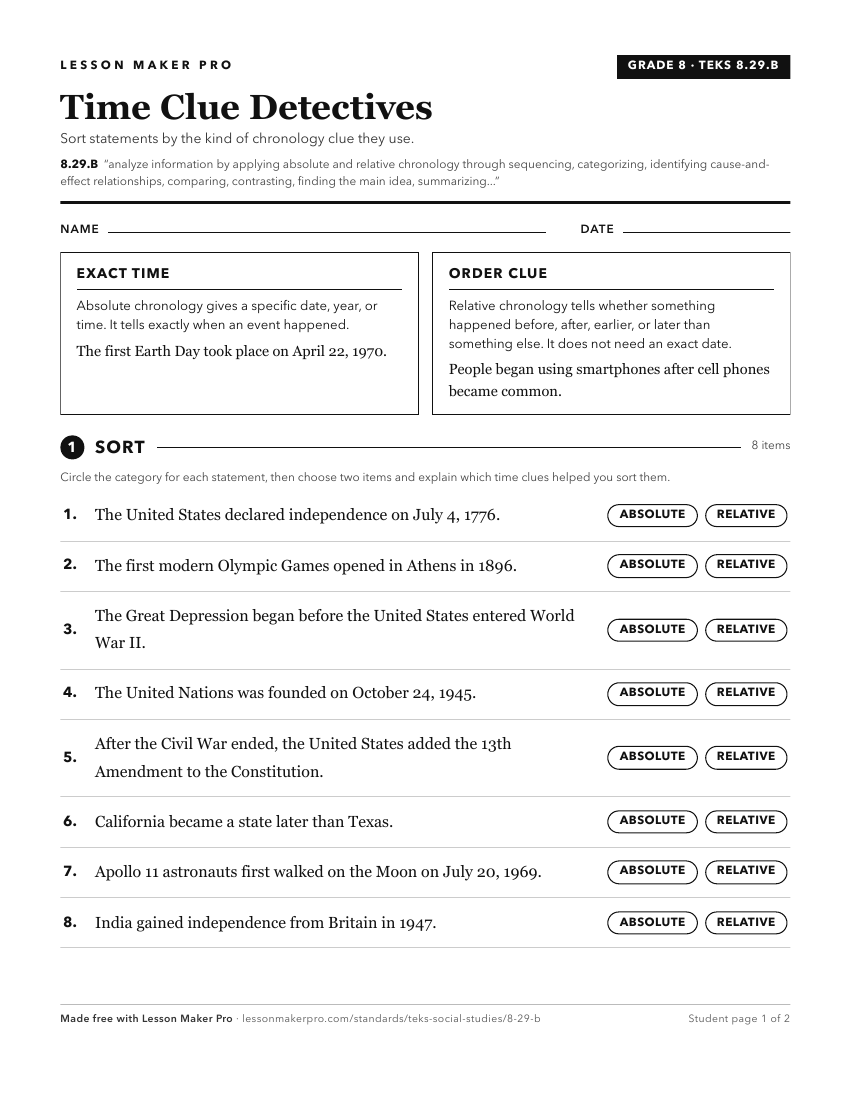
A ready-to-print activity worksheet aligned to 8.29.B, with an answer key for the teacher on its own page. No account needed.
PDF, US Letter, prints cleanly in black and white.
Download the worksheetKeep exploring
Related Standards
- 4.19.C
analyze information by applying absolute and relative chronology through sequencing, categorizing, identifying cause-and-effect relationships, comparing, contra...
- 7.20.B
analyze information by applying absolute and relative chronology through sequencing, categorizing, identifying cause-and-effect relationships, comparing, contra...
- 6.19.B
analyze information by sequencing, categorizing, identifying cause-and-effect relationships, comparing, contrasting, finding the main idea, summarizing, making ...
- 5.23.C
analyze information by applying absolute and relative chronology through sequencing, categorizing, identifying cause-and-effect relationships, comparing, contra...
Turn this exact standard into a lesson
Grade, subject, topic, and the complete standard are prefilled. Create one free, no account needed.
Also for this standard:Make a WorksheetMake a QuizMake a Sub Lesson