Texas TEKS 8.25
TEKS Knowledge Statement (Expectation Cluster)
Culture. The student understands the impact of religion on the American way of life. The student is expected to: trace the development of religious freedom in the United States; describe religious influences on social movements, including the impact of the first and second Great Awakenings; and analyze the impact of the First Amendment guarantees of religious freedom on the American way of life.
Texas Essential Knowledge and Skills for Social Studies
Cluster contents
Student Expectations in This Statement
8.25 is a TEKS knowledge and skills statement. These are the student expectations under it.
Teacher's field guide
What This Cluster Means
What Students Need to Do
- Students build a timeline showing how protections for belief changed from the colonies through the Bill of Rights. They explain how the First and Second Great Awakenings shaped churches, public debate, and reform movements. They use the establishment and free exercise clauses to explain limits on government and protections for individuals.
What Mastery Looks Like
- A student can place Roger Williams, the Virginia Statute for Religious Freedom, and the First Amendment in a logical sequence. The student can distinguish government establishment from individual free exercise. The student can support a claim about revival movements with evidence from abolition, temperance, or expanded church participation.
Common Misconceptions
- Students may assume every colony allowed all religions from the start. They often think the First Amendment bans religion from public life rather than limiting government action. They may blend the two Great Awakenings together or treat religion as the only cause of reform movements.
How to Assess It
- On an exit ticket, have students order the First Great Awakening, Virginia Statute, First Amendment, and Second Great Awakening. Then ask them to explain one revival impact and apply one religion clause to teacher-led prayer.
Lesson moves
Ways to Teach It
Give pairs event cards to sequence, then have them label each event as restriction, toleration, free exercise, or no establishment.
Ask students to write which Great Awakening changed American society more, using two specific examples as evidence.
Run a matching relay with religious freedom events, key people, constitutional principles, and social movement outcomes.
Have students read a school prayer scenario and decide which First Amendment clause applies, then defend their answer.
Free download
Printable 8.25 Worksheet
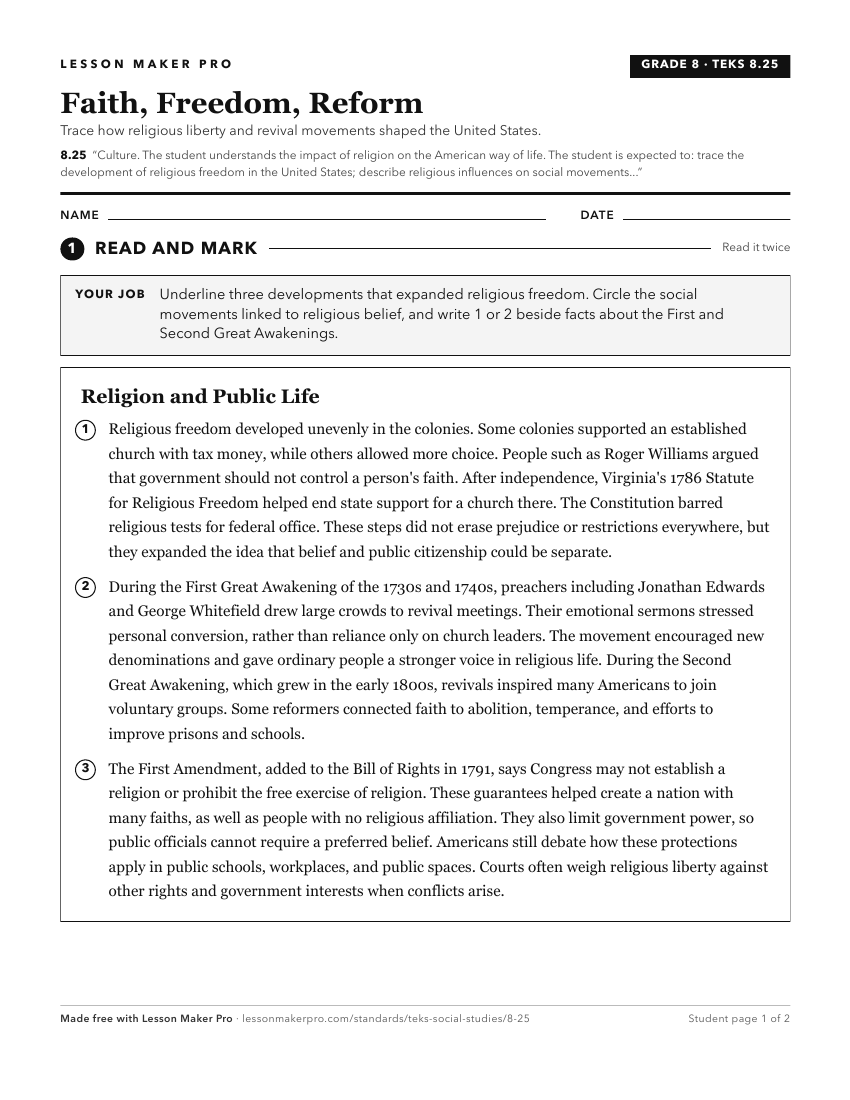
A ready-to-print activity worksheet aligned to 8.25, with an answer key for the teacher on its own page. No account needed.
PDF, US Letter, prints cleanly in black and white.
Download the worksheetKeep exploring
Related Standards
- 8.23
Culture. The student understands the relationships between and among people from various groups, including racial, ethnic, and religious groups, during the 17th...
- 4.17
Culture. The student understands the contributions of people of various racial, ethnic, and religious groups to Texas culture. The student is expected to:
- 5.21
Culture. The student understands the contributions of people of various racial, ethnic, and religious groups to the United States culture. The student is expect...
- 1.14
Culture. The student understands the importance of family and community beliefs, language, and traditions. The student is expected to:
Turn this cluster into a lesson
Grade, subject, topic, and the complete cluster are prefilled. Create one free, no account needed.
Also for this cluster:Make a WorksheetMake a QuizMake a Sub Lesson