Texas TEKS 8.13
TEKS Knowledge Statement (Expectation Cluster)
Economics. The student understands how various economic forces resulted in the Industrial Revolution in the 19th century. The student is expected to: analyze the economic effects of the War of 1812; and identify the economic factors that brought about rapid industrialization and urbanization.
Texas Essential Knowledge and Skills for Social Studies
Cluster contents
Student Expectations in This Statement
8.13 is a TEKS knowledge and skills statement. These are the student expectations under it.
Teacher's field guide
What This Cluster Means
What Students Need to Do
- Students explain how disrupted trade during and after the War of 1812 changed American manufacturing, banking, and tariffs. They connect resources, inventions, transportation, labor, and investment to factory growth and expanding cities.
What Mastery Looks Like
- Students can build a clear cause-and-effect chain from an economic condition to industrialization or urbanization. They support each link with accurate examples, such as textile mills, canals, tariffs, or wage labor.
Common Misconceptions
- Students may treat industrialization and urbanization as the same process. They may claim the war destroyed American industry, overlooking how blocked imports encouraged domestic manufacturing. They also may credit inventions alone and ignore labor, capital, resources, and transportation.
How to Assess It
- Give students this exit prompt: “Explain one economic effect of the War of 1812, then connect two economic factors to factory or city growth.” Require three labeled arrows.
Lesson moves
Ways to Teach It
Give groups event and factor cards to arrange into cause-and-effect chains linking wartime trade disruption, manufacturing, transportation, factories, and city growth.
Ask students to write: “Which mattered more for industrial growth, inventions or transportation?” Require two named examples and one counterclaim.
Run a matching relay where teams pair economic factors with outcomes, then defend one match involving tariffs, canals, labor, capital, or resources.
Use a map of a nearby city to trace roads, rail lines, or waterways, then explain how transportation shaped business and population growth.
Free download
Printable 8.13 Worksheet
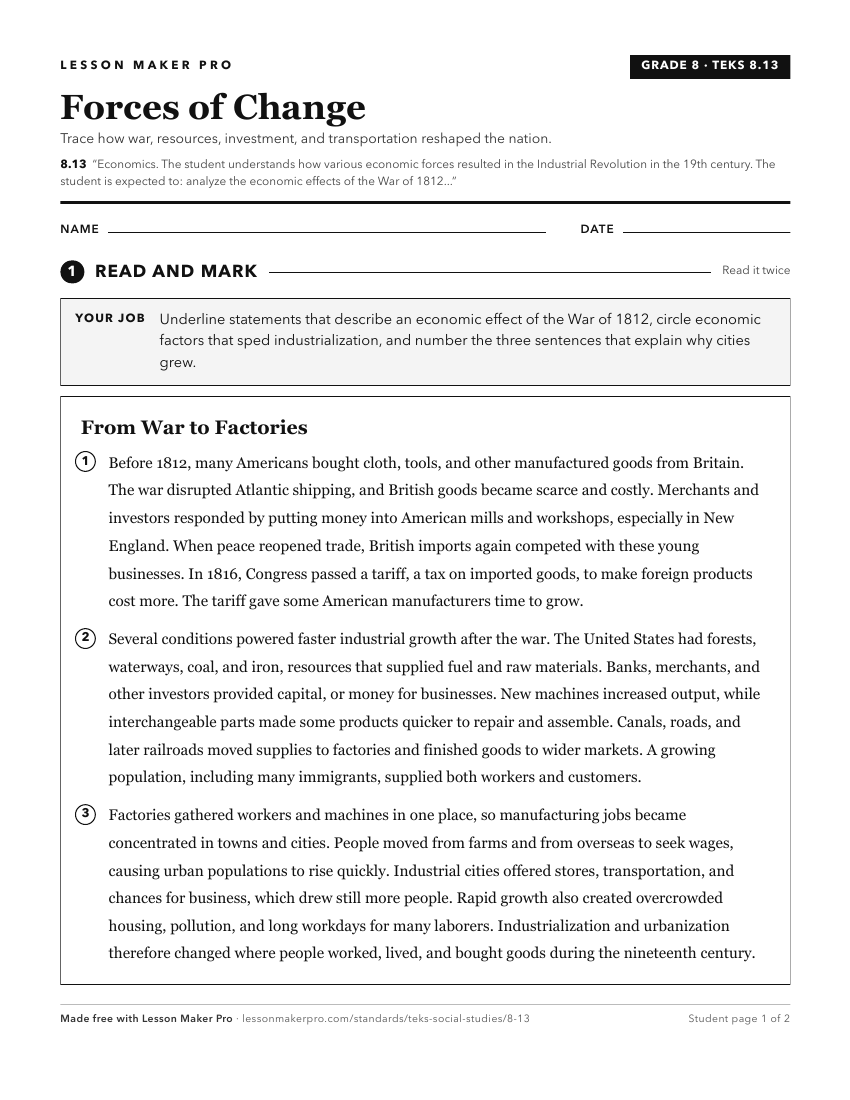
A ready-to-print activity worksheet aligned to 8.13, with an answer key for the teacher on its own page. No account needed.
PDF, US Letter, prints cleanly in black and white.
Download the worksheetKeep exploring
Related Standards
- 7.11
Economics. The student understands the factors that caused Texas to change from an agrarian to an urban society. The student is expected to:
- 8.12
Economics. The student understands why various sections of the United States developed different patterns of economic activity through 1877. The student is expe...
- 5.9
Economics. The student understands the basic economic patterns of early societies in the United States. The student is expected to:
- 5.4
History. The student understands political, economic, and social changes that occurred in the United States during the 19th century. The student is expected to:
Turn this cluster into a lesson
Grade, subject, topic, and the complete cluster are prefilled. Create one free, no account needed.
Also for this cluster:Make a WorksheetMake a QuizMake a Sub Lesson