Texas TEKS 8.12
TEKS Knowledge Statement (Expectation Cluster)
Economics. The student understands why various sections of the United States developed different patterns of economic activity through 1877. The student is expected to: identify economic differences among different regions of the United States; explain reasons for the development of the plantation system, the transatlantic slave trade, and the spread of slavery; and analyze the causes and effects of economic differences among different regions of the United States at selected times.
Texas Essential Knowledge and Skills for Social Studies
Cluster contents
Student Expectations in This Statement
8.12 is a TEKS knowledge and skills statement. These are the student expectations under it.
- 8.12.A
identify economic differences among different regions of the United States
- 8.12.B
explain reasons for the development of the plantation system, the transatlantic slave trade, and the spread of slavery
- 8.12.C
analyze the causes and effects of economic differences among different regions of the United States at selected times.
Teacher's field guide
What This Cluster Means
What Students Need to Do
- Students compare how the North, South, and West produced goods, used labor, and traded through 1877. They explain how land, climate, markets, laws, and forced labor shaped plantations, the slave trade, and slavery’s expansion. They connect regional economic differences to political conflict and social change.
What Mastery Looks Like
- Students can read a map, chart, or short source and identify a region’s main economic patterns. They can support a cause-and-effect claim with evidence and explain why slavery expanded alongside plantation agriculture.
Common Misconceptions
- Students may assume climate alone determined each region’s economy or that everyone within a region did the same work. They may describe slavery as only a labor system, overlooking violence, laws, family separation, resistance, and the agency of enslaved people.
How to Assess It
- Use this exit ticket: “Compare the North and South around 1850. Name one economic difference, explain one cause, and describe one effect.”
Lesson moves
Ways to Teach It
Give groups crop, resource, transportation, and labor cards to place on an 1850 regional map, then require evidence for each placement.
Ask students to write: “Why did plantation agriculture expand, and who benefited or suffered from that expansion?”
Run a cause-and-effect matching game using cards for cotton demand, land expansion, slavery, railroads, immigration, industry, and regional conflict.
Compare an 1860 economic map with current regional industry data, then identify one lasting pattern and one major change.
Free download
Printable 8.12 Worksheet
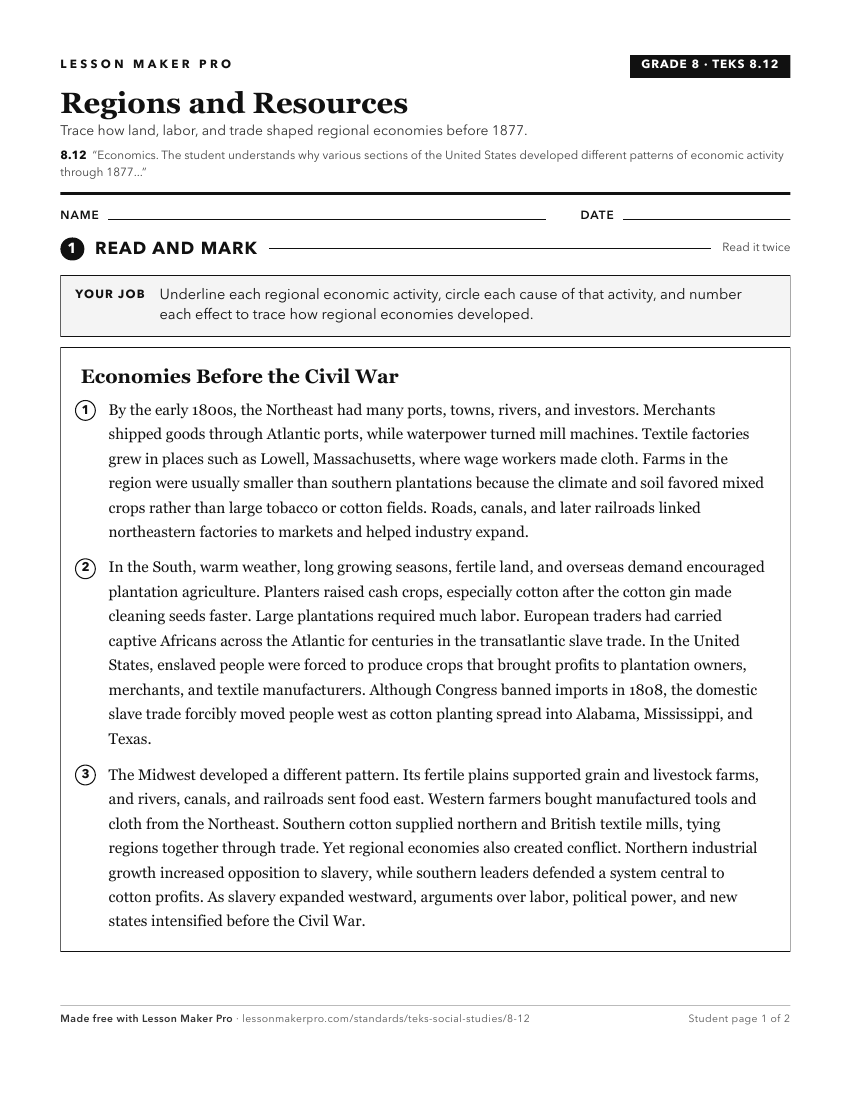
A ready-to-print activity worksheet aligned to 8.12, with an answer key for the teacher on its own page. No account needed.
PDF, US Letter, prints cleanly in black and white.
Download the worksheetKeep exploring
Related Standards
- 8.14
Economics. The student understands the origins and development of the free enterprise system in the United States. The student is expected to:
- 5.12
Economics. The student understands patterns of work and economic activities in the United States. The student is expected to:
- 7.11
Economics. The student understands the factors that caused Texas to change from an agrarian to an urban society. The student is expected to:
- 5.9
Economics. The student understands the basic economic patterns of early societies in the United States. The student is expected to:
Turn this cluster into a lesson
Grade, subject, topic, and the complete cluster are prefilled. Create one free, no account needed.
Also for this cluster:Make a WorksheetMake a QuizMake a Sub Lesson