Texas TEKS 6.7.A
The Standard
- 6.7
- The student understands the various ways in which people organize economic systems
compare ways in which various societies organize the production and distribution of goods and services
Texas Essential Knowledge and Skills for Social Studies
Teacher's field guide
What This Standard Means
What Students Need to Do
- Students identify who decides what is produced, how it is made, and who receives it. They compare ownership, labor, prices, trade, and government involvement across societies.
What Mastery Looks Like
- Students can examine two societies and identify how each organizes work, resources, and exchange. They make a clear comparison and support it with details from maps, readings, images, or data.
Common Misconceptions
- Students may assume every society uses one pure economic system. They may confuse distribution with transportation, rather than how goods are exchanged or assigned. They may also treat any government rule as complete government control.
How to Assess It
- Exit ticket: In Community A, families grow food for themselves. In Community B, businesses sell food for profit. Compare who controls production and distribution in each community.
Lesson moves
Ways to Teach It
Give groups worker, resource, business, government, and consumer cards, then have them model how two different societies produce and distribute bread.
Ask students to write: Who should decide what a society produces, families, businesses, or government, and what could be gained or lost?
Play a scenario match game where teams pair short society descriptions with traditional, market, command, or mixed economic features.
Compare a farmers market with a government-run school lunch program, noting who produces food, sets prices, and decides who receives it.
Free download
Printable 6.7.A Worksheet
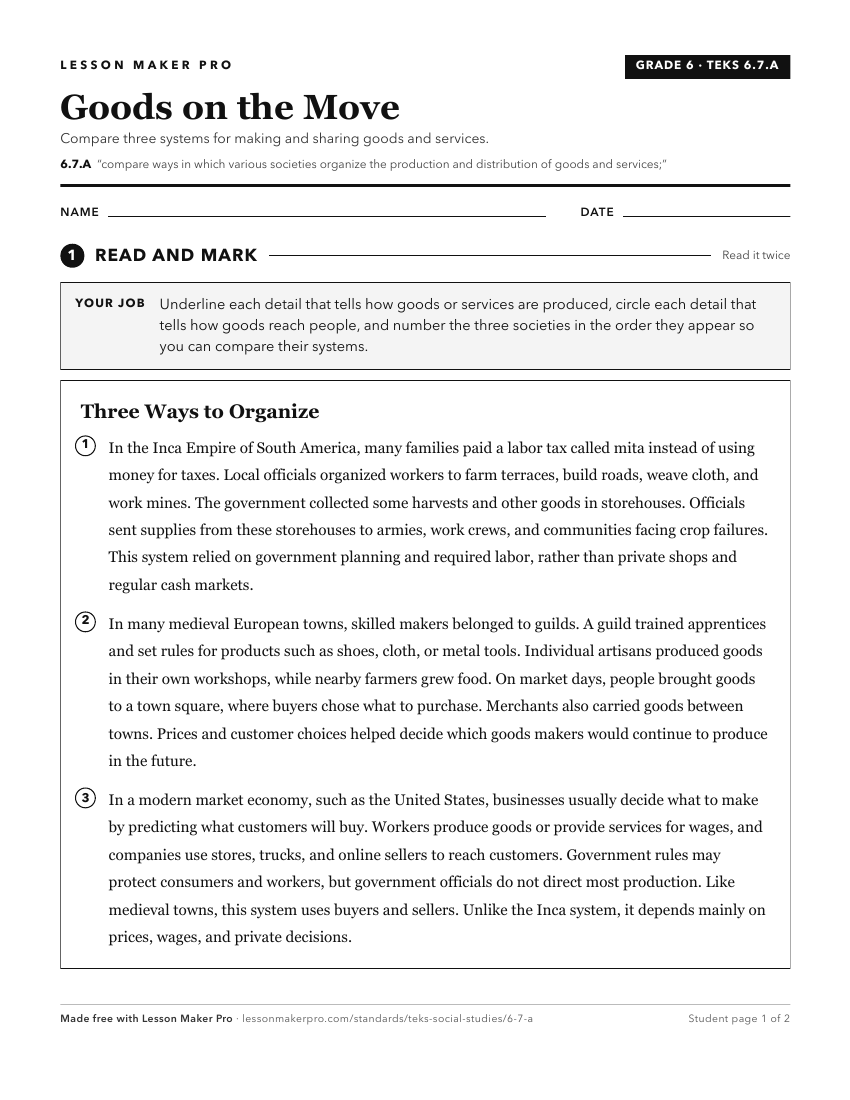
A ready-to-print activity worksheet aligned to 6.7.A, with an answer key for the teacher on its own page. No account needed.
PDF, US Letter, prints cleanly in black and white.
Download the worksheetKeep exploring
Related Standards
- 6.7
The student understands the various ways in which people organize economic systems
- 1.9.B
describe how various jobs contribute to the production of goods and services.
- 6.10.B
compare ways in which various societies such as China, Germany, India, and Russia organize government and how they function
- 1.7.B
identify ways people exchange goods and services
Turn this exact standard into a lesson
Grade, subject, topic, and the complete standard are prefilled. Create one free, no account needed.
Also for this standard:Make a WorksheetMake a QuizMake a Sub Lesson