Texas TEKS 6.7
TEKS Knowledge Statement (Expectation Cluster)
Economics. The student understands the various ways in which people organize economic systems. The student is expected to: compare ways in which various societies organize the production and distribution of goods and services; compare and contrast free enterprise, socialist, and communist economies in various contemporary societies, including the benefits of the U.S. free enterprise system; and understand the importance of ethics in maintaining a functional free enterprise system.
Texas Essential Knowledge and Skills for Social Studies
Cluster contents
Student Expectations in This Statement
6.7 is a TEKS knowledge and skills statement. These are the student expectations under it.
- 6.7.A
compare ways in which various societies organize the production and distribution of goods and services
- 6.7.B
compare and contrast free enterprise, socialist, and communist economies in various contemporary societies, including the benefits of the U.S. free enterprise s...
- 6.7.C
understand the importance of ethics in maintaining a functional free enterprise system
Teacher's field guide
What This Cluster Means
What Students Need to Do
- Students explain who decides what gets made, how it is made, and who receives it. They compare free enterprise, socialist, and communist economies using current country examples while recognizing that most economies mix features. They identify benefits of U.S. free enterprise and explain how honest business practices, fair dealing, and obeying laws help markets work.
What Mastery Looks Like
- Given two societies, students accurately compare ownership, decision making, prices, and distribution. They support claims with examples such as private businesses, government services, consumer choice, or central planning. They can explain how competition benefits consumers and how fraud damages trust in markets.
Common Misconceptions
- Students may treat every economy as a pure type, including the United States. They may assume socialism and communism are identical or that government involvement automatically makes an economy socialist. They may also see business ethics as personal behavior with no effect on prices, trust, or competition.
How to Assess It
- Exit ticket: Compare the United States with one contemporary socialist or communist society. Name two economic differences, one U.S. free enterprise benefit, and one ethical practice that supports markets.
Lesson moves
Ways to Teach It
Give groups resource cards and assign market, government, or central planning rules for producing and distributing classroom supplies.
Ask students to write which economic system gives consumers the most choice, then defend the answer with two specific features.
Run a card sort matching country examples, ownership patterns, price decisions, and distribution methods to the closest economic system.
Trace a smartphone from raw materials to sale, noting who owns each business, sets prices, earns profits, and checks working conditions.
Free download
Printable 6.7 Worksheet
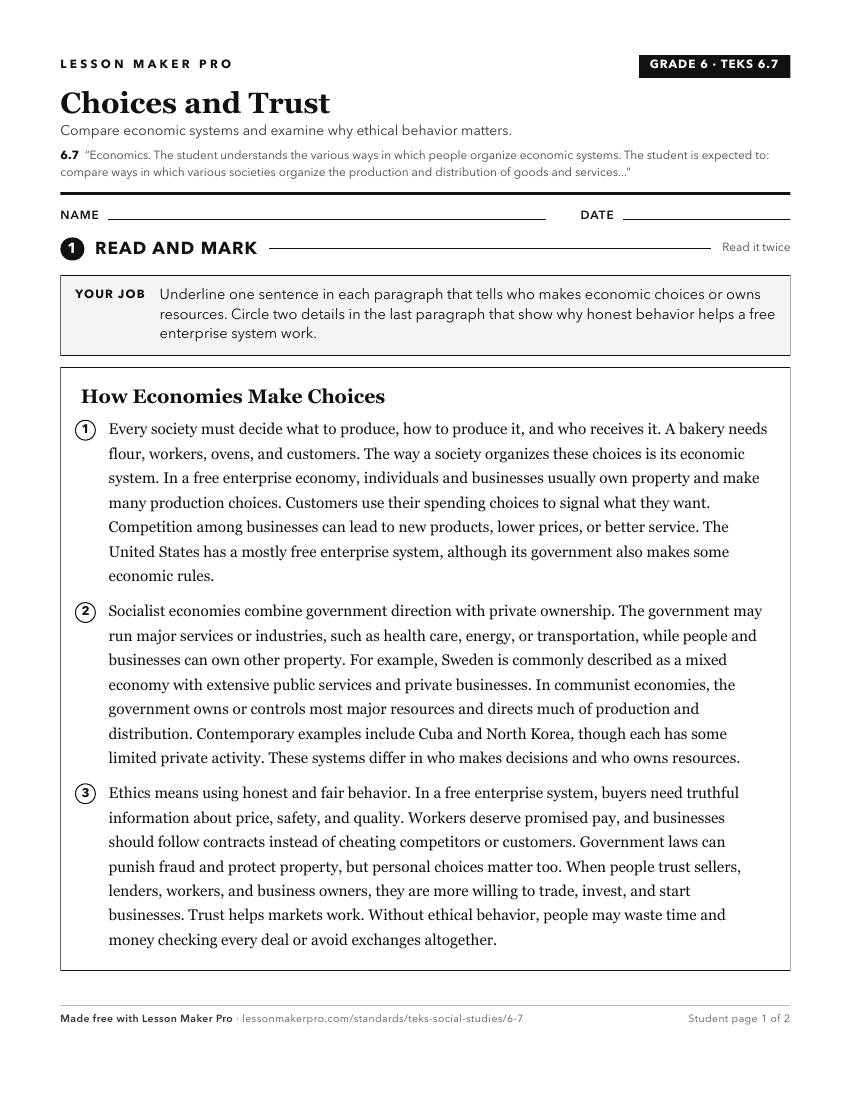
A ready-to-print activity worksheet aligned to 6.7, with an answer key for the teacher on its own page. No account needed.
PDF, US Letter, prints cleanly in black and white.
Download the worksheetKeep exploring
Related Standards
- 6.6
The student understands the factors of production in a society's economy
- 6.10
The student understands various ways in which people organize governments
- 6.4
The student understands how geographic factors influence the economic development and political relationships of societies
- 6.8
The student understands categories of economic activities and the data used to measure a society's economic level
Turn this cluster into a lesson
Grade, subject, topic, and the complete cluster are prefilled. Create one free, no account needed.
Also for this cluster:Make a WorksheetMake a QuizMake a Sub Lesson