Texas TEKS 3.14.C
The Standard
- 3.14
- Social studies skills. The student applies critical-thinking skills to organize and use information acquired from a variety of valid sources, including technology. The student is expected to:
interpret oral, visual, and print material by sequencing, categorizing, identifying the main idea, distinguishing between fact and opinion, identifying cause and effect, comparing, and contrasting
Texas Essential Knowledge and Skills for Social Studies
Teacher's field guide
What This Standard Means
What Students Need to Do
- Students make sense of a short talk, picture, chart, or passage. They order and group information, find the main point, check facts against opinions, trace results, and note similarities and differences.
What Mastery Looks Like
- After hearing or reading a short source, a student can organize details and state the main point with evidence. The student can explain event order, causes and results, similarities and differences, and whether statements are facts or opinions.
Common Misconceptions
- Students may choose an interesting detail as the main idea or assume every printed statement is a fact. They may reverse cause and result, compare unrelated features, or use page order instead of time clues.
How to Assess It
- Give students two short paragraphs and one picture about the same event. Ask them to order three details, state the main idea, label one fact and opinion, and name one cause, result, similarity, and difference.
Lesson moves
Ways to Teach It
Give groups picture and sentence cards about a school event to sort by category, arrange by time, and link causes to results.
Read two short playground accounts, then ask, “What is the main idea, and which details are facts or opinions?”
Play Source Detective with brief passages; teams earn a point for correct sequence, category, comparison, or cause-and-result answers.
Compare two weather forecasts, list shared and different details, and discuss how each forecast could affect plans for recess.
Free download
Printable 3.14.C Worksheet
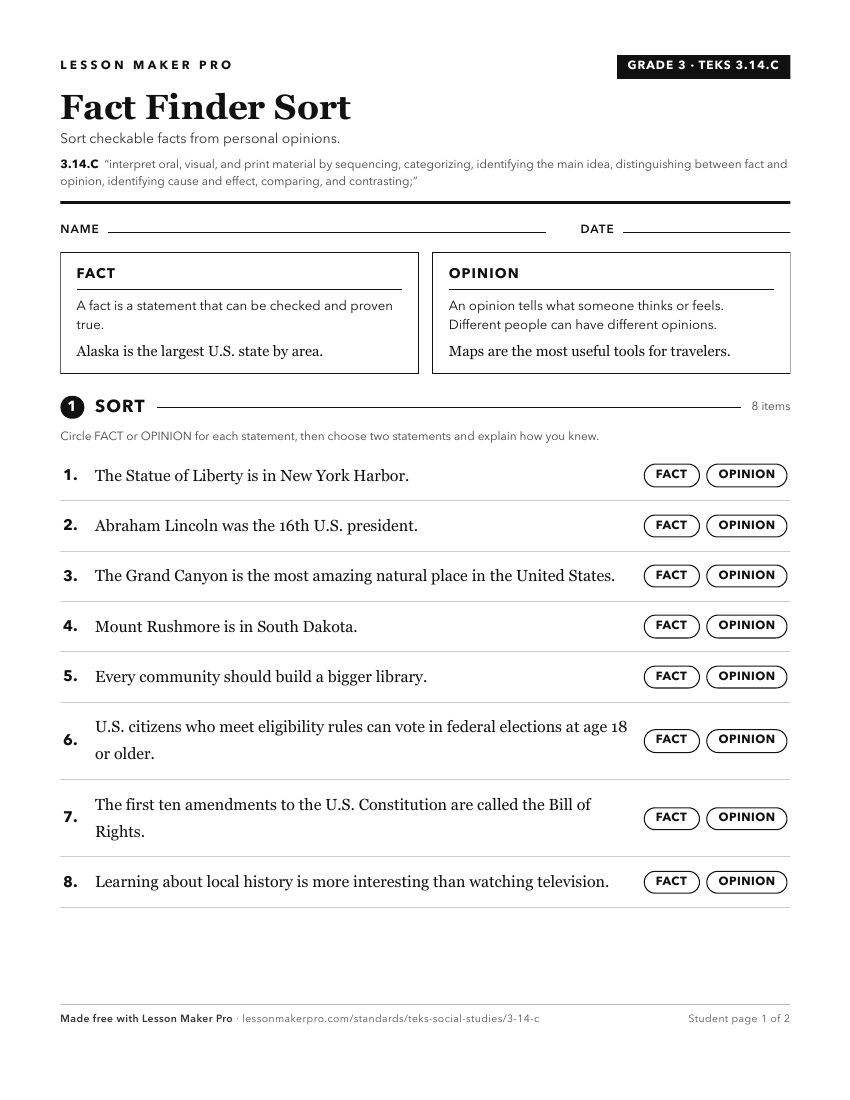
A ready-to-print activity worksheet aligned to 3.14.C, with an answer key for the teacher on its own page. No account needed.
PDF, US Letter, prints cleanly in black and white.
Download the worksheetKeep exploring
Related Standards
- 2.15.D
interpret oral, visual, and print material by sequencing, categorizing, identifying the main idea, predicting, comparing, and contrasting.
- 6.19.B
analyze information by sequencing, categorizing, identifying cause-and-effect relationships, comparing, contrasting, finding the main idea, summarizing, making ...
- 5.23.C
analyze information by applying absolute and relative chronology through sequencing, categorizing, identifying cause-and-effect relationships, comparing, contra...
- 8.29.B
analyze information by applying absolute and relative chronology through sequencing, categorizing, identifying cause-and-effect relationships, comparing, contra...
Turn this exact standard into a lesson
Grade, subject, topic, and the complete standard are prefilled. Create one free, no account needed.
Also for this standard:Make a WorksheetMake a QuizMake a Sub Lesson