Texas TEKS 2.15.D
The Standard
- 2.15
- Social studies skills. The student applies critical-thinking skills to organize and use information acquired from a variety of valid sources, including technology. The student is expected to:
interpret oral, visual, and print material by sequencing, categorizing, identifying the main idea, predicting, comparing, and contrasting.
Texas Essential Knowledge and Skills for Social Studies
Teacher's field guide
What This Standard Means
What Students Need to Do
- Students make sense of information they hear, see, or read. They arrange events, group related details, find the big idea, make supported predictions, and explain similarities and differences.
What Mastery Looks Like
- Students can place story events in order and sort details into sensible groups. They can state the main idea, support a prediction with evidence, and give an accurate similarity and difference.
Common Misconceptions
- Students may choose an interesting detail as the main idea or arrange events by preference instead of time. They may guess without evidence or confuse a similarity with a difference.
How to Assess It
- Read a four-sentence school announcement aloud and show two related pictures. Ask students to order three events, circle the main idea, make one prediction, and name one similarity and difference.
Lesson moves
Ways to Teach It
Give pairs six picture cards from a familiar story to order, then have them sort the cards into people, places, and events.
Read a short paragraph aloud and ask, “What is it mostly about, and which detail proves your answer?”
Play Same or Different: show two images, and teams earn points for one accurate similarity and one accurate difference.
Use a lunch menu and weather forecast; students group information, compare days, and predict what clothing or meal choice fits.
Free download
Printable 2.15.D Worksheet
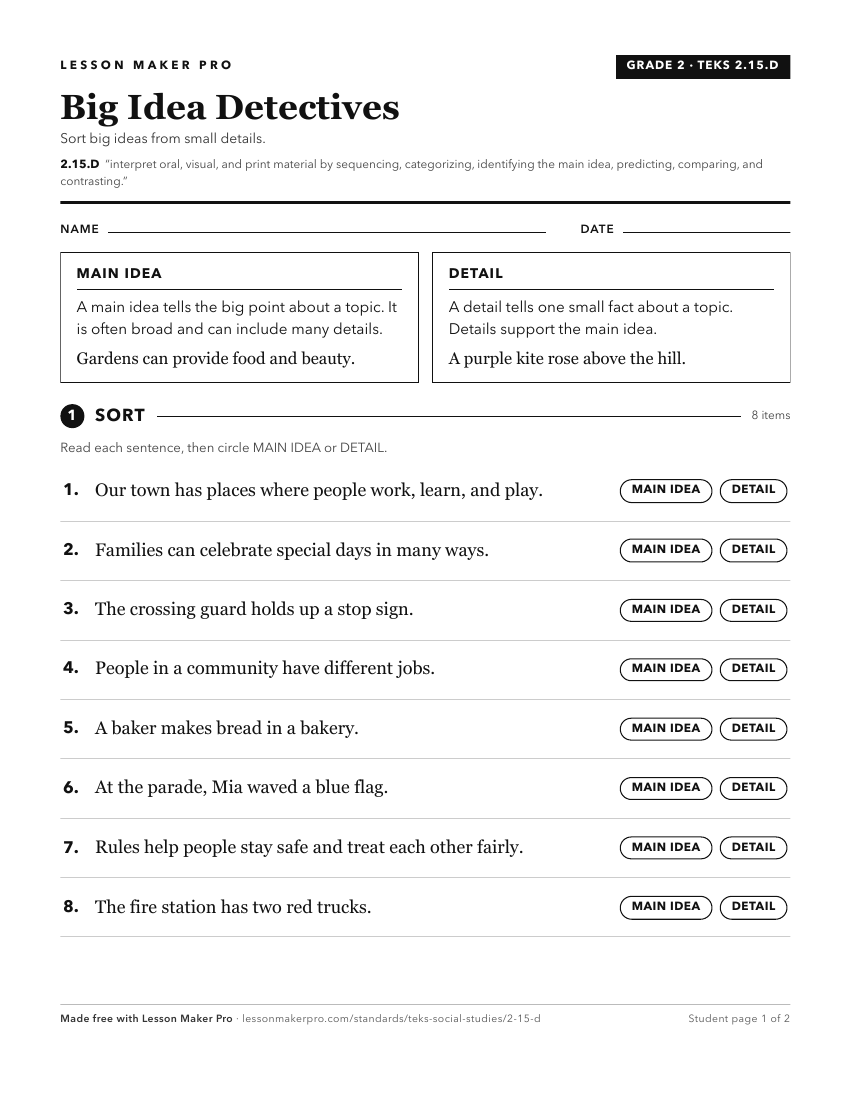
A ready-to-print activity worksheet aligned to 2.15.D, with an answer key for the teacher on its own page. No account needed.
PDF, US Letter, prints cleanly in black and white.
Download the worksheetKeep exploring
Related Standards
- 4.19.C
analyze information by applying absolute and relative chronology through sequencing, categorizing, identifying cause-and-effect relationships, comparing, contra...
- 3.14.C
interpret oral, visual, and print material by sequencing, categorizing, identifying the main idea, distinguishing between fact and opinion, identifying cause an...
- 6.19.B
analyze information by sequencing, categorizing, identifying cause-and-effect relationships, comparing, contrasting, finding the main idea, summarizing, making ...
- 8.29.B
analyze information by applying absolute and relative chronology through sequencing, categorizing, identifying cause-and-effect relationships, comparing, contra...
Turn this exact standard into a lesson
Grade, subject, topic, and the complete standard are prefilled. Create one free, no account needed.
Also for this standard:Make a WorksheetMake a QuizMake a Sub Lesson