Texas TEKS K.13
TEKS Knowledge Statement (Expectation Cluster)
Organisms and environments. The student knows that organisms resemble their parents and have structures and undergo processes that help them interact and survive within their environments. The student is expected to: identify the structures of plants, including roots, stems, leaves, flowers, and fruits; identify the different structures that animals have that allow them to interact with their environment such as seeing, hearing, moving, and grasping objects; identify and record the changes from seed, seedling, plant, flower, and fruit in a simple plant life cycle; and identify ways that young plants resemble the parent plant.
Texas Essential Knowledge and Skills for Science
Cluster contents
Student Expectations in This Statement
K.13 is a TEKS knowledge and skills statement. These are the student expectations under it.
- K.13.A
identify the structures of plants, including roots, stems, leaves, flowers, and fruits
- K.13.B
identify the different structures that animals have that allow them to interact with their environment such as seeing, hearing, moving, and grasping objects
- K.13.C
identify and record the changes from seed, seedling, plant, flower, and fruit in a simple plant life cycle
- K.13.D
identify ways that young plants resemble the parent plant.
Teacher's field guide
What This Cluster Means
What Students Need to Do
- Students name roots, stems, leaves, flowers, and fruits on real plants or pictures. They connect animal body parts with seeing, hearing, moving, or grasping. They sequence a plant life cycle and compare a young plant with its parent.
What Mastery Looks Like
- A student correctly labels common plant and animal structures and tells how an animal uses each part. The student orders seed, seedling, plant, flower, and fruit, then names a feature shared by young and parent plants.
Common Misconceptions
- Students may think roots are not part of a plant because they are underground, or that every plant has visible flowers and fruit. They may confuse growth stages with separate kinds of plants. Some expect young plants to look exactly like parent plants.
How to Assess It
- Give students five plant life cycle picture cards to order. Ask them to label two plant parts, match one animal structure to its use, and circle a shared parent and young plant feature.
Lesson moves
Ways to Teach It
Give pairs a real plant and hand lenses, then have them point to and sketch each visible plant structure.
Show parent and young plant photos, then ask, “What looks the same, and what looks different?”
Play a picture-card match game linking animal structures, such as eyes, ears, legs, and paws, to their uses.
Take a schoolyard walk to photograph plant parts and observe how birds, insects, or squirrels use body structures.
Free download
Printable K.13 Worksheet
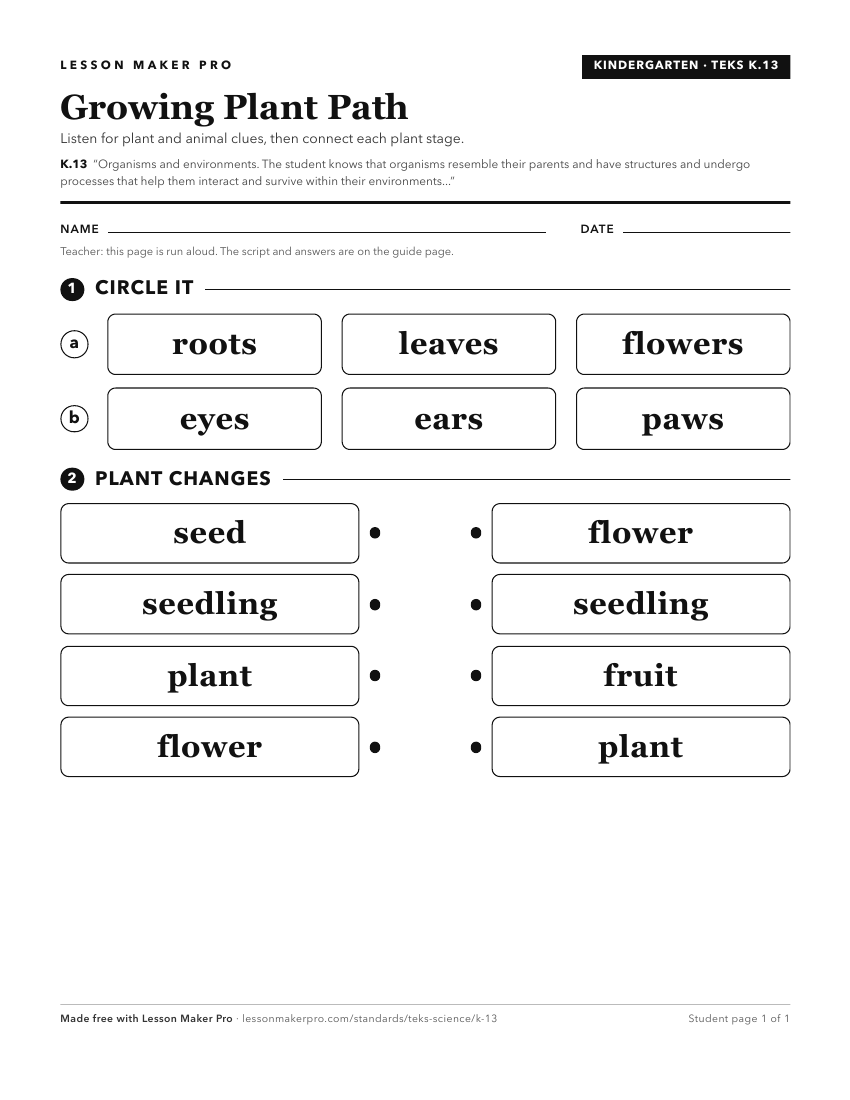
A ready-to-print activity worksheet aligned to K.13, with an answer key for the teacher on its own page. No account needed.
PDF, US Letter, prints cleanly in black and white.
Download the worksheetKeep exploring
Related Standards
- 1.13
The 1st Grade version of this standard.
- 2.13
Organisms and environments. The student knows that organisms have structures and undergo processes that help them interact and survive within their environments...
- 5.13
Organisms and environments. The student knows that organisms undergo similar life processes and have structures and behaviors that help them survive within thei...
- 3.13
Organisms and environments. The student knows that organisms undergo similar life processes and have structures that function to help them survive within their ...
Turn this cluster into a lesson
Grade, subject, topic, and the complete cluster are prefilled. Create one free, no account needed.
Also for this cluster:Make a WorksheetMake a QuizMake a Sub Lesson