Texas TEKS K.13.D
The Standard
- K.13
- Organisms and environments. The student knows that organisms resemble their parents and have structures and undergo processes that help them interact and survive within their environments. The student is expected to:
identify ways that young plants resemble the parent plant.
Texas Essential Knowledge and Skills for Science
Teacher's field guide
What This Standard Means
What Students Need to Do
- Students observe a young plant and an adult plant of the same kind. They name shared traits such as leaf shape, leaf color, or stem features.
What Mastery Looks Like
- Given plant pictures, a student matches a young plant to the correct adult plant. The student points out one or more visible traits that support the match.
Common Misconceptions
- Students may think every young plant looks exactly like the adult plant. They may choose the closest or largest plant as the parent instead of comparing visible traits.
How to Assess It
- Show one seedling and two adult plant pictures. Ask, “Which adult matches this seedling, and what feature helped you decide?”
Lesson moves
Ways to Teach It
Give pairs of bean seedlings and mature bean plants, then have students use magnifiers to find matching leaf and stem features.
Show a young sunflower and an adult sunflower, then ask students to draw and label one feature both plants share.
Play a card-matching game where students pair seedling photos with adult plant photos and explain each match.
Walk through the school garden and compare new plant growth with mature plants of the same kind nearby.
Free download
Printable K.13.D Worksheet
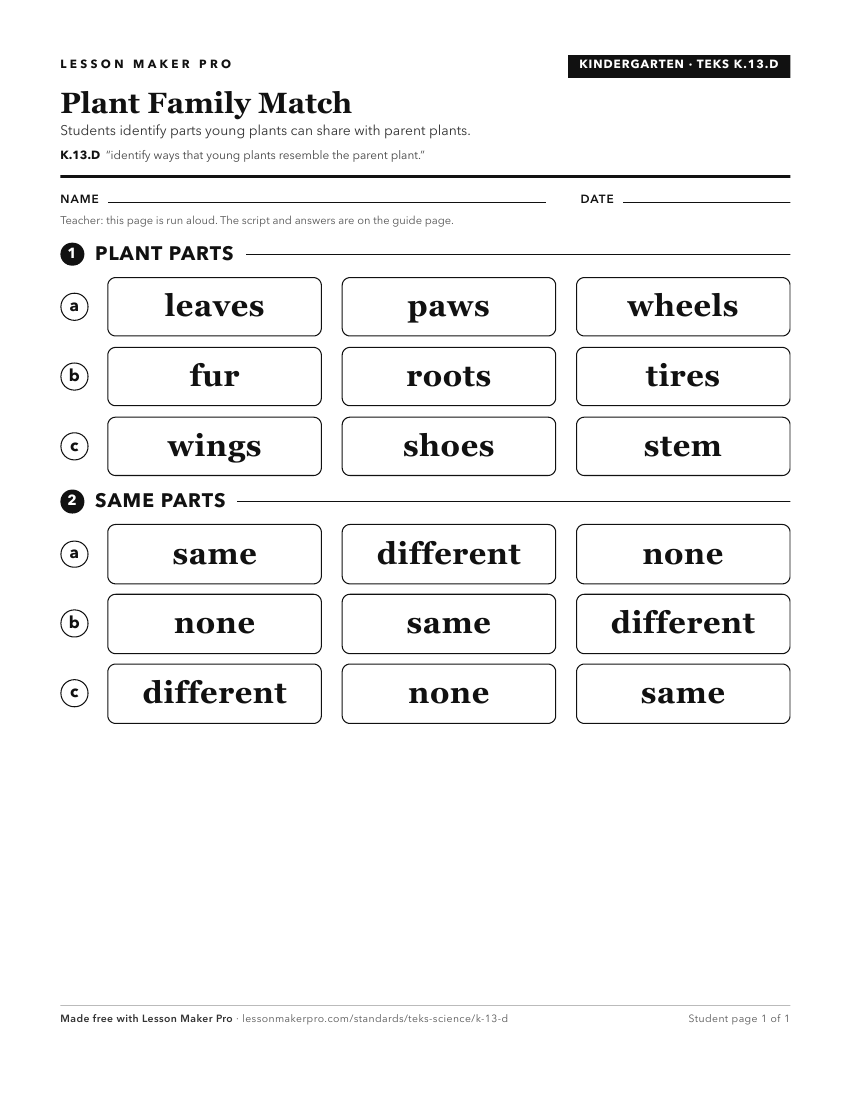
A ready-to-print activity worksheet aligned to K.13.D, with an answer key for the teacher on its own page. No account needed.
PDF, US Letter, prints cleanly in black and white.
Download the worksheetKeep exploring
Related Standards
- K.13.A
identify the structures of plants, including roots, stems, leaves, flowers, and fruits
- 2.13.A
identify the roots, stems, leaves, flowers, fruits, and seeds of plants and compare how those structures help different plants meet their basic needs for surviv...
- 4.13.A
explore and explain how structures and functions of plants such as waxy leaves and deep roots enable them to survive in their environment
- 1.13.C
compare ways that young animals resemble their parents.
Turn this exact standard into a lesson
Grade, subject, topic, and the complete standard are prefilled. Create one free, no account needed.
Also for this standard:Make a WorksheetMake a QuizMake a Sub Lesson