Texas TEKS 8.13
TEKS Knowledge Statement (Expectation Cluster)
Organisms and environments. The student knows how cell functions support the health of an organism and how adaptation and variation relate to survival. The student is expected to: identify the function of the cell membrane, cell wall, nucleus, ribosomes, cytoplasm, mitochondria, chloroplasts, and vacuoles in plant or animal cells; describe the function of genes within chromosomes in determining inherited traits of offspring; and describe how variations of traits within a population lead to structural, behavioral, and physiological adaptations that influence the likelihood of survival and reproductive success of a species over generations.
Texas Essential Knowledge and Skills for Science
Cluster contents
Student Expectations in This Statement
8.13 is a TEKS knowledge and skills statement. These are the student expectations under it.
- 8.13.A
identify the function of the cell membrane, cell wall, nucleus, ribosomes, cytoplasm, mitochondria, chloroplasts, and vacuoles in plant or animal cells
- 8.13.B
describe the function of genes within chromosomes in determining inherited traits of offspring
- 8.13.C
describe how variations of traits within a population lead to structural, behavioral, and physiological adaptations that influence the likelihood of survival an...
Teacher's field guide
What This Cluster Means
What Students Need to Do
- Students match major cell parts with the jobs they perform in plant and animal cells. They explain how genes carried on chromosomes pass trait information to offspring. They classify adaptations as structural, behavioral, or physiological and explain population changes across generations.
What Mastery Looks Like
- Given a cell diagram or malfunction, students name the cell part involved and explain its job. Given parent and offspring information, they connect a trait to genes carried on chromosomes. With population data, they explain why one inherited variation becomes more common and identify the adaptation type.
Common Misconceptions
- Students often confuse the cell membrane with the cell wall or place chloroplasts in animal cells. They may think genes and chromosomes are unrelated, or that acquired traits pass to offspring. They may also claim individuals change because they need to, rather than populations changing across generations.
How to Assess It
- Exit ticket: Match cell membrane, nucleus, mitochondria, and chloroplast to control entry, store genetic material, release usable energy, and capture light energy. Then explain how an inherited camouflage trait could become more common over generations.
Lesson moves
Ways to Teach It
Build plant and animal cell models with labeled clay, then place function cards beside each structure and compare which structures are shared.
Write a claim explaining how a helpful inherited variation can spread, using the words survival, reproduction, population, and generations.
Play organelle matching relay: teams pair structure cards with function cards, then find one planted mismatch and justify the correction.
Analyze peppered moth images and pollution records to explain how camouflage affected survival and moth color frequencies across generations.
Free download
Printable 8.13 Worksheet
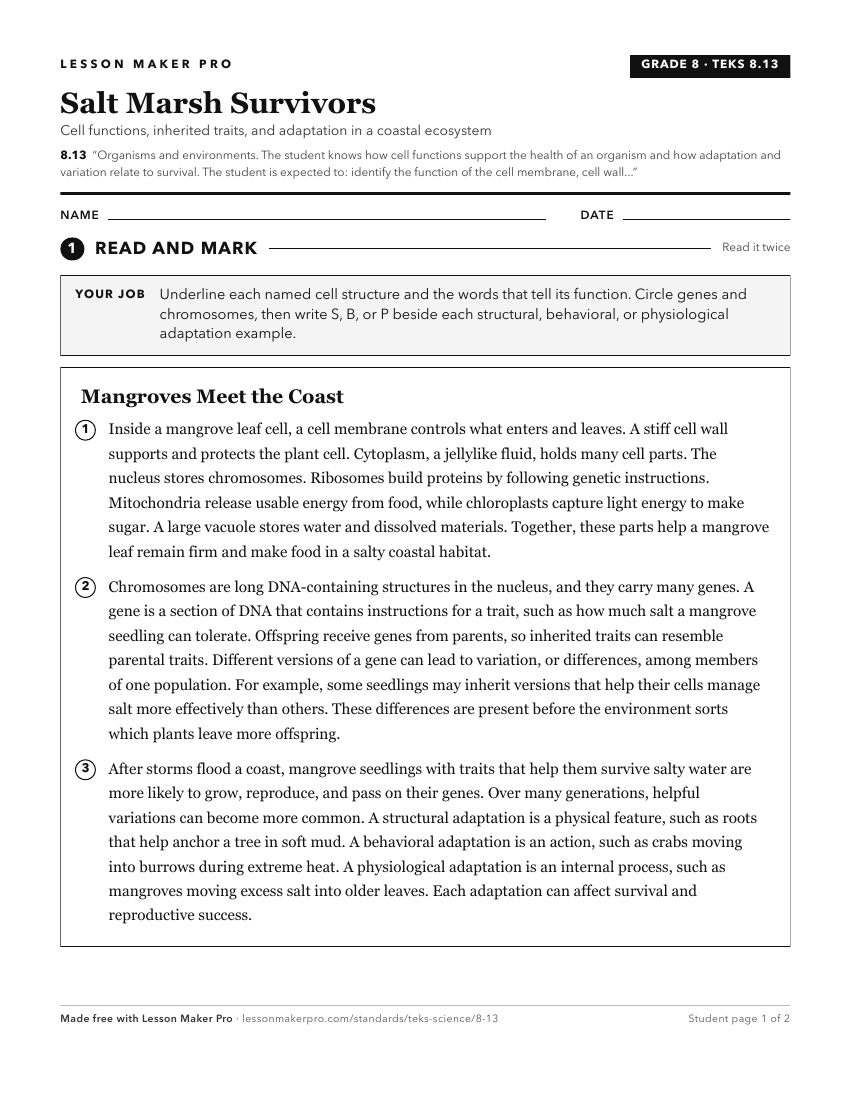
A ready-to-print activity worksheet aligned to 8.13, with an answer key for the teacher on its own page. No account needed.
PDF, US Letter, prints cleanly in black and white.
Download the worksheetKeep exploring
Related Standards
- 7.13
Organisms and environments. The student knows how systems are organized and function to support the health of an organism and how traits are inherited. The stud...
- 3.13
Organisms and environments. The student knows that organisms undergo similar life processes and have structures that function to help them survive within their ...
- 6.13
Organisms and environments. The student knows that organisms have an organizational structure and variations can influence survival of populations. The student ...
- 4.13
Organisms and environments. The student knows that organisms undergo similar life processes and have structures that function to help them survive within their ...
Turn this cluster into a lesson
Grade, subject, topic, and the complete cluster are prefilled. Create one free, no account needed.
Also for this cluster:Make a WorksheetMake a QuizMake a Sub Lesson