Texas TEKS 7.13
TEKS Knowledge Statement (Expectation Cluster)
Organisms and environments. The student knows how systems are organized and function to support the health of an organism and how traits are inherited. The student is expected to: identify and model the main functions of the systems of the human organism, including the circulatory, respiratory, skeletal, muscular, digestive, urinary, reproductive, integumentary, nervous, immune, and endocrine systems; describe the hierarchical organization of cells, tissues, organs, and organ systems within plants and animals; compare the results of asexual and sexual reproduction of plants and animals in relation to the diversity of offspring and the changes in the population over time; and describe and give examples of how natural and artificial selection change the occurrence of traits in a population over generations.
Texas Essential Knowledge and Skills for Science
Cluster contents
Student Expectations in This Statement
7.13 is a TEKS knowledge and skills statement. These are the student expectations under it.
- 7.13.A
identify and model the main functions of the systems of the human organism, including the circulatory, respiratory, skeletal, muscular, digestive, urinary, repr...
- 7.13.B
describe the hierarchical organization of cells, tissues, organs, and organ systems within plants and animals
- 7.13.C
compare the results of asexual and sexual reproduction of plants and animals in relation to the diversity of offspring and the changes in the population over ti...
- 7.13.D
describe and give examples of how natural and artificial selection change the occurrence of traits in a population over generations.
Teacher's field guide
What This Cluster Means
What Students Need to Do
- Students identify each major human body system, model its main job, and explain how systems work together. They organize cells, tissues, organs, and organ systems in order. They compare sexual and asexual reproduction, then explain how natural and artificial selection shift traits across generations.
What Mastery Looks Like
- A student can label a body model, match organs to systems, and trace an event such as running through several interacting systems. They can build a correct biological hierarchy and use offspring or population data to explain diversity and changes in trait frequency.
Common Misconceptions
- Students often treat body systems as isolated, confuse organs with tissues, or reverse the biological hierarchy. They may think asexual offspring are always perfectly identical or that individual organisms gain traits because they need them. Some also confuse artificial selection with genetic engineering.
How to Assess It
- Give a four-box exit ticket: connect two systems during a sprint, order four hierarchy examples, compare reproduction types, and explain a trait-frequency graph.
Lesson moves
Ways to Teach It
Use organ cards, yarn, and a body outline to build connected system models and explain how oxygen reaches a leg muscle.
Write: How would clone-producing and sexually reproducing lizard populations respond differently to a new disease?
Play a hierarchy relay where teams sort cell, tissue, organ, and system cards, then justify each sequence.
Compare antibiotic resistance data with dog-breeding examples to identify natural versus artificial selection and track trait frequencies across generations.
Free download
Printable 7.13 Worksheet
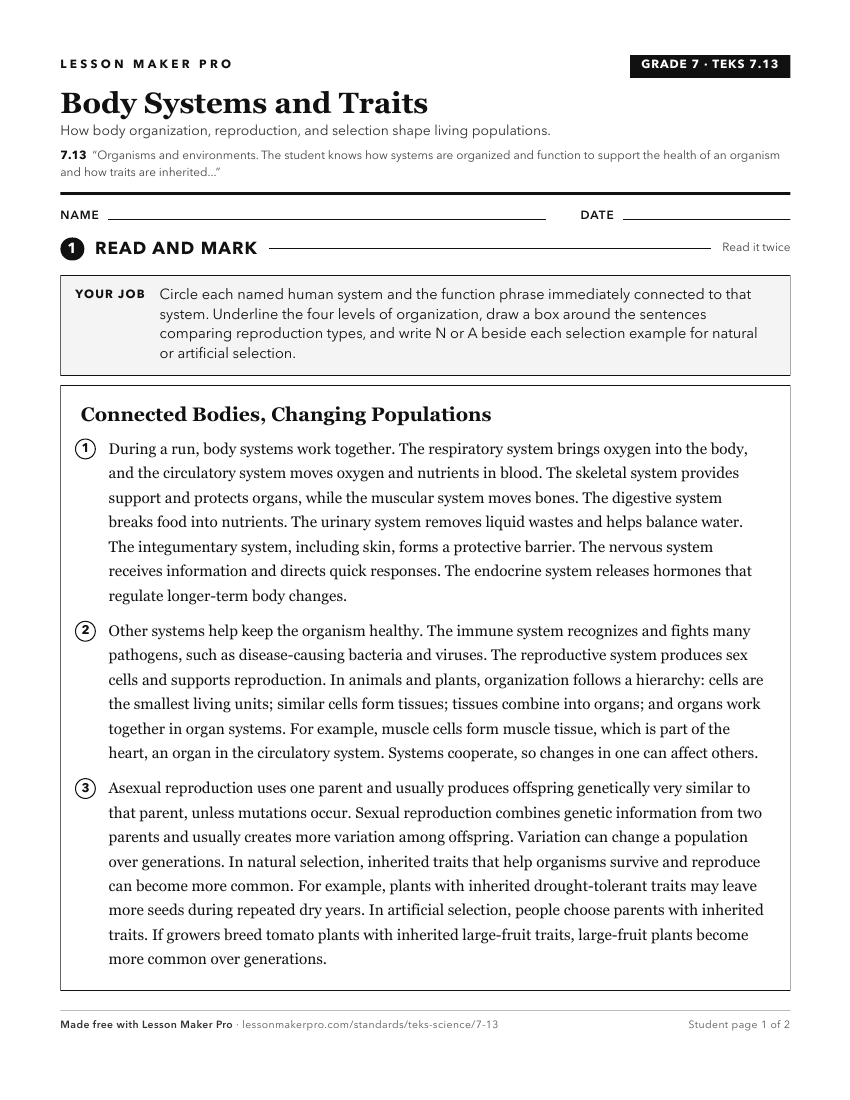
A ready-to-print activity worksheet aligned to 7.13, with an answer key for the teacher on its own page. No account needed.
PDF, US Letter, prints cleanly in black and white.
Download the worksheetKeep exploring
Related Standards
- K.13
Organisms and environments. The student knows that organisms resemble their parents and have structures and undergo processes that help them interact and surviv...
- 2.13
Organisms and environments. The student knows that organisms have structures and undergo processes that help them interact and survive within their environments...
- 3.13
Organisms and environments. The student knows that organisms undergo similar life processes and have structures that function to help them survive within their ...
- 4.13
Organisms and environments. The student knows that organisms undergo similar life processes and have structures that function to help them survive within their ...
Turn this cluster into a lesson
Grade, subject, topic, and the complete cluster are prefilled. Create one free, no account needed.
Also for this cluster:Make a WorksheetMake a QuizMake a Sub Lesson