Texas TEKS 7.13.C
The Standard
- 7.13
- Organisms and environments. The student knows how systems are organized and function to support the health of an organism and how traits are inherited. The student is expected to:
compare the results of asexual and sexual reproduction of plants and animals in relation to the diversity of offspring and the changes in the population over time
Texas Essential Knowledge and Skills for Science
Teacher's field guide
What This Standard Means
What Students Need to Do
- Students compare offspring produced through sexual and asexual reproduction. They explain how each method affects inherited variation and population patterns across generations.
What Mastery Looks Like
- Students can identify which reproductive method usually produces more genetic diversity. They can use offspring data to predict how a population may respond to disease or environmental change.
Common Misconceptions
- Students may think asexual offspring are always perfectly identical or that sexual reproduction always produces completely different offspring. They may also confuse genetic diversity with population size or assume plants use only asexual reproduction.
How to Assess It
- Exit ticket: One population produces 40 nearly identical offspring, while another produces 40 varied offspring. Predict how each might change after a new disease arrives, and justify your answer using diversity.
Lesson moves
Ways to Teach It
Use colored beads to model copied traits in asexual reproduction and mixed parental traits in sexual reproduction, then compare offspring variation.
Write a claim answering: Which reproductive method gives a population more possible responses to environmental change, and why?
Play four survival rounds using organism trait cards and changing environment cards, then graph how each population changes.
Compare cloned banana plants with seed-grown plants and explain how genetic similarity can affect disease risk across a crop.
Free download
Printable 7.13.C Worksheet
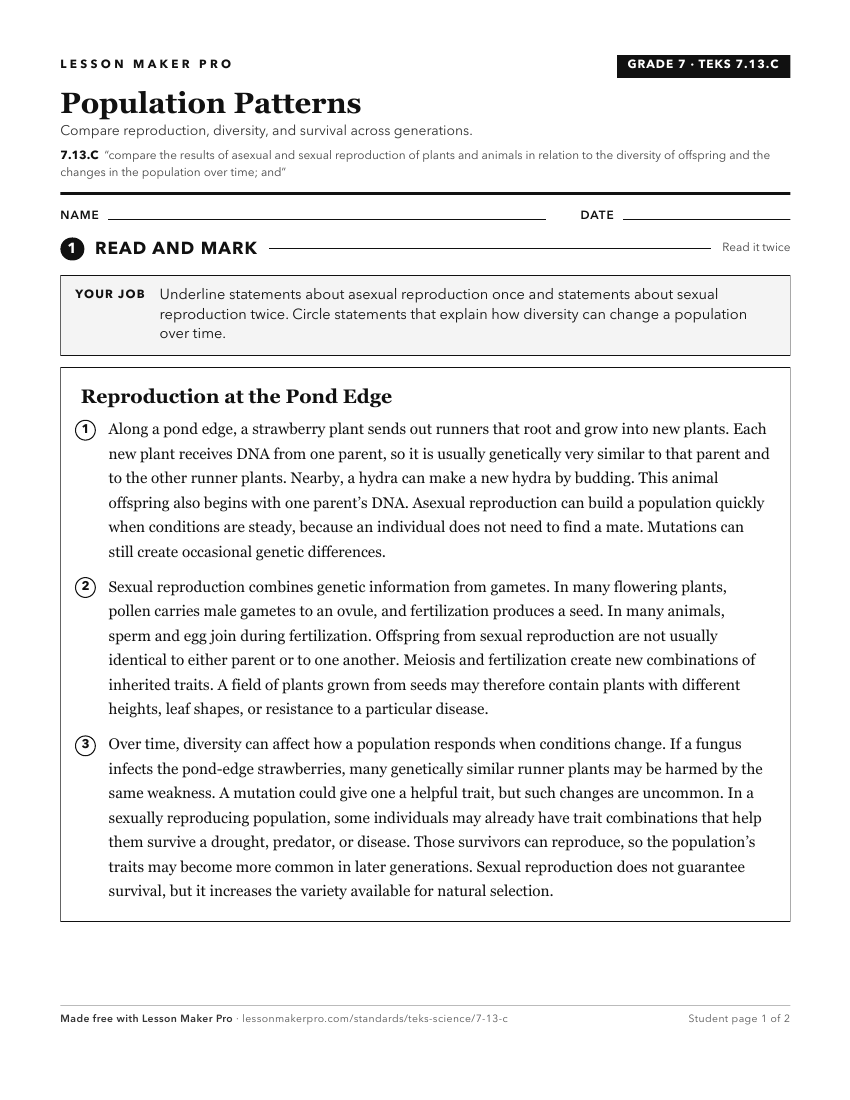
A ready-to-print activity worksheet aligned to 7.13.C, with an answer key for the teacher on its own page. No account needed.
PDF, US Letter, prints cleanly in black and white.
Download the worksheetKeep exploring
Related Standards
- 6.13.B
identify and compare the basic characteristics of organisms, including prokaryotic and eukaryotic, unicellular and multicellular, and autotrophic and heterotrop...
- 2.13.D
investigate and describe some of the unique life cycles of animals where young animals do not resemble their parents, including butterflies and frogs.
- 5.13.A
analyze the structures and functions of different species to identify how organisms survive in the same environment
- 8.13.C
describe how variations of traits within a population lead to structural, behavioral, and physiological adaptations that influence the likelihood of survival an...
Turn this exact standard into a lesson
Grade, subject, topic, and the complete standard are prefilled. Create one free, no account needed.
Also for this standard:Make a WorksheetMake a QuizMake a Sub Lesson