Texas TEKS 8.13.C
The Standard
- 8.13
- The student knows how cell functions support the health of an organism and how adaptation and variation relate to survival
describe how variations of traits within a population lead to structural, behavioral, and physiological adaptations that influence the likelihood of survival and reproductive success of a species over generations.
Texas Essential Knowledge and Skills for Science
Teacher's field guide
What This Standard Means
What Students Need to Do
- Students compare inherited trait differences within a population and identify them as structural, behavioral, or physiological. They explain how environmental conditions affect which individuals survive, reproduce, and pass traits to later generations.
What Mastery Looks Like
- A student can use evidence from a population scenario to identify a helpful variation and explain its effect on reproductive success. The student can predict how the trait may become more common over generations.
Common Misconceptions
- Students may think individuals change traits because they need to, rather than populations changing across generations. They may assume every variation is helpful or that survival alone guarantees a trait will spread.
How to Assess It
- Give students a beetle population with color variation on dark soil. Ask them to predict which color may become more common and explain why using survival, reproduction, and inheritance.
Lesson moves
Ways to Teach It
Use spoons, tweezers, and clothespins as bird beaks to collect beans, then graph which tool gathers enough food for reproduction.
Ask students to classify a rabbit trait as structural, behavioral, or physiological, then explain how it could affect reproduction.
Play a trait card game where students match environments, inherited variations, survival outcomes, and changes across generations.
Examine pesticide resistance in insects and explain why resistant insects leave more offspring after repeated pesticide use.
Free download
Printable 8.13.C Worksheet
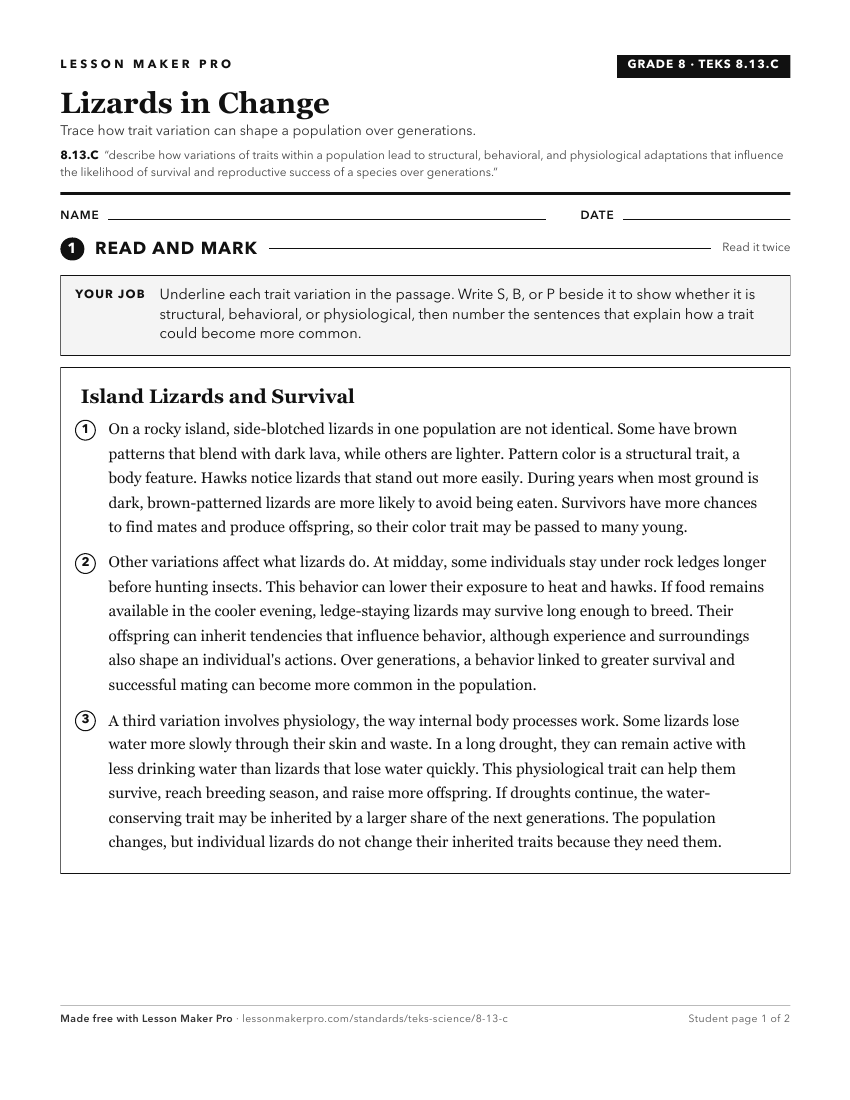
A ready-to-print activity worksheet aligned to 8.13.C, with an answer key for the teacher on its own page. No account needed.
PDF, US Letter, prints cleanly in black and white.
Download the worksheetKeep exploring
Related Standards
- 6.13.C
describe how variations within a population can be an advantage or disadvantage to the survival of a population as environments change.
- 7.13.D
describe and give examples of how natural and artificial selection change the occurrence of traits in a population over generations.
- 5.13.B
explain how instinctual behavioral traits such as turtle hatchlings returning to the sea and learned behavioral traits such as orcas hunting in packs increase c...
- 6.13
Organisms and environments. The student knows that organisms have an organizational structure and variations can influence survival of populations. The student ...
Turn this exact standard into a lesson
Grade, subject, topic, and the complete standard are prefilled. Create one free, no account needed.
Also for this standard:Make a WorksheetMake a QuizMake a Sub Lesson