Texas TEKS 6.13.C
The Standard
- 6.13
- Organisms and environments. The student knows that organisms have an organizational structure and variations can influence survival of populations. The student is expected to:
describe how variations within a population can be an advantage or disadvantage to the survival of a population as environments change.
Texas Essential Knowledge and Skills for Science
Teacher's field guide
What This Standard Means
What Students Need to Do
- Students identify trait differences among members of one population. They explain how changes in food, climate, predators, or habitat can make a trait helpful or harmful to population survival.
What Mastery Looks Like
- Given a scenario, students name the environmental change, compare two variations, and predict which group is more likely to survive and reproduce. They support the prediction with evidence from the scenario.
Common Misconceptions
- Students may say individuals develop needed traits during their lives, rather than recognizing that variations already exist. They may assume one trait is always best or that every variation affects survival. They may also confuse one individual surviving with the population surviving over time.
How to Assess It
- Exit ticket: A drought leaves mostly large, hard seeds. How could thick and thin beaks affect which birds survive and the population over time?
Lesson moves
Ways to Teach It
Use spoons, clothespins, and tweezers as beaks to gather seeds, switch seed sizes, and graph each beak type’s success.
Write: When a grassy habitat becomes rocky, which fur color might help a mouse population survive, and why?
Draw trait and environment cards, then earn a point by explaining whether the pairing helps or harms survival.
Examine pesticide resistance in insects and explain why some members survive treatment while others die.
Free download
Printable 6.13.C Worksheet
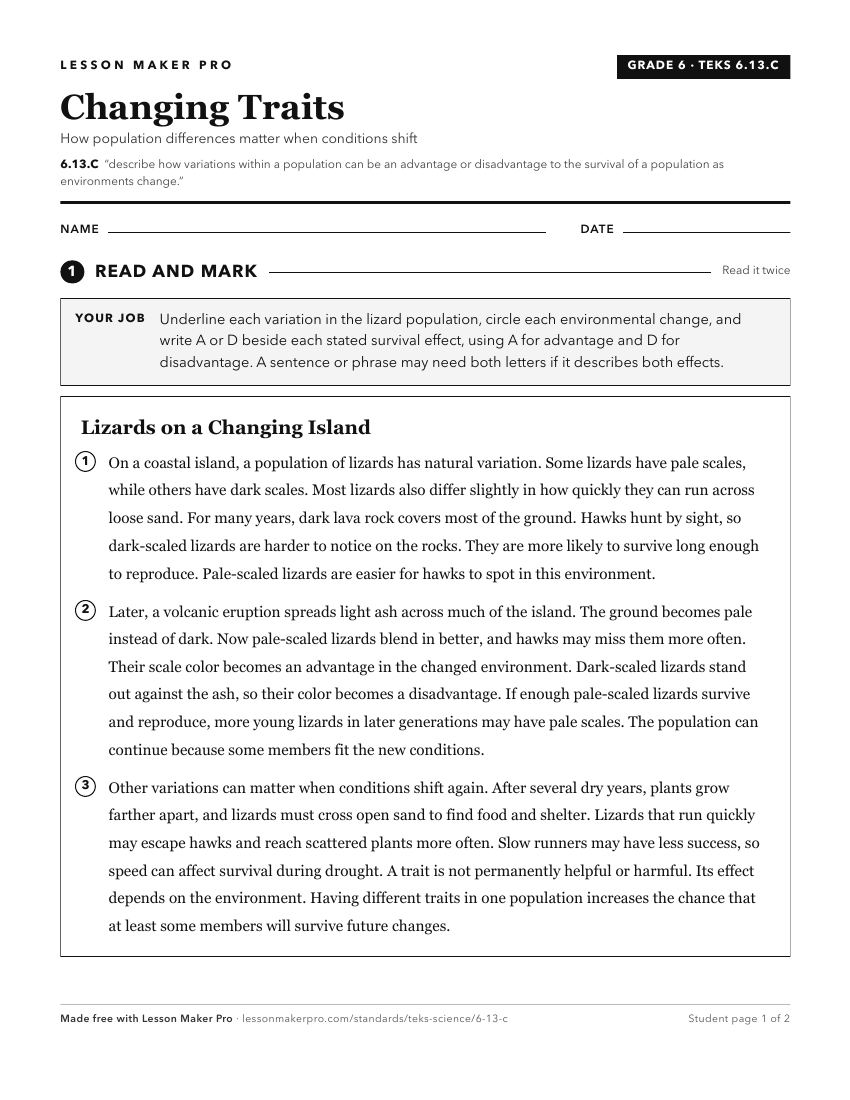
A ready-to-print activity worksheet aligned to 6.13.C, with an answer key for the teacher on its own page. No account needed.
PDF, US Letter, prints cleanly in black and white.
Download the worksheetKeep exploring
Related Standards
- 3.12.C
describe how natural changes to the environment such as floods and droughts cause some organisms to thrive and others to perish or move to new locations
- 7.13.D
describe and give examples of how natural and artificial selection change the occurrence of traits in a population over generations.
- 6.13
Organisms and environments. The student knows that organisms have an organizational structure and variations can influence survival of populations. The student ...
- 8.13.C
describe how variations of traits within a population lead to structural, behavioral, and physiological adaptations that influence the likelihood of survival an...
Turn this exact standard into a lesson
Grade, subject, topic, and the complete standard are prefilled. Create one free, no account needed.
Also for this standard:Make a WorksheetMake a QuizMake a Sub Lesson