Texas TEKS 7.13.D
The Standard
- 7.13
- Organisms and environments. The student knows how systems are organized and function to support the health of an organism and how traits are inherited. The student is expected to:
describe and give examples of how natural and artificial selection change the occurrence of traits in a population over generations.
Texas Essential Knowledge and Skills for Science
Teacher's field guide
What This Standard Means
What Students Need to Do
- Students explain why some inherited traits become more or less common across many generations. They compare environmental pressures with human choices and give examples of each process.
What Mastery Looks Like
- Students can trace how survival, reproduction, and inheritance affect a trait’s frequency in a population. They can explain examples such as camouflage in insects and selective breeding in dogs.
Common Misconceptions
- Students may think individuals change traits because they need to survive. They may assume selection creates new traits or that artificial selection always involves genetic engineering.
How to Assess It
- Give students two cases, pesticide-resistant insects and farmers breeding larger tomatoes. Ask them to identify the type of selection and explain how one trait becomes more common.
Lesson moves
Ways to Teach It
Use colored paper dots on patterned fabric to model predation, reproduction, and trait frequencies across four generations.
Ask students to write how breeding dairy cows differs from environmental selection acting on a wild population.
Play a card-sorting game matching scenarios, selection type, favored trait, and expected population change.
Compare photographs of wild mustard and crops bred from it, then identify the traits people selected in each crop.
Free download
Printable 7.13.D Worksheet
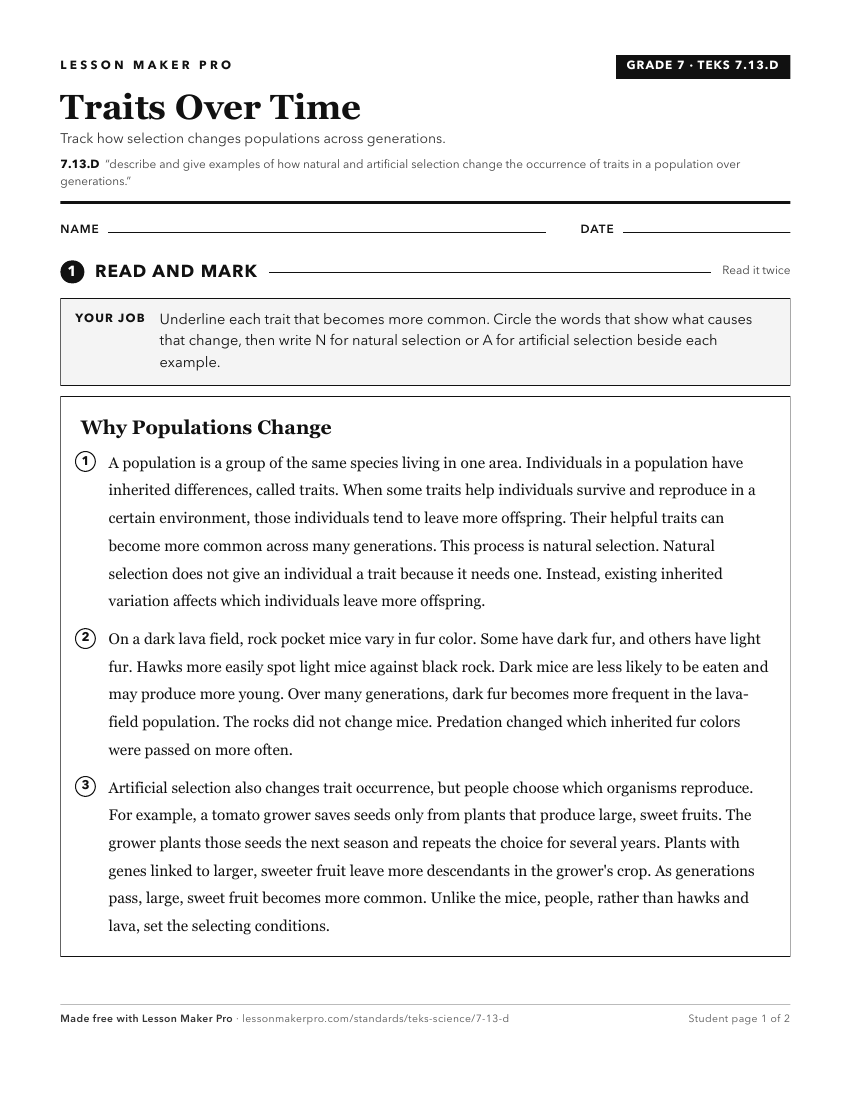
A ready-to-print activity worksheet aligned to 7.13.D, with an answer key for the teacher on its own page. No account needed.
PDF, US Letter, prints cleanly in black and white.
Download the worksheetKeep exploring
Related Standards
- 6.13.C
describe how variations within a population can be an advantage or disadvantage to the survival of a population as environments change.
- 3.12.C
describe how natural changes to the environment such as floods and droughts cause some organisms to thrive and others to perish or move to new locations
- 2.5.G
describe how factors or conditions can cause objects, organisms, and systems to either change or stay the same.
- 8.13.C
describe how variations of traits within a population lead to structural, behavioral, and physiological adaptations that influence the likelihood of survival an...
Turn this exact standard into a lesson
Grade, subject, topic, and the complete standard are prefilled. Create one free, no account needed.
Also for this standard:Make a WorksheetMake a QuizMake a Sub Lesson