Texas TEKS 6.13
TEKS Knowledge Statement (Expectation Cluster)
Organisms and environments. The student knows that organisms have an organizational structure and variations can influence survival of populations. The student is expected to: describe the historical development of cell theory and explain how organisms are composed of one or more cells, which come from pre-existing cells and are the basic unit of structure and function; identify and compare the basic characteristics of organisms, including prokaryotic and eukaryotic, unicellular and multicellular, and autotrophic and heterotrophic; and describe how variations within a population can be an advantage or disadvantage to the survival of a population as environments change.
Texas Essential Knowledge and Skills for Science
Cluster contents
Student Expectations in This Statement
6.13 is a TEKS knowledge and skills statement. These are the student expectations under it.
- 6.13.A
describe the historical development of cell theory and explain how organisms are composed of one or more cells, which come from pre-existing cells and are the b...
- 6.13.B
identify and compare the basic characteristics of organisms, including prokaryotic and eukaryotic, unicellular and multicellular, and autotrophic and heterotrop...
- 6.13.C
describe how variations within a population can be an advantage or disadvantage to the survival of a population as environments change.
Teacher's field guide
What This Cluster Means
What Students Need to Do
- Students trace how evidence from microscopes and several scientists shaped cell theory. They classify organisms by cell type, number of cells, and how they obtain energy. They also predict how a trait may help or harm a population when conditions change.
What Mastery Looks Like
- Students can explain the contributions of Hooke, Leeuwenhoek, Schleiden, Schwann, and Virchow, then summarize the main ideas of cell theory. They correctly classify examples such as bacteria, amoebas, plants, and animals. Given an environmental change, they explain which variation affects population survival and why.
Common Misconceptions
- Students may think all microorganisms are prokaryotic, all unicellular organisms are bacteria, or plants do not use energy from food. They may also think individuals change traits because they need to, rather than populations already having variations. Some confuse a helpful trait with one that is always helpful in every environment.
How to Assess It
- Give students a four-box exit ticket: sequence three cell theory discoveries, classify a bacterium and an oak tree, and explain which rabbit fur color would help after snowfall.
Lesson moves
Ways to Teach It
Have pairs sort organism cards by cell type, cell number, and energy source, then defend two placements using visible evidence.
Ask students to write how new microscope observations changed ideas about where cells come from and what living things contain.
Play a survival round with colored paper beetles on changing backgrounds, tallying which color variations remain after each round.
Use antibiotic resistance data to connect inherited variation with why some bacterial populations survive treatment and increase.
Free download
Printable 6.13 Worksheet
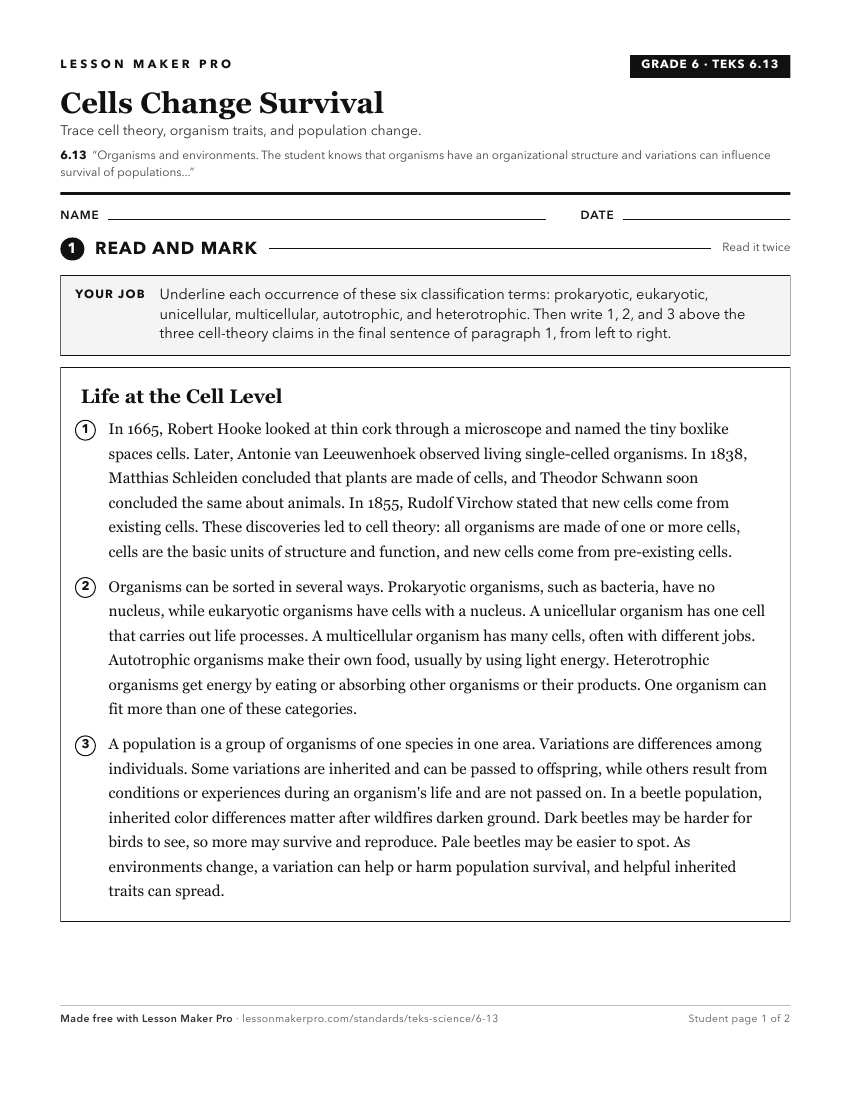
A ready-to-print activity worksheet aligned to 6.13, with an answer key for the teacher on its own page. No account needed.
PDF, US Letter, prints cleanly in black and white.
Download the worksheetKeep exploring
Related Standards
- 2.13
Organisms and environments. The student knows that organisms have structures and undergo processes that help them interact and survive within their environments...
- 5.13
Organisms and environments. The student knows that organisms undergo similar life processes and have structures and behaviors that help them survive within thei...
- 3.13
Organisms and environments. The student knows that organisms undergo similar life processes and have structures that function to help them survive within their ...
- 4.13
Organisms and environments. The student knows that organisms undergo similar life processes and have structures that function to help them survive within their ...
Turn this cluster into a lesson
Grade, subject, topic, and the complete cluster are prefilled. Create one free, no account needed.
Also for this cluster:Make a WorksheetMake a QuizMake a Sub Lesson