Texas TEKS 6.13.A
The Standard
- 6.13
- Organisms and environments. The student knows that organisms have an organizational structure and variations can influence survival of populations. The student is expected to:
describe the historical development of cell theory and explain how organisms are composed of one or more cells, which come from pre-existing cells and are the basic unit of structure and function
Texas Essential Knowledge and Skills for Science
Teacher's field guide
What This Standard Means
What Students Need to Do
- Students trace how microscope observations and evidence from several scientists shaped cell theory over time. They explain how cells relate to an organism's body, life processes, growth, and reproduction.
What Mastery Looks Like
- Students place Hooke, Leeuwenhoek, Schleiden, Schwann, and Virchow in a reasonable sequence and match each scientist to key evidence. They use cell theory to explain examples involving plants, animals, microorganisms, growth, and healing.
Common Misconceptions
- Students may think Hooke saw living cells or developed the entire theory alone. They may think only animals have cells, or that cells can appear from nonliving material. Some confuse cells with atoms, tissues, or organs.
How to Assess It
- Give an exit ticket with three scientist evidence cards to sequence, then ask: How does a cut heal without new cells appearing from nothing?
Lesson moves
Ways to Teach It
Examine prepared cork, onion, animal tissue, and bacteria slides, then sketch the cells and note similarities and differences.
Write a claim explaining why cell theory changed over time, using evidence from at least three scientists.
Run a timeline relay where teams match scientist cards, observation cards, and dates, then correct one mismatched set.
Use wound healing photos to explain how cell division produces new cells that repair damaged tissue.
Free download
Printable 6.13.A Worksheet
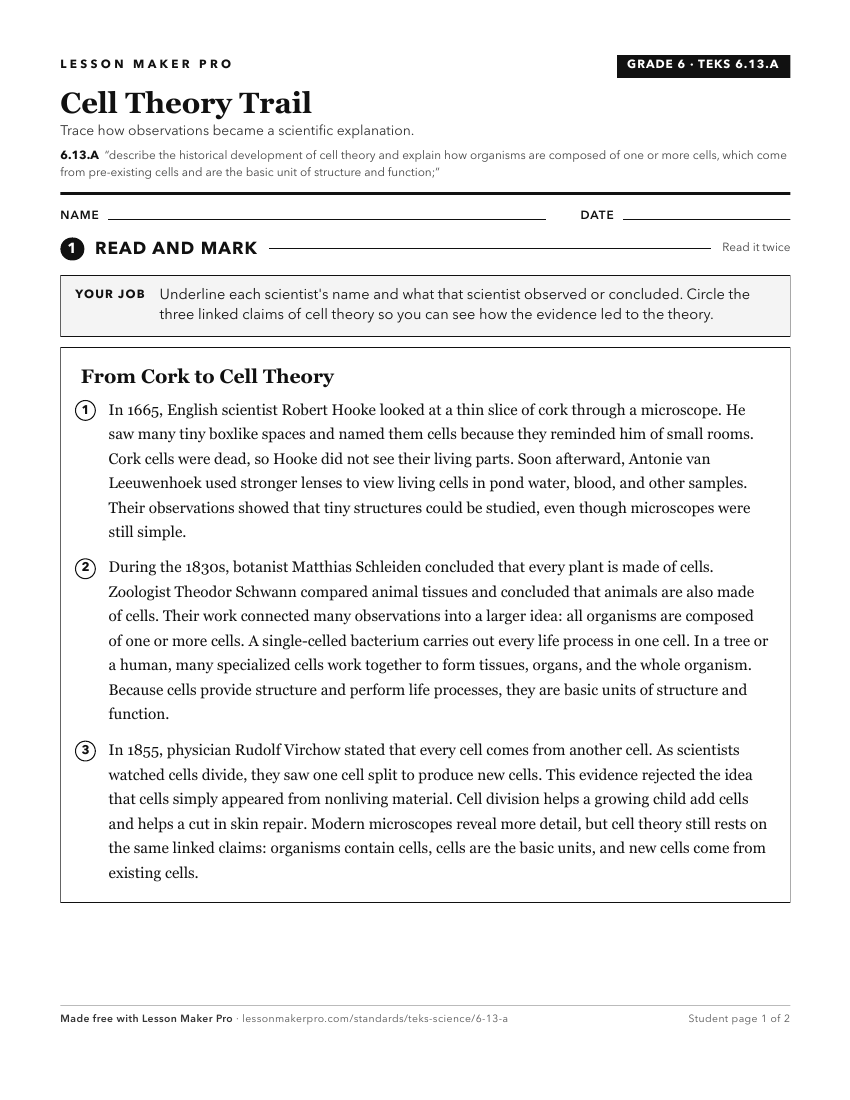
A ready-to-print activity worksheet aligned to 6.13.A, with an answer key for the teacher on its own page. No account needed.
PDF, US Letter, prints cleanly in black and white.
Download the worksheetKeep exploring
Related Standards
- 7.13.B
describe the hierarchical organization of cells, tissues, organs, and organ systems within plants and animals
- 4.5.F
explain the relationship between the structure and function of objects, organisms, and systems
- 5.5.F
explain the relationship between the structure and function of objects, organisms, and systems
- 3.5.F
explain the relationship between the structure and function of objects, organisms, and systems
Turn this exact standard into a lesson
Grade, subject, topic, and the complete standard are prefilled. Create one free, no account needed.
Also for this standard:Make a WorksheetMake a QuizMake a Sub Lesson