Texas TEKS 5.13.B
The Standard
- 5.13
- Organisms and environments. The student knows that organisms undergo similar life processes and have structures and behaviors that help them survive within their environments. The student is expected to:
explain how instinctual behavioral traits such as turtle hatchlings returning to the sea and learned behavioral traits such as orcas hunting in packs increase chances of survival.
Texas Essential Knowledge and Skills for Science
Teacher's field guide
What This Standard Means
What Students Need to Do
- Students sort animal behaviors into instincts present without teaching and learned traits gained through experience or observation. They explain how each behavior helps an animal find food, avoid danger, or reproduce.
What Mastery Looks Like
- Given a new animal example, students correctly identify the behavior as instinctual or learned. They use a clear cause-and-effect statement to connect the behavior to survival.
Common Misconceptions
- Students may confuse a behavior with a body structure, such as calling claws an instinct. They may think learned behaviors must be taught by humans. They may name the behavior type without explaining its survival benefit.
How to Assess It
- Give students two cases: a spider spins a web without being shown, and a wolf pup improves hunting by watching adults. Ask them to classify each behavior and explain how it supports survival.
Lesson moves
Ways to Teach It
Have pairs sort animal behavior cards into instinctual and learned groups, then match each card to a food, safety, or reproduction benefit.
Ask students to write: How could the same animal use both instinctual and learned behaviors to survive?
Play Behavior Detective: teams draw scenario cards, classify each behavior, and earn a point for explaining its survival benefit.
Have students observe a pet or local bird, record one behavior, and identify evidence that it may be instinctual or learned.
Free download
Printable 5.13.B Worksheet
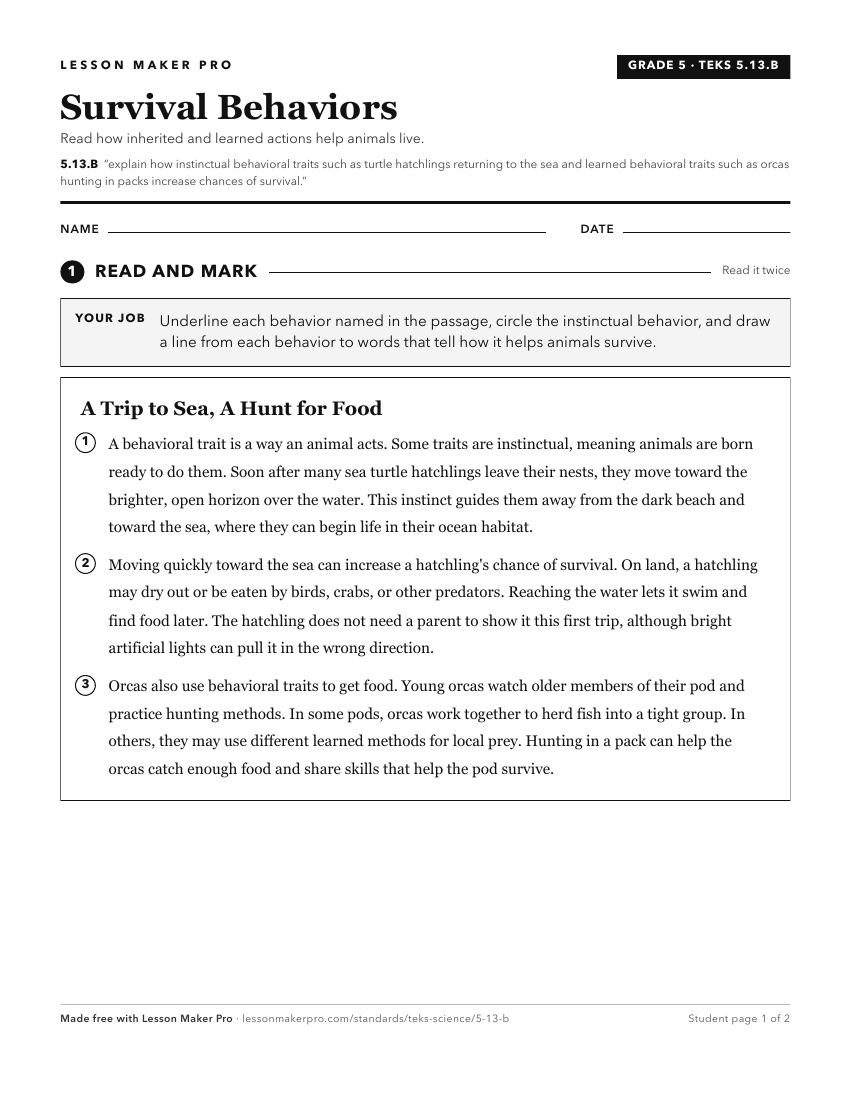
A ready-to-print activity worksheet aligned to 5.13.B, with an answer key for the teacher on its own page. No account needed.
PDF, US Letter, prints cleanly in black and white.
Download the worksheetKeep exploring
Related Standards
- 3.12.C
describe how natural changes to the environment such as floods and droughts cause some organisms to thrive and others to perish or move to new locations
- 2.13.C
record and compare how being part of a group helps animals obtain food, defend themselves, and cope with changes
- 3.13.A
explore and explain how external structures and functions of animals such as the neck of a giraffe or webbed feet on a duck enable them to survive in their envi...
- 8.13.C
describe how variations of traits within a population lead to structural, behavioral, and physiological adaptations that influence the likelihood of survival an...
Turn this exact standard into a lesson
Grade, subject, topic, and the complete standard are prefilled. Create one free, no account needed.
Also for this standard:Make a WorksheetMake a QuizMake a Sub Lesson