Texas TEKS 7.13.A
The Standard
- 7.13
- Organisms and environments. The student knows how systems are organized and function to support the health of an organism and how traits are inherited. The student is expected to:
identify and model the main functions of the systems of the human organism, including the circulatory, respiratory, skeletal, muscular, digestive, urinary, reproductive, integumentary, nervous, immune, and endocrine systems
Texas Essential Knowledge and Skills for Science
Teacher's field guide
What This Standard Means
What Students Need to Do
- Students name the major body systems and explain the main job of each one. They use diagrams, body maps, or flow models to show how each system works.
What Mastery Looks Like
- A student can match all 12 systems with their main functions. Their model uses accurate labels and arrows to show how organs or materials work together within a system.
Common Misconceptions
- Students often say the digestive system removes all body wastes, confusing feces with wastes filtered from blood by the urinary system. They may place each organ in only one system or confuse nerve signals with hormone messages.
How to Assess It
- Give students 11 system cards and 11 function cards to match. Students show mastery by matching all 11 systems with their main functions, then sketching one labeled model showing how a chosen system performs its job.
Lesson moves
Ways to Teach It
Give pairs tracing-paper body outlines; assign four systems per layer, then add organ labels, arrows, and a one-line function for each.
Ask students to write: Which three body systems work hardest during a sprint, and what does each contribute?
Use organ, system, and function cards for a timed team sort; teams earn a point only when all three cards match.
Have students trace a sandwich and glass of water through a body outline, marking where digestive, circulatory, and urinary systems act.
Free download
Printable 7.13.A Worksheet
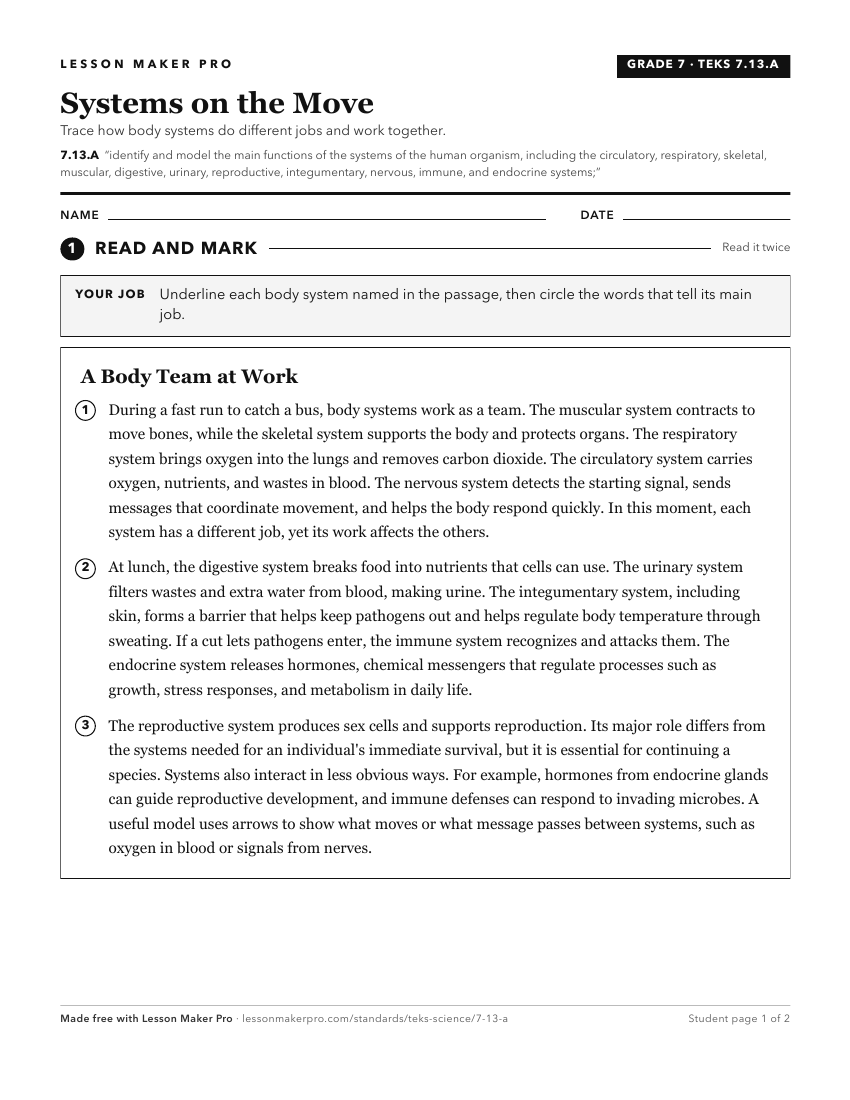
A ready-to-print activity worksheet aligned to 7.13.A, with an answer key for the teacher on its own page. No account needed.
PDF, US Letter, prints cleanly in black and white.
Download the worksheetKeep exploring
Related Standards
- 6.5.D
examine and model the parts of a system and their interdependence in the function of the system
- 4.5.D
examine and model the parts of a system and their interdependence in the function of the system
- 7.5.D
examine and model the parts of a system and their interdependence in the function of the system
- 3.5.D
examine and model the parts of a system and their interdependence in the function of the system
Turn this exact standard into a lesson
Grade, subject, topic, and the complete standard are prefilled. Create one free, no account needed.
Also for this standard:Make a WorksheetMake a QuizMake a Sub Lesson