Texas TEKS 8.13.A
The Standard
- 8.13
- The student knows how cell functions support the health of an organism and how adaptation and variation relate to survival
identify the function of the cell membrane, cell wall, nucleus, ribosomes, cytoplasm, mitochondria, chloroplasts, and vacuoles in plant or animal cells
Texas Essential Knowledge and Skills for Science
Teacher's field guide
What This Standard Means
What Students Need to Do
- Students identify major cell structures in plant and animal cell diagrams. They match each structure to its job and explain how it helps the cell survive.
What Mastery Looks Like
- A student can label the eight structures and describe each function without relying on a word bank. The student can also compare plant and animal cells accurately.
Common Misconceptions
- Students often confuse the cell wall with the cell membrane and think plant cells lack mitochondria. They may say chloroplasts create energy rather than capture light to make sugar.
How to Assess It
- Give students an unlabeled plant cell and animal cell diagram. Ask them to label four assigned structures and write one accurate function for each.
Lesson moves
Ways to Teach It
Build plant and animal cell models with clay, then attach function labels and explain why each organelle belongs.
Write a claim predicting what would happen if the membrane, ribosomes, or mitochondria stopped working, using each organelle’s function as evidence.
Play an organelle relay where teams race to match eight structure cards, function cards, and plant or animal cell diagrams.
Compare firm and wilted celery stalks, then connect water storage in plant vacuoles to the difference in stiffness.
Free download
Printable 8.13.A Worksheet
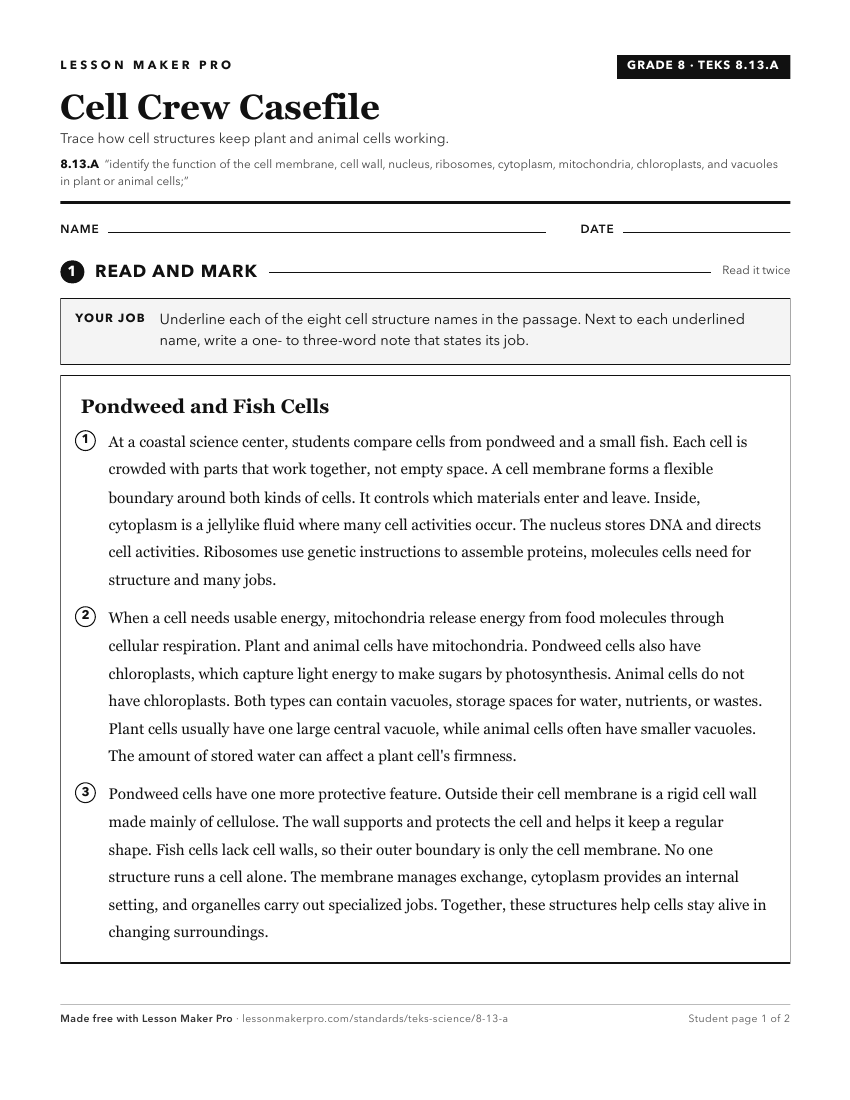
A ready-to-print activity worksheet aligned to 8.13.A, with an answer key for the teacher on its own page. No account needed.
PDF, US Letter, prints cleanly in black and white.
Download the worksheetKeep exploring
Related Standards
- 7.13.B
describe the hierarchical organization of cells, tissues, organs, and organ systems within plants and animals
- K.13.A
identify the structures of plants, including roots, stems, leaves, flowers, and fruits
- 2.13.A
identify the roots, stems, leaves, flowers, fruits, and seeds of plants and compare how those structures help different plants meet their basic needs for surviv...
- 6.13.B
identify and compare the basic characteristics of organisms, including prokaryotic and eukaryotic, unicellular and multicellular, and autotrophic and heterotrop...
Turn this exact standard into a lesson
Grade, subject, topic, and the complete standard are prefilled. Create one free, no account needed.
Also for this standard:Make a WorksheetMake a QuizMake a Sub Lesson