Texas TEKS 8.13.B
The Standard
- 8.13
- The student knows how cell functions support the health of an organism and how adaptation and variation relate to survival
describe the function of genes within chromosomes in determining inherited traits of offspring
Texas Essential Knowledge and Skills for Science
Teacher's field guide
What This Standard Means
What Students Need to Do
- Explain that genes are sections of DNA carried on chromosomes and contain instructions that influence traits. Trace gene versions from each parent to a fictional offspring and connect them to possible traits.
What Mastery Looks Like
- Given a chromosome diagram, a student can identify a gene as one segment rather than the whole chromosome. The student can explain how gene versions from both parents produce similarities and differences among offspring.
Common Misconceptions
- Students may use gene, DNA, chromosome, and trait as if they mean the same thing. They may think one chromosome controls one trait or that offspring receive traits from only one parent. They may also think genes always guarantee a trait, even when several genes or environmental factors are involved.
How to Assess It
- Exit ticket: Draw a chromosome pair, mark one gene at matching locations, and write two sentences explaining how versions from both parents can affect fur color.
Lesson moves
Ways to Teach It
Build chromosome models from paper strips, mark matching gene locations, then combine one strip from each parent to predict a fictional offspring trait.
Write: How can siblings have different traits even though they share the same parents? Use gene versions and chromosome inheritance in your answer.
Play a card sort matching gene cards to chromosome locations, parent pairs, and possible offspring traits, then justify each match.
Compare photos of puppies from one litter and explain how inherited gene versions can produce differences in coat color or texture.
Free download
Printable 8.13.B Worksheet
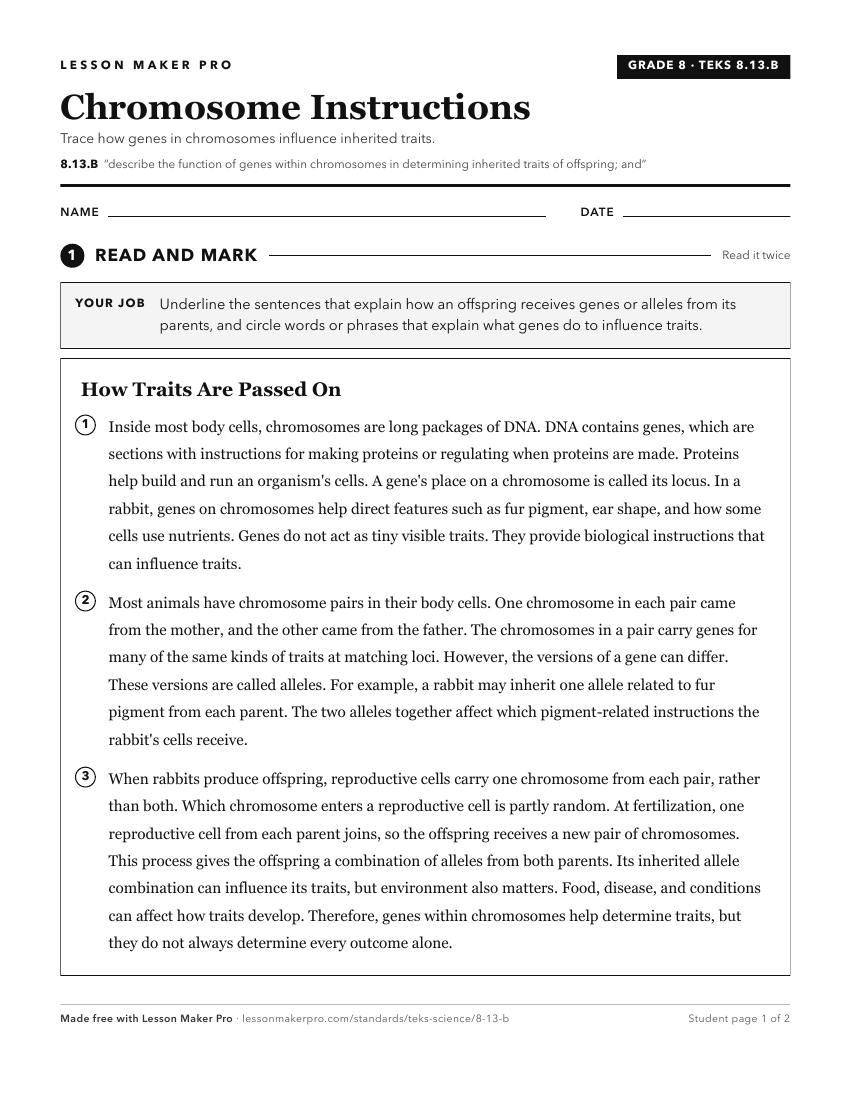
A ready-to-print activity worksheet aligned to 8.13.B, with an answer key for the teacher on its own page. No account needed.
PDF, US Letter, prints cleanly in black and white.
Download the worksheetKeep exploring
Related Standards
- 7.13.D
describe and give examples of how natural and artificial selection change the occurrence of traits in a population over generations.
- 4.13.B
differentiate between inherited and acquired physical traits of organisms.
- 1.13.C
compare ways that young animals resemble their parents.
- 8.13.C
describe how variations of traits within a population lead to structural, behavioral, and physiological adaptations that influence the likelihood of survival an...
Turn this exact standard into a lesson
Grade, subject, topic, and the complete standard are prefilled. Create one free, no account needed.
Also for this standard:Make a WorksheetMake a QuizMake a Sub Lesson