Texas TEKS 7.8
TEKS Knowledge Statement (Expectation Cluster)
Force, motion, and energy. The student understands the behavior of thermal energy as it flows into and out of systems. The student is expected to: investigate methods of thermal energy transfer into and out of systems, including conduction, convection, and radiation; investigate how thermal energy moves in a predictable pattern from warmer to cooler until all substances within the system reach thermal equilibrium; and explain the relationship between temperature and the kinetic energy of the particles within a substance.
Texas Essential Knowledge and Skills for Science
Cluster contents
Student Expectations in This Statement
7.8 is a TEKS knowledge and skills statement. These are the student expectations under it.
- 7.8.A
investigate methods of thermal energy transfer into and out of systems, including conduction, convection, and radiation
- 7.8.B
investigate how thermal energy moves in a predictable pattern from warmer to cooler until all substances within the system reach thermal equilibrium
- 7.8.C
explain the relationship between temperature and the kinetic energy of the particles within a substance.
Teacher's field guide
What This Cluster Means
What Students Need to Do
- Students test how thermal energy moves by conduction, convection, and radiation. They trace energy from warmer matter to cooler matter until temperatures become equal. They connect higher temperature with faster average particle motion.
What Mastery Looks Like
- Given a setup or diagram, students identify the transfer method and support the choice with observed evidence. They draw energy arrows in the correct direction and predict thermal equilibrium. They explain temperature changes using particle kinetic energy.
Common Misconceptions
- Students may treat cold as something that flows or draw thermal energy moving from cooler to warmer. They may confuse convection with any movement and think radiation needs matter. Some assume particles get larger or stop moving at thermal equilibrium.
How to Assess It
- Exit ticket: On a diagram of a pot heating under a lamp, label conduction, convection, and radiation and add energy arrows. Explain what happens to particle motion after heating stops.
Lesson moves
Ways to Teach It
Run three stations: touch a metal spoon in warm water, observe dyed convection in heated water, and feel lamp warmth without contact.
Write: Why does a hot drink cool on a desk, and what happens to particle motion in the drink and air?
Sort scenario cards by conduction, convection, or radiation, then place arrows from warmer objects to cooler objects.
Compare an insulated lunch bag, a metal bottle, and a reflective emergency blanket, then explain which transfer method each limits.
Free download
Printable 7.8 Worksheet
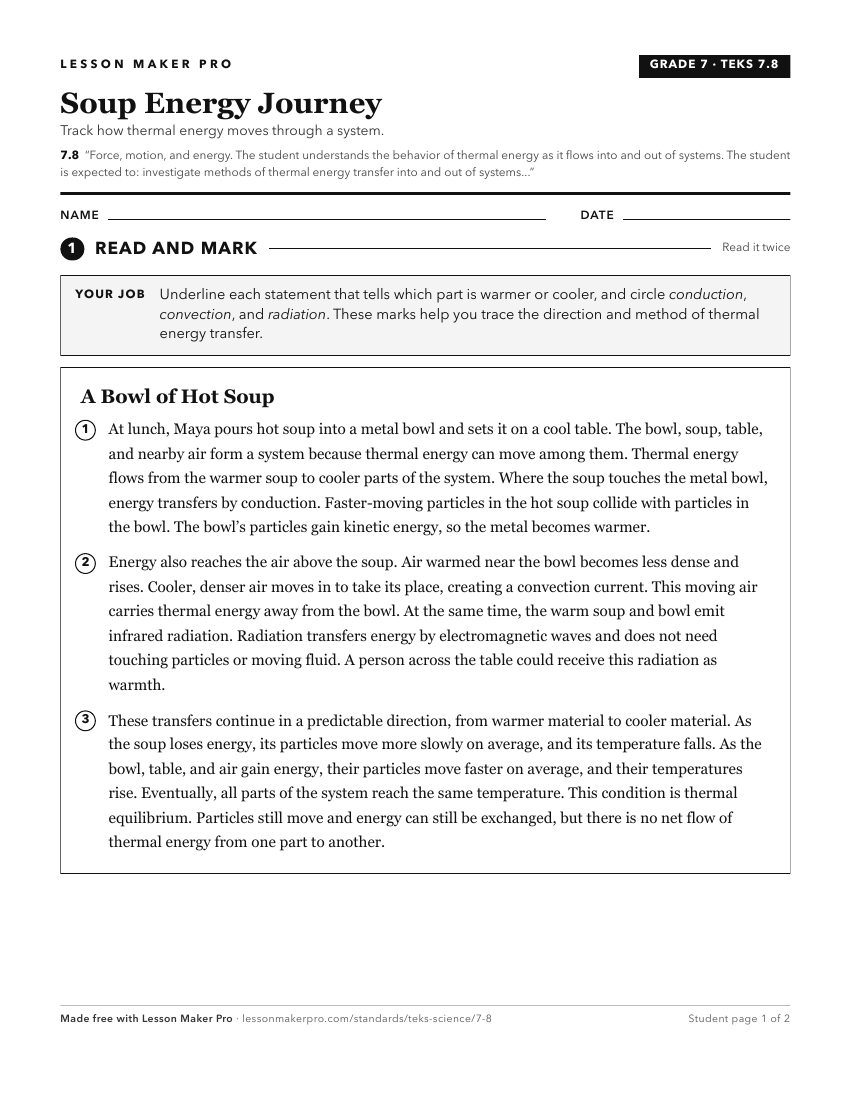
A ready-to-print activity worksheet aligned to 7.8, with an answer key for the teacher on its own page. No account needed.
PDF, US Letter, prints cleanly in black and white.
Download the worksheetKeep exploring
Related Standards
- 3.8
Force, motion, and energy. The student knows that energy is everywhere and can be observed in cycles, patterns, and systems. The student is expected to:
- 3.7
Force, motion, and energy. The student knows the nature of forces and the patterns of their interactions. The student is expected to:
- 4.8
Force, motion, and energy. The student knows that energy is everywhere and can be observed in cycles, patterns, and systems. The student is expected to:
- 5.8
Force, motion, and energy. The student knows that energy is everywhere and can be observed in cycles, patterns, and systems. The student is expected to:
Turn this cluster into a lesson
Grade, subject, topic, and the complete cluster are prefilled. Create one free, no account needed.
Also for this cluster:Make a WorksheetMake a QuizMake a Sub Lesson