Texas TEKS 7.8.C
The Standard
- 7.8
- Force, motion, and energy. The student understands the behavior of thermal energy as it flows into and out of systems. The student is expected to:
explain the relationship between temperature and the kinetic energy of the particles within a substance.
Texas Essential Knowledge and Skills for Science
Teacher's field guide
What This Standard Means
What Students Need to Do
- Students use particle models to show that warmer particles move faster on average and cooler particles move slower. They connect changes in temperature to changes in average kinetic energy.
What Mastery Looks Like
- Given two samples, students can identify which has greater average particle motion from temperature data or particle diagrams. They can explain their choice using average kinetic energy.
Common Misconceptions
- Students may think heating makes particles larger rather than making them move faster. They may confuse temperature with total energy or assume every particle in a sample moves at the same speed.
How to Assess It
- Exit ticket: Draw five particles in water at 10°C and five in water at 60°C, using arrows to show motion. Explain the difference in one sentence.
Lesson moves
Ways to Teach It
Place one drop of food coloring in warm and ice water, time the spreading, and explain the difference using particle motion.
Draw particle diagrams for hot and cold water, then explain how arrow length represents average kinetic energy.
Sort temperature cards and particle motion diagrams into matches, then earn a point for each correct explanation using average kinetic energy.
Explain how a refrigerator changes the average kinetic energy of particles in food, using before and after particle sketches.
Free download
Printable 7.8.C Worksheet
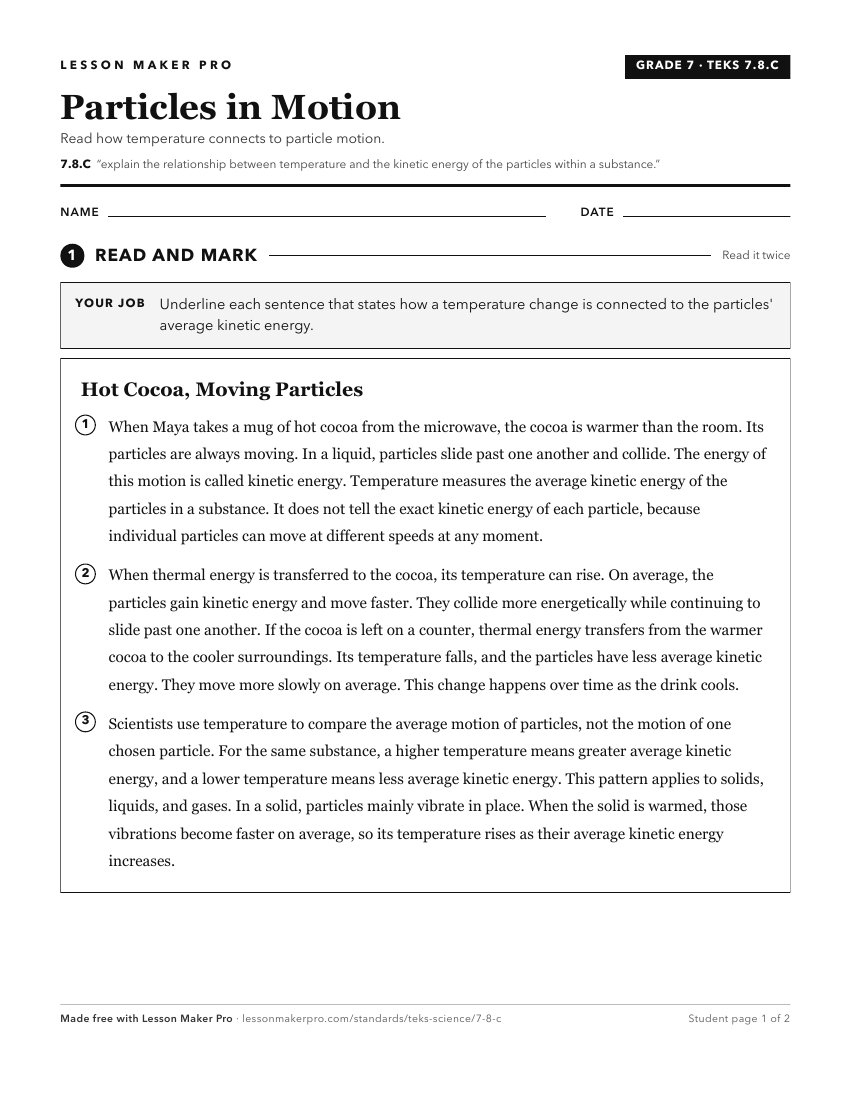
A ready-to-print activity worksheet aligned to 7.8.C, with an answer key for the teacher on its own page. No account needed.
PDF, US Letter, prints cleanly in black and white.
Download the worksheetKeep exploring
Related Standards
- 6.6.A
compare solids, liquids, and gases in terms of their structure, shape, volume, and kinetic energy of atoms and molecules
- 7.8.B
investigate how thermal energy moves in a predictable pattern from warmer to cooler until all substances within the system reach thermal equilibrium
- 6.8.A
compare and contrast gravitational, elastic, and chemical potential energies with kinetic energy
- 7.8
Force, motion, and energy. The student understands the behavior of thermal energy as it flows into and out of systems. The student is expected to:
Turn this exact standard into a lesson
Grade, subject, topic, and the complete standard are prefilled. Create one free, no account needed.
Also for this standard:Make a WorksheetMake a QuizMake a Sub Lesson