TEKS ELAR 1.6
Knowledge and Skills Statement (Standard Cluster)
The student uses metacognitive skills to both develop and deepen comprehension of increasingly complex texts.
Texas Essential Knowledge and Skills for English Language Arts and Reading
Cluster contents
Student Expectations in This Statement
1.6 is a knowledge and skills statement. These are the student expectations under it.
- 1.6.A
establish purpose for reading assigned and self-selected texts with adult assistance
- 1.6.B
generate questions about text before, during, and after reading to deepen understanding and gain information with adult assistance
- 1.6.C
make, correct, or confirm predictions using text features, characteristics of genre, and structures with adult assistance
- 1.6.D
create mental images to deepen understanding with adult assistance
- 1.6.E
make connections to personal experiences, ideas in other texts, and society with adult assistance
- 1.6.F
make inferences and use evidence to support understanding with adult assistance
- 1.6.G
evaluate details to determine what is most important with adult assistance
- 1.6.H
synthesize information to create new understanding with adult assistance
- 1.6.I
monitor comprehension and make adjustments such as re-reading, using background knowledge, checking for visual cues, and asking questions when understanding bre...
Teacher's field guide
What This Cluster Means
What Students Need to Do
- Students set a reason for reading and ask questions before, during, and after. They predict, picture, connect, infer, identify key details, combine ideas, and fix confusion using clues and rereading.
What Mastery Looks Like
- With a brief teacher prompt, students can state their reading purpose, ask a useful question, and support a prediction or inference with evidence. They notice confusion and choose a helpful strategy, such as rereading, checking a picture, or using what they already know.
Common Misconceptions
- Students may treat every detail as equally important or make predictions based on guesses instead of text clues. They may share unrelated personal connections or make inferences without evidence. When confused, they may keep reading without rereading, checking pictures, or asking a question.
How to Assess It
- Give students a short illustrated passage. Ask them to draw what they pictured, make one prediction with evidence, circle the key detail, and name a strategy for confusion.
Lesson moves
Ways to Teach It
Give pairs picture cards from a short story to sequence, then have them point to the card that supports an inference.
Ask, “What changed in your thinking after reading, and which word or picture caused the change?”
Play Stop and Fix: pause during a read-aloud, name a confusing part, and let students choose reread, inspect pictures, or ask.
Read a school lunch menu and ask students to identify its purpose, key information, and one question they still have.
Free download
Printable 1.6 Worksheet
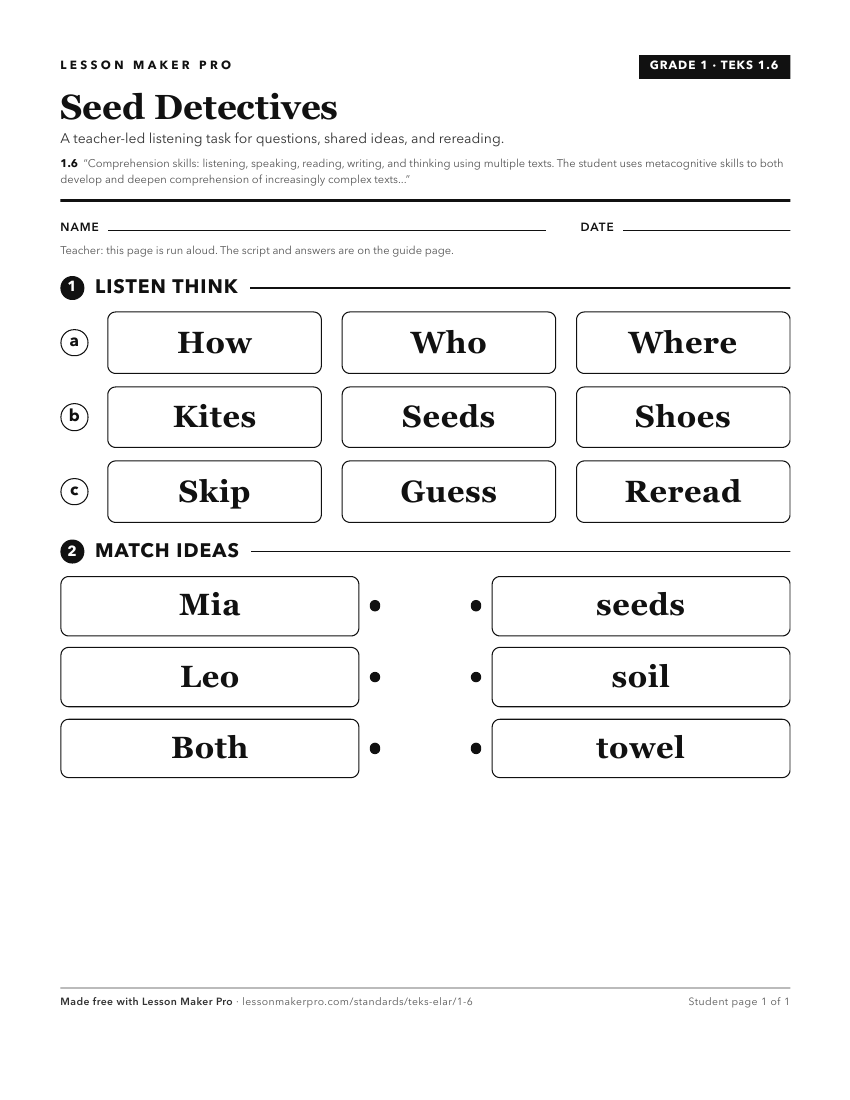
A ready-to-print activity worksheet aligned to 1.6, with an answer key for the teacher on its own page. No account needed.
PDF, US Letter, prints cleanly in black and white.
Download the worksheetKeep exploring
Related Standards
Turn this cluster into a lesson
Grade, subject, topic, and the complete cluster are prefilled. Create one free, no account needed.
Also for this cluster:Make a WorksheetMake a QuizMake a Sub Lesson