TEKS ELAR 1.6.E
The Standard
make connections to personal experiences, ideas in other texts, and society with adult assistance
Texas Essential Knowledge and Skills for English Language Arts and Reading
Teacher's field guide
What This Standard Means
What Students Need to Do
- Students connect parts of a text to their own lives, another book, or events and ideas beyond school. With prompts, they tell how the connection helps them understand.
What Mastery Looks Like
- With a teacher prompt, the student gives a relevant connection for each type and points to a matching detail in the text. The student explains how one connection helped them understand an event, character, or idea.
Common Misconceptions
- Students may name a memory that has little to do with the text. They may retell the story instead of making a connection. They may confuse another book connection with a real-world connection.
How to Assess It
- After a read-aloud, give students three boxes labeled My Life, Another Book, and Our World. Have them draw one connection in each box and explain one aloud.
Lesson moves
Ways to Teach It
Create three hoops labeled My Life, Another Book, and Our World, then place student-drawn connection cards into the matching hoop.
Ask, “What did this part remind you of, and how does that connection help you understand the story?”
Play Connection Match by pairing story event cards with personal, book, or world connection cards and explaining each match.
Read a school announcement, then connect its message to a character’s problem, a class experience, and something happening in the community.
Free download
Printable 1.6.E Worksheet
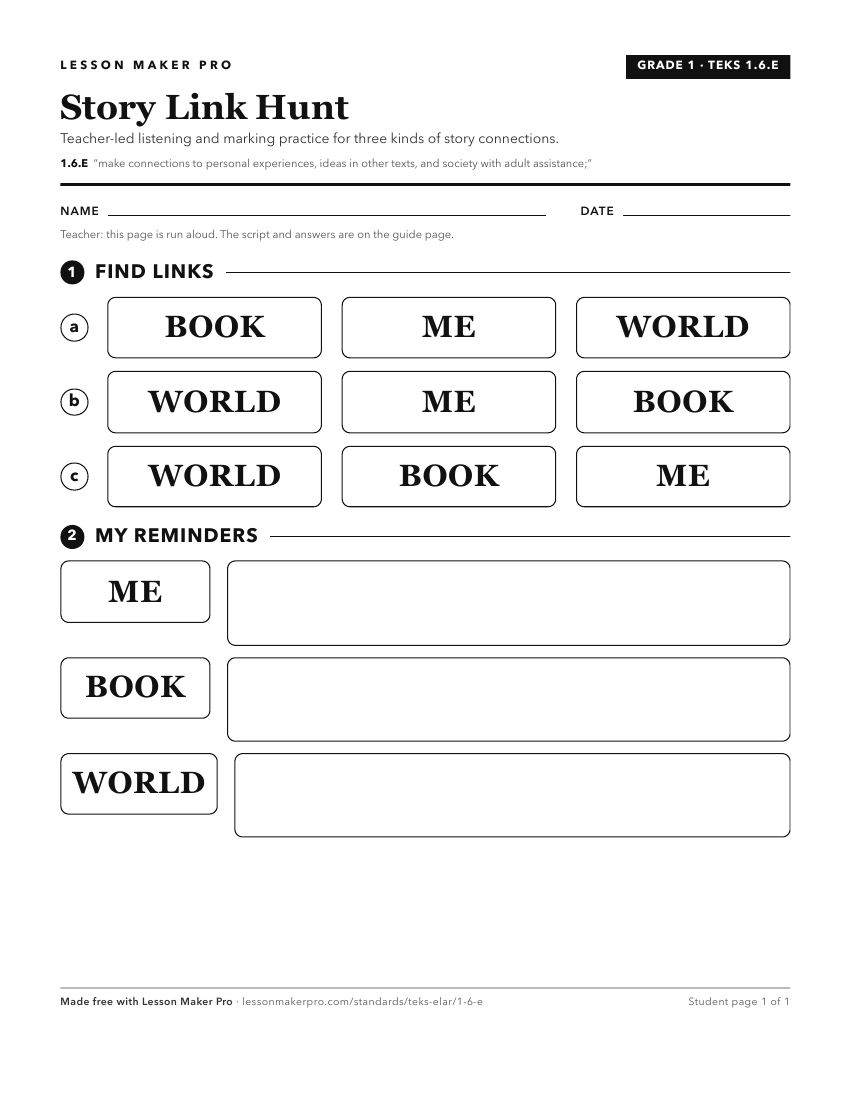
A ready-to-print activity worksheet aligned to 1.6.E, with an answer key for the teacher on its own page. No account needed.
PDF, US Letter, prints cleanly in black and white.
Download the worksheetKeep exploring
Related Standards
Turn this exact standard into a lesson
Grade, subject, topic, and the complete standard are prefilled. Create one free, no account needed.
Also for this standard:Make a WorksheetMake a QuizMake a Sub Lesson