TEKS ELAR 1.6.I
The Standard
monitor comprehension and make adjustments such as re-reading, using background knowledge, checking for visual cues, and asking questions when understanding breaks down.
Texas Essential Knowledge and Skills for English Language Arts and Reading
Teacher's field guide
What This Standard Means
What Students Need to Do
- Students notice when a word, sentence, or event does not make sense. They pause, reread, study pictures, think about what they know, or ask a focused question.
What Mastery Looks Like
- A student can point to the exact word, sentence, or event that caused confusion. The student chooses a useful action and explains how it cleared up the meaning.
Common Misconceptions
- Students may keep reading even when the text stops making sense. They may guess from the picture alone, reread without thinking, or ask a question unrelated to the confusing part.
How to Assess It
- Give students a four-sentence passage with one unfamiliar word and a supporting picture. Ask them to mark where they became confused and name the action that helped.
Lesson moves
Ways to Teach It
Give pairs a short picture book and sticky notes; students mark a confusing page, then reread or inspect the picture to solve it.
After reading, ask, "Where did the story stop making sense, which clue helped, and what makes sense now?"
Play Fix-Up Match: students pair confusion cards with strategy cards, then explain which strategy would help and why.
Follow a simple recipe; students stop at an unclear step, study the photo or earlier steps, and ask a useful question.
Free download
Printable 1.6.I Worksheet
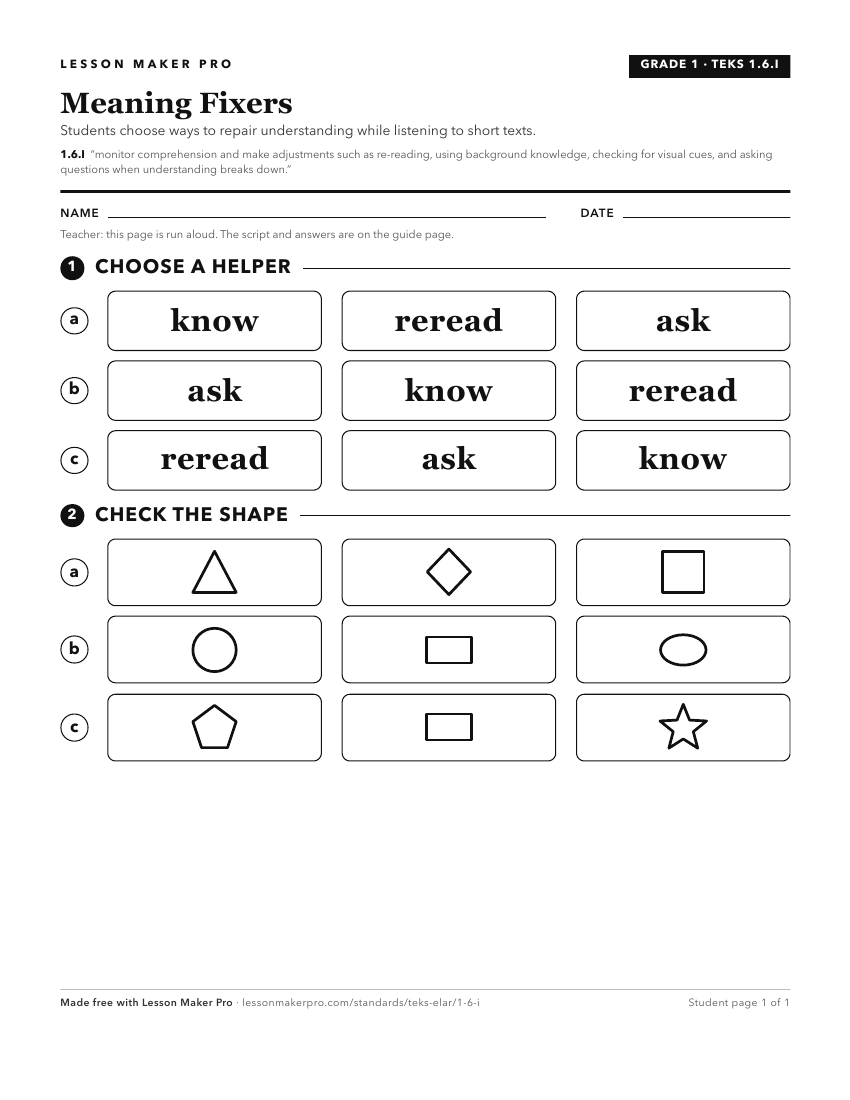
A ready-to-print activity worksheet aligned to 1.6.I, with an answer key for the teacher on its own page. No account needed.
PDF, US Letter, prints cleanly in black and white.
Download the worksheetKeep exploring
Related Standards
- 2.6.I
The 2nd Grade version of this standard.
- 6.5.I
monitor comprehension and make adjustments such as re-reading, using background knowledge, asking questions, and annotating when understanding breaks down.
- 5.6.I
monitor comprehension and make adjustments such as re-reading, using background knowledge, asking questions, and annotating when understanding breaks down.
- 4.6.I
monitor comprehension and make adjustments such as re-reading, using background knowledge, asking questions, and annotating when understanding breaks down.
Turn this exact standard into a lesson
Grade, subject, topic, and the complete standard are prefilled. Create one free, no account needed.
Also for this standard:Make a WorksheetMake a QuizMake a Sub Lesson