Oklahoma Social Studies USH.P.1
Standard Cluster
Apply critical thinking skills to address authentic civic issues. Demonstrate an understanding of the virtue of civil discourse to analyze and address real-world problems. Evaluate the impact of perspectives, civil discourse, and democratic principles on addressing civic issues. Engage in a range of deliberative and democratic processes to develop strategies to address authentic, real-world problems in community and out-of-school contexts. Gather and evaluate information regarding complex problems, assessing individual and collective actions taken to address them. Develop practices which demonstrate an understanding that social studies involves the evaluation of evidence. Develop, investigate, and evaluate plausible answers to essential questions that reflect enduring understandings across time, real world circumstances, and social studies disciplines. Evaluate points of agreement and disagreement from reliable information and expert interpretations used to answer supporting questions related to content knowledge. Reinforce critical thinking by evaluating and challenging ideas and assumptions, analyzing and explaining inconsistencies in reasoning. Demonstrate understanding of content through the development of self-driven inquiries and the completion of multi-staged, authentic tasks and assessments.
Oklahoma Academic Standards for Social Studies (2026)
Cluster contents
Standards in This Cluster
USH.P.1 is a cluster heading. These are the individual standards under it.
- USH.P.1.1
Demonstrate an understanding of the virtue of civil discourse to analyze and address real- world problems.
- USH.P.1.1.A
Evaluate the impact of perspectives, civil discourse, and democratic principles on addressing civic issues.
- USH.P.1.1.B
Engage in a range of deliberative and democratic processes to develop strategies to address authentic, real-world problems in community and out-of-school contex...
- USH.P.1.1.C
Gather and evaluate information regarding complex problems, assessing individual and collective actions taken to address them.
- USH.P.1.2
Develop practices which demonstrate an understanding that social studies involves the evaluation of evidence.
- USH.P.1.2.A
Develop, investigate, and evaluate plausible answers to essential questions that reflect enduring understandings across time, real world circumstances, and soci...
- USH.P.1.2.B
Evaluate points of agreement and disagreement from reliable information and expert interpretations used to answer supporting questions related to content knowle...
- USH.P.1.2.C
Reinforce critical thinking by evaluating and challenging ideas and assumptions, analyzing and explaining inconsistencies in reasoning.
- USH.P.1.2.D
Demonstrate understanding of content through the development of self-driven inquiries and the completion of multi-staged, authentic tasks and assessments.
Teacher's field guide
What This Cluster Means
What Students Need to Do
- Students investigate a local problem using records, data, and firsthand accounts. They check claims, compare viewpoints, and discuss possible responses without attacking people.
What Mastery Looks Like
- A student asks a focused question, finds reliable sources, and explains where the evidence agrees or conflicts. They defend a workable proposal, address an opposing concern, and name a tradeoff.
Common Misconceptions
- Students may treat one personal story as proof of a widespread problem or assume an official source cannot be biased. They may think civil discussion means avoiding disagreement or mistake winning a vote for solving the problem.
How to Assess It
- Give students a school-area map, a traffic-count excerpt, and two conflicting comments about a proposed crossing. Ask for a two-sentence council recommendation that cites evidence, addresses one opposing concern, and names what they still need to know.
Lesson moves
Ways to Teach It
Give pairs a printed school-area map and crossing photos; have them mark possible hazards and write one question to check with traffic data.
Hold a five-minute council hearing on a proposed crossing; assign speakers different concerns and require each to cite a provided source.
Give teams three source cards about the crossing; have them rank reliability, trade cards, and challenge one unsupported claim.
Open the next city council agenda; have students draft a 60-second comment on a listed issue, naming one fact they still need.
Free download
Printable USH.P.1 Worksheet
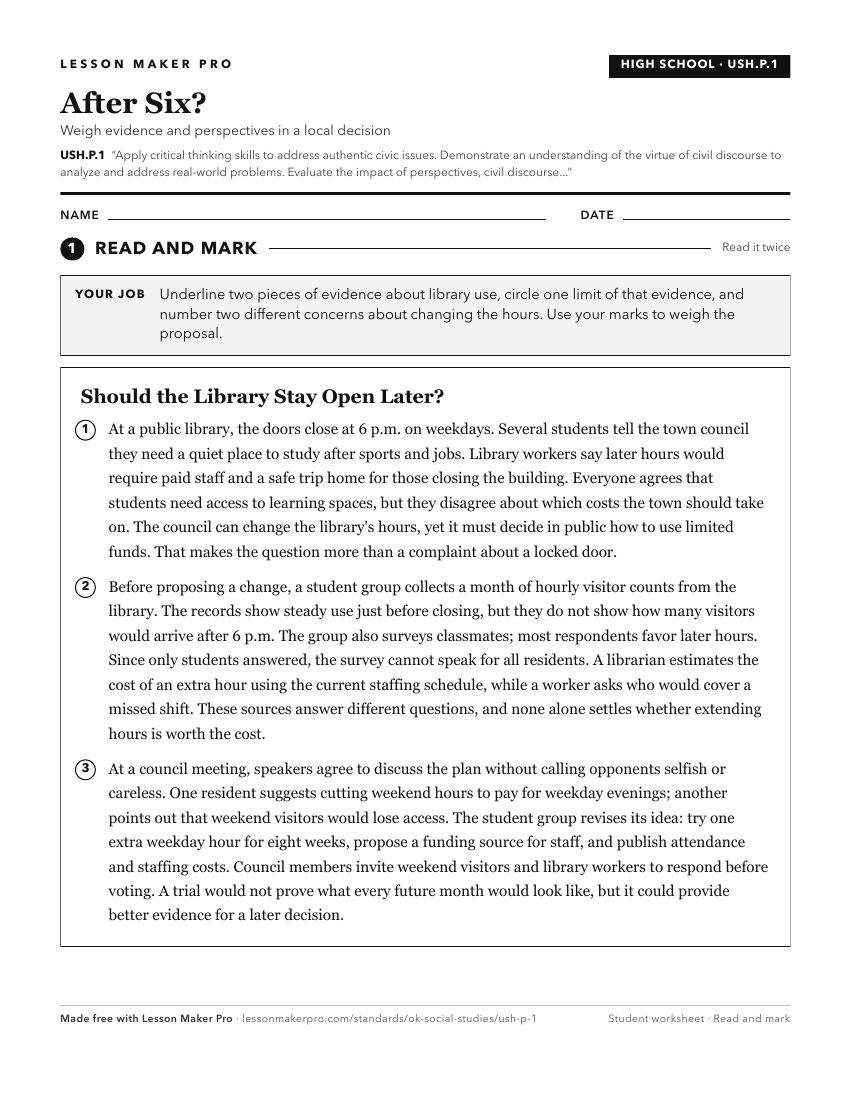
A ready-to-print activity worksheet aligned to USH.P.1, with an answer key for the teacher on its own page. No account needed.
PDF, US Letter, prints cleanly in black and white.
Download the worksheetKeep exploring
Related Standards
Turn this cluster into a lesson
Grade, subject, topic, and the complete cluster are prefilled. Create one free, no account needed.
Also for this cluster:Make a WorksheetMake a QuizMake a Sub Lesson