Oklahoma Social Studies 3.P.1
Standard Cluster
Apply critical thinking skills to address authentic civic issues. Demonstrate an understanding of the virtue of civil discourse to analyze and address real-world problems. Explain how people make decisions in a constitutional republic, using examples from their community and state. Use democratic processes to consider and propose actions to address authentic, real-world problems in the community and state. Describe a range of local and state problems and how communities and local governments are trying to address them. Develop practices which demonstrate an understanding that social studies involves the evaluation of evidence. Ask and respond to enduring essential questions of common concerns to the community and state. Develop responses to supporting questions relevant to specific social studies content knowledge. Reinforce critical thinking skills by regularly asking and responding to levels of open-ended questions. Demonstrate understanding of social studies content through completion of authentic tasks and assessments.
Oklahoma Academic Standards for Social Studies (2026)
Cluster contents
Standards in This Cluster
3.P.1 is a cluster heading. These are the individual standards under it.
- 3.P.1.1
Demonstrate an understanding of the virtue of civil discourse to analyze and address real- world problems.
- 3.P.1.1.A
Explain how people make decisions in a constitutional republic, using examples from their community and state.
- 3.P.1.1.B
Use democratic processes to consider and propose actions to address authentic, real-world problems in the community and state.
- 3.P.1.1.C
Describe a range of local and state problems and how communities and local governments are trying to address them.
- 3.P.1.2
Develop practices which demonstrate an understanding that social studies involves the evaluation of evidence.
- 3.P.1.2.A
Ask and respond to enduring essential questions of common concerns to the community and state.
- 3.P.1.2.B
Develop responses to supporting questions relevant to specific social studies content knowledge.
- 3.P.1.2.C
Reinforce critical thinking skills by regularly asking and responding to levels of open-ended questions.
- 3.P.1.2.D
Demonstrate understanding of social studies content through completion of authentic tasks and assessments.
Teacher's field guide
What This Cluster Means
What Students Need to Do
- Students ask questions about a local or state problem and check counts, maps, or public notices for evidence. They listen to other views and propose a practical response. They explain how voters choose representatives and how those officials make decisions.
What Mastery Looks Like
- A student uses a traffic count to support a safer-crossing proposal and explains how a city council might respond. They weigh another option without insulting its supporters. They can name a state problem, such as road repairs, and explain what state lawmakers could do.
Common Misconceptions
- Some students think a class vote makes a city rule, rather than choosing a proposal to bring to elected officials. Others treat a strong opinion as proof or think respectful disagreement means giving up their own view. They may assume state lawmakers decide every neighborhood problem.
How to Assess It
- Exit ticket: Cars speed near a school. Name evidence to collect, a local official to contact, and a respectful reply to someone who opposes a speed bump. Say how your class could choose between two solutions.
Lesson moves
Ways to Teach It
From a safe spot near the school entrance, tally cars for five minutes and mark busy spots on a printed street map.
Read two short statements about adding a crosswalk, then ask, “Whose concern is missing, and what evidence would help us decide?”
Give pairs evidence cards and opinion cards about a park cleanup; have them sort cards and use evidence to defend one proposal.
Read a printed local council agenda item, then write a two-sentence public comment naming a solution and evidence.
Free download
Printable 3.P.1 Worksheet
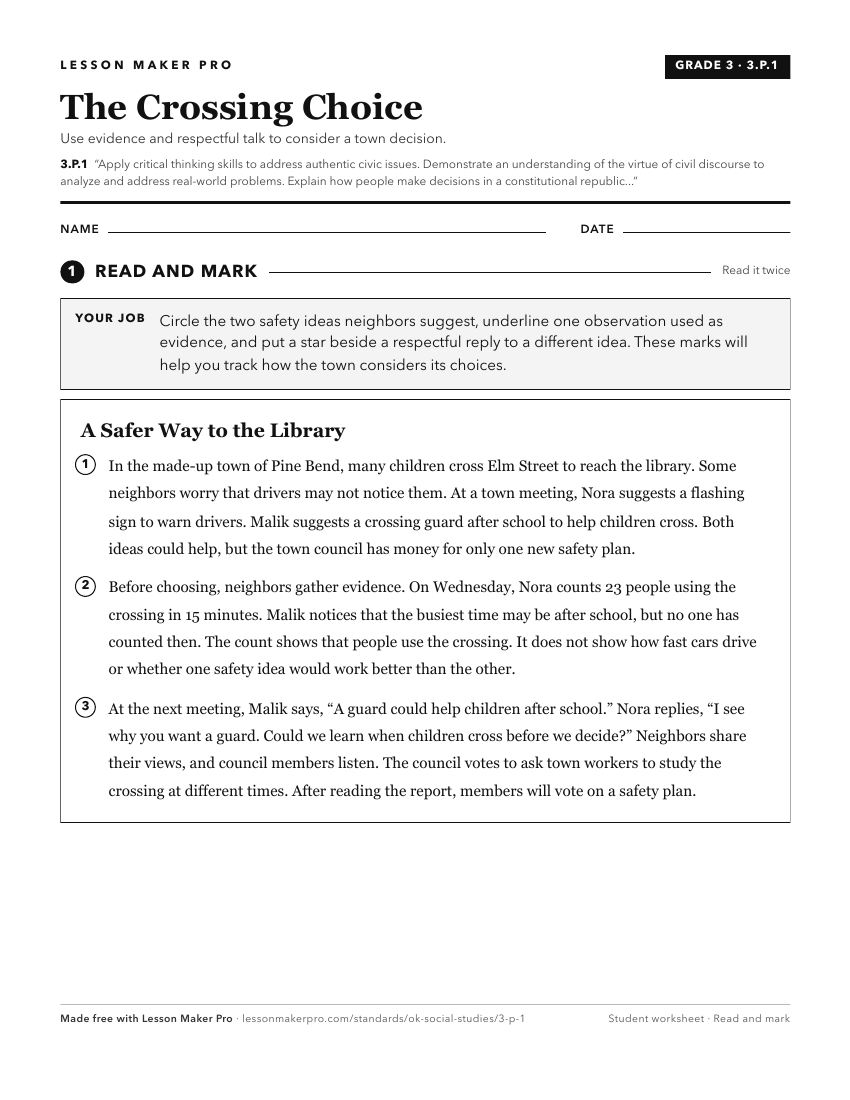
A ready-to-print activity worksheet aligned to 3.P.1, with an answer key for the teacher on its own page. No account needed.
PDF, US Letter, prints cleanly in black and white.
Download the worksheetKeep exploring
Related Standards
Turn this cluster into a lesson
Grade, subject, topic, and the complete cluster are prefilled. Create one free, no account needed.
Also for this cluster:Make a WorksheetMake a QuizMake a Sub Lesson