Oklahoma Social Studies 3.P.1.1
Standard Cluster
- 3.P.1
- Apply critical thinking skills to address authentic civic issues.
Demonstrate an understanding of the virtue of civil discourse to analyze and address real-world problems. Explain how people make decisions in a constitutional republic, using examples from their community and state. Use democratic processes to consider and propose actions to address authentic, real-world problems in the community and state. Describe a range of local and state problems and how communities and local governments are trying to address them.
Oklahoma Academic Standards for Social Studies (2026) · 3.P.1
Cluster contents
Standards in This Cluster
3.P.1.1 is a cluster heading. These are the individual standards under it.
- 3.P.1.1.A
Explain how people make decisions in a constitutional republic, using examples from their community and state.
- 3.P.1.1.B
Use democratic processes to consider and propose actions to address authentic, real-world problems in the community and state.
- 3.P.1.1.C
Describe a range of local and state problems and how communities and local governments are trying to address them.
Teacher's field guide
What This Cluster Means
What Students Need to Do
- Students identify a town or state problem and describe how people and government are trying to solve it. They listen politely, suggest a fix, and vote on a proposal. They explain that voters elect people who make public decisions under the law.
What Mastery Looks Like
- A student can explain why residents might ask a city council about an unsafe crossing, while state lawmakers handle rules for roads across the state. They can give a reason for a fix, respond calmly to another view, and explain that a class vote does not make the city act.
Common Misconceptions
- Students may think a class vote makes a new law or that the mayor decides every problem alone. They may mix up city and state responsibilities, or think disagreement means they should stop listening.
How to Assess It
- Ask: “Your street needs a safer crossing. What would you propose, who could you ask to decide, and how would you respond to a neighbor who prefers another fix?”
Lesson moves
Ways to Teach It
Give groups a street map and resident and council role cards; hear crosswalk proposals, then have council members vote.
Ask, “Should our town repair a playground or add a crosswalk first?” Have partners disagree politely and give one reason each.
Play a card sort matching park repairs to city officials, a statewide speed limit to state lawmakers, and cleanup to residents.
Show a photo of a nearby public park, then have students write a two-sentence request to the city council about one problem they spot.
Free download
Printable 3.P.1.1 Worksheet
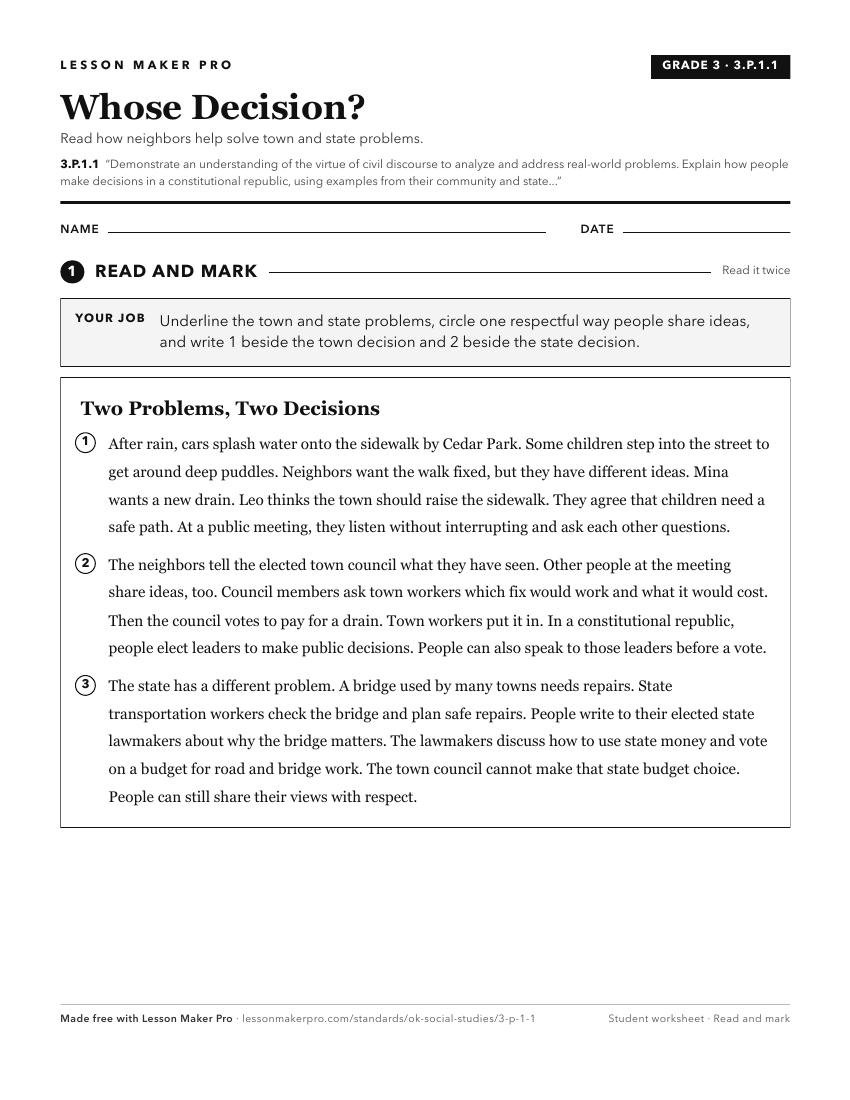
A ready-to-print activity worksheet aligned to 3.P.1.1, with an answer key for the teacher on its own page. No account needed.
PDF, US Letter, prints cleanly in black and white.
Download the worksheetKeep exploring
Related Standards
- 4.P.1.1
The 4th Grade version of this standard.
- 5.P.1.1
The 5th Grade version of this standard.
- AWH.P.1.1
Demonstrate an understanding of the virtue of civil discourse to analyze and address real- world problems.
- E.P.1.1
Demonstrate an understanding of the virtue of civil discourse to analyze and address real- world problems.
Turn this cluster into a lesson
Grade, subject, topic, and the complete cluster are prefilled. Create one free, no account needed.
Also for this cluster:Make a WorksheetMake a QuizMake a Sub Lesson