Oklahoma Social Studies AWH.P.1.1
Standard Cluster
Demonstrate an understanding of the virtue of civil discourse to analyze and address real-world problems. Evaluate the impact of perspectives, civil discourse, and democratic principles on addressing civic issues. Engage in a range of deliberative and democratic processes to develop strategies to address authentic, real-world problems in community and out-of-school contexts. Gather and evaluate information regarding complex problems, assessing individual and collective actions taken to address them.
Oklahoma Academic Standards for Social Studies (2026)
Cluster contents
Standards in This Cluster
AWH.P.1.1 is a cluster heading. These are the individual standards under it.
- AWH.P.1.1.A
Evaluate the impact of perspectives, civil discourse, and democratic principles on addressing civic issues.
- AWH.P.1.1.B
Engage in a range of deliberative and democratic processes to develop strategies to address authentic, real-world problems in community and out-of-school contex...
- AWH.P.1.1.C
Gather and evaluate information regarding complex problems, assessing individual and collective actions taken to address them.
Teacher's field guide
What This Cluster Means
What Students Need to Do
- Students investigate a current community decision using public records and other reliable sources. They compare viewpoints, discuss disagreements respectfully, and use a fair process to propose an action.
What Mastery Looks Like
- A student can explain who is affected, check a claim against a source, and compare what one resident and a group have done. They can propose a workable step and explain how public input and a vote could shape it.
Common Misconceptions
- Students may assume the loudest speaker represents everyone, or that a majority vote always makes a decision fair. They may repeat an online claim without checking its source, or mistake polite agreement for a useful discussion.
How to Assess It
- Exit ticket: Using a school board agenda item discussed today, name two affected groups, cite one checked fact, propose a next step, and explain how residents could weigh in.
Lesson moves
Ways to Teach It
Give pairs the latest school board agenda; have them mark one pending decision and sort notes into affected groups, facts, and questions.
Hold a four-minute mock board meeting on that decision; ask each speaker to cite a source and summarize the previous speaker fairly.
Give pairs source cards about the decision; award points for spotting unsupported claims and comparing one resident's action with a group's action.
Draft a 100-word comment on the decision for the school board, with one proposed action, one trade-off, and a question for board members.
Free download
Printable AWH.P.1.1 Worksheet
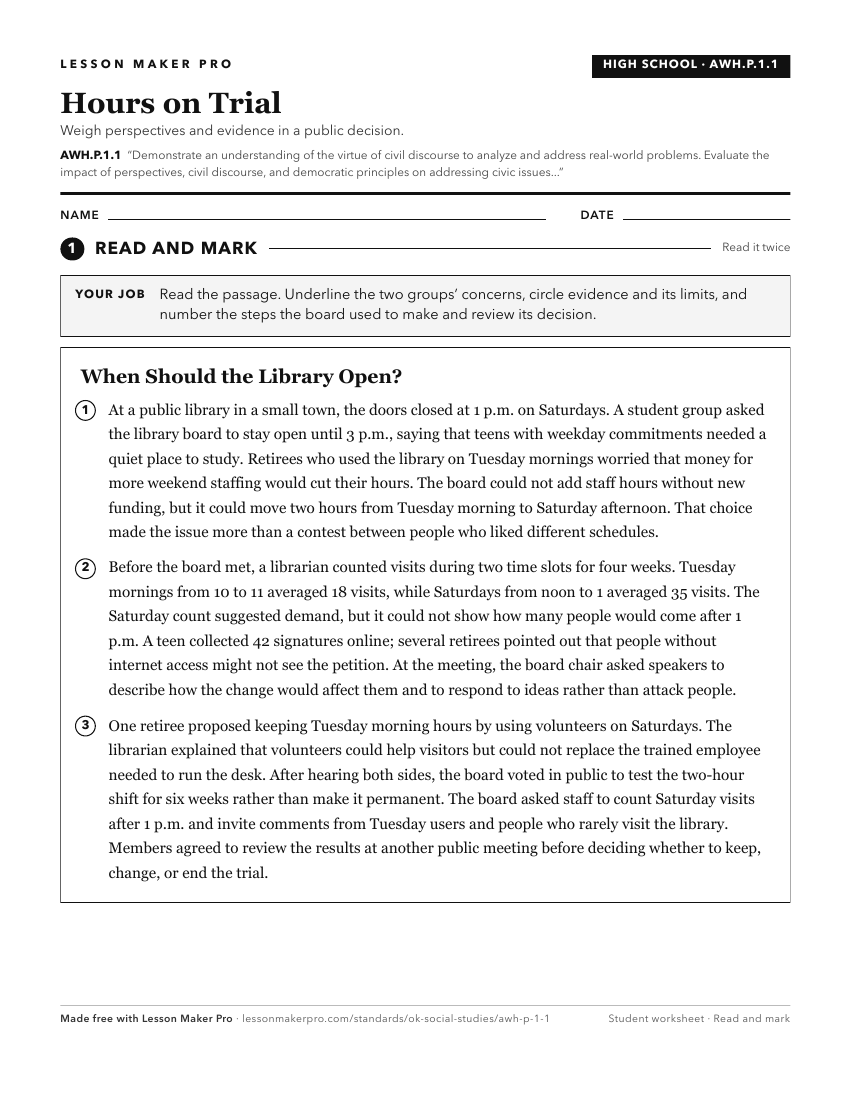
A ready-to-print activity worksheet aligned to AWH.P.1.1, with an answer key for the teacher on its own page. No account needed.
PDF, US Letter, prints cleanly in black and white.
Download the worksheetKeep exploring
Related Standards
- 5.P.1.1
Demonstrate an understanding of the virtue of civil discourse to analyze and address real- world problems.
- TOT.P.1.1
Demonstrate an understanding of the virtue of civil discourse to analyze and address real- world problems.
- E.P.1.1
Demonstrate an understanding of the virtue of civil discourse to analyze and address real- world problems.
- USH.P.1.1
Demonstrate an understanding of the virtue of civil discourse to analyze and address real- world problems.
Turn this cluster into a lesson
Grade, subject, topic, and the complete cluster are prefilled. Create one free, no account needed.
Also for this cluster:Make a WorksheetMake a QuizMake a Sub Lesson