Oklahoma Social Studies TOT.P.1.1
Standard Cluster
Demonstrate an understanding of the virtue of civil discourse to analyze and address real-world problems. Evaluate the impact of perspectives, civil discourse, and democratic principles on addressing civic issues. Engage in a range of deliberative and democratic processes to develop strategies to address authentic, real-world problems in community and out-of-school contexts. Gather and evaluate information regarding complex problems, assessing individual and collective actions taken to address them.
Oklahoma Academic Standards for Social Studies (2026)
Cluster contents
Standards in This Cluster
TOT.P.1.1 is a cluster heading. These are the individual standards under it.
- TOT.P.1.1.A
Evaluate the impact of perspectives, civil discourse, and democratic principles on addressing civic issues.
- TOT.P.1.1.B
Engage in a range of deliberative and democratic processes to develop strategies to address authentic, real-world problems in community and out-of-school contex...
- TOT.P.1.1.C
Gather and evaluate information regarding complex problems, assessing individual and collective actions taken to address them.
Teacher's field guide
What This Cluster Means
What Students Need to Do
- Students use local evidence to define a civic problem and check what residents and officials have already tried. They listen to people affected, weigh proposals, and use public comment or a vote to recommend a next step.
What Mastery Looks Like
- A student can use a crossing tally and city records to support a proposal. They can answer an objection fairly and explain what residents can request and what the city must decide.
Common Misconceptions
- Students may think civil discussion means agreeing or avoiding hard questions. They may treat a personal story as enough evidence, or assume a class vote can make the city change a road.
How to Assess It
- Exit ticket: Based on our crossing tally, should the city change this crossing? Name one action already tried, one concern from another viewpoint, and a way residents can request a change.
Lesson moves
Ways to Teach It
From school grounds, tally how many drivers yield at a nearby crosswalk for ten minutes, then mark the counts on a street map.
Read a local traffic rule, then write a response to a driver's objection using one count from the tally and a respectful question.
Use role cards to hold a mock council hearing: students, drivers, and wheelchair users testify; council members weigh evidence and vote on a crossing proposal.
Send the city transportation office a class letter with crossing counts, a proposed fix, and a question about steps the city has already taken.
Free download
Printable TOT.P.1.1 Worksheet
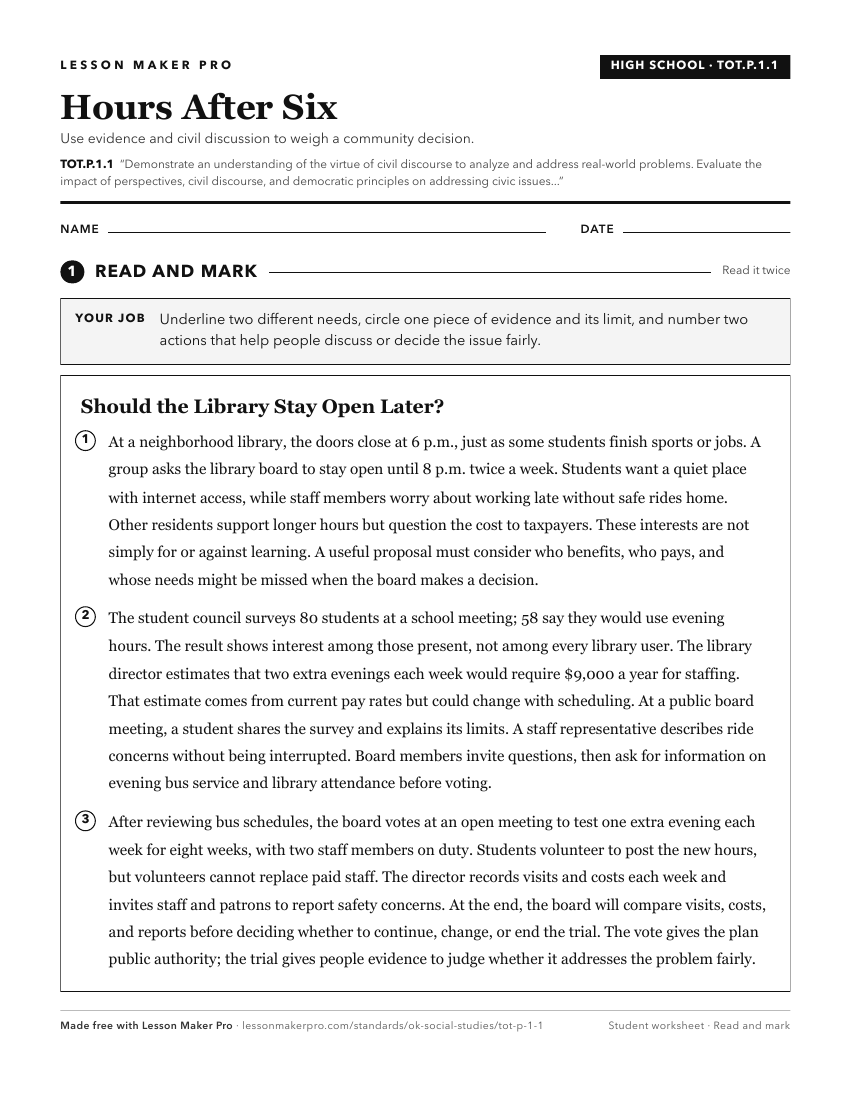
A ready-to-print activity worksheet aligned to TOT.P.1.1, with an answer key for the teacher on its own page. No account needed.
PDF, US Letter, prints cleanly in black and white.
Download the worksheetKeep exploring
Related Standards
- 5.P.1.1
Demonstrate an understanding of the virtue of civil discourse to analyze and address real- world problems.
- AWH.P.1.1
Demonstrate an understanding of the virtue of civil discourse to analyze and address real- world problems.
- E.P.1.1
Demonstrate an understanding of the virtue of civil discourse to analyze and address real- world problems.
- USH.P.1.1
Demonstrate an understanding of the virtue of civil discourse to analyze and address real- world problems.
Turn this cluster into a lesson
Grade, subject, topic, and the complete cluster are prefilled. Create one free, no account needed.
Also for this cluster:Make a WorksheetMake a QuizMake a Sub Lesson