Oklahoma Social Studies USG.P.2.1
Standard Cluster
- USG.P.2
- Use interdisciplinary tools to acquire, apply, and evaluate content understanding of the four strands of social studies.
Demonstrate an understanding of the principles of government, the benefits of democratic systems, and their responsibilities as citizens. Evaluate various significant documents from the United States of America and other nations to compare civic virtues and principles of political systems. Evaluate the impact of the structure and powers exercised by governmental systems on public policy, using historical and contemporary examples. Analyze the impact of constitutions, laws, treaties, and international agreements, by comparing how various governmental powers and responsibilities have changed over time.
Oklahoma Academic Standards for Social Studies (2026) · USG.P.2
Cluster contents
Standards in This Cluster
USG.P.2.1 is a cluster heading. These are the individual standards under it.
- USG.P.2.1.A
Evaluate various significant documents from the United States of America and other nations to compare civic virtues and principles of political systems.
- USG.P.2.1.B
Evaluate the impact of the structure and powers exercised by governmental systems on public policy, using historical and contemporary examples.
- USG.P.2.1.C
Analyze the impact of constitutions, laws, treaties, and international agreements, by comparing how various governmental powers and responsibilities have change...
Teacher's field guide
What This Cluster Means
What Students Need to Do
- Students compare U.S. and other nations' documents to identify rights, citizen responsibilities, and limits on government power. They use past and current examples to explain how laws and international agreements shape policy and change over time.
What Mastery Looks Like
- A student cites clauses from the U.S. and South African constitutions to compare voting rights. They explain how the Voting Rights Act changed voting rules and why federal power mattered.
Common Misconceptions
- Students may assume every democracy protects the same rights, or that a right written in a constitution is always enforced. They may confuse an international agreement with a domestic law or think only presidents make policy.
How to Assess It
- Give students excerpts from the Fifteenth Amendment and Section 19 of South Africa's Constitution. Ask them to name one right both protect and one way government could help enforce it.
Lesson moves
Ways to Teach It
Give pairs printed excerpts from the U.S. and South African constitutions; have them highlight voting rights and circle who must protect them.
Ask students to write: If voting is a right, what responsibilities do citizens have during an election? Use one document excerpt.
Run a timeline race with cards for the Fifteenth Amendment, Voting Rights Act, and Shelby County v. Holder; students order them and explain each change.
Put a Paris Agreement pledge beside an EPA methane rule; ask students how an international promise becomes a U.S. policy.
Free download
Printable USG.P.2.1 Worksheet
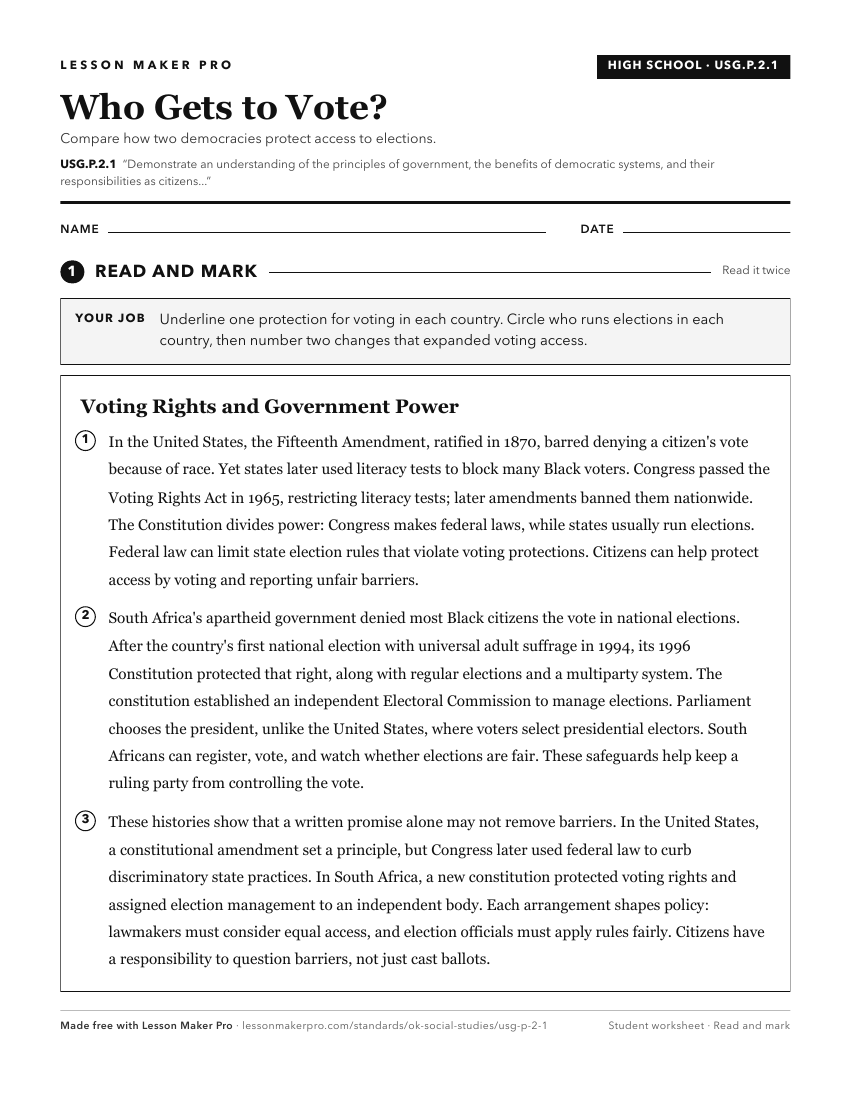
A ready-to-print activity worksheet aligned to USG.P.2.1, with an answer key for the teacher on its own page. No account needed.
PDF, US Letter, prints cleanly in black and white.
Download the worksheetKeep exploring
Related Standards
- AWH.P.2.1
Demonstrate an understanding of the principles of government, the benefits of democratic systems, and their responsibilities as citizens.
- 6.P.2.1
Demonstrate an understanding of the principles of government, the benefits of democratic systems, and their responsibilities as citizens.
- 5.P.2.1
Demonstrate an understanding of the principles of government, the benefits of democratic systems, and their responsibilities as citizens.
- 1.P.2.1
Demonstrate an understanding of the principles of government, the benefits of democratic systems, and their responsibilities as citizens.
Turn this cluster into a lesson
Grade, subject, topic, and the complete cluster are prefilled. Create one free, no account needed.
Also for this cluster:Make a WorksheetMake a QuizMake a Sub Lesson