Oklahoma Social Studies AWH.P.2.1
Standard Cluster
Demonstrate an understanding of the principles of government, the benefits of democratic systems, and their responsibilities as citizens. Evaluate various significant documents from the United States of America and other nations to compare civic virtues and principles of political systems. Evaluate the impact of the structure and powers exercised by governmental systems on public policy, using historical and contemporary examples. Analyze the impact of constitutions, laws, treaties, and international agreements, by comparing how various governmental powers and responsibilities have changed over time.
Oklahoma Academic Standards for Social Studies (2026)
Cluster contents
Standards in This Cluster
AWH.P.2.1 is a cluster heading. These are the individual standards under it.
- AWH.P.2.1.A
Evaluate various significant documents from the United States of America and other nations to compare civic virtues and principles of political systems.
- AWH.P.2.1.B
Evaluate the impact of the structure and powers exercised by governmental systems on public policy, using historical and contemporary examples.
- AWH.P.2.1.C
Analyze the impact of constitutions, laws, treaties, and international agreements, by comparing how various governmental powers and responsibilities have change...
Teacher's field guide
What This Cluster Means
What Students Need to Do
- Students compare U.S. and South African documents to find rights, government powers, and ways citizens can take part. They explain how those powers shape a policy, such as air pollution rules. They track how later laws and international agreements change government action.
What Mastery Looks Like
- A student uses a clause from each country's constitution to explain two legal routes to air pollution rules. They can explain how a later law or agreement changed what a government does, and name a way citizens can respond.
Common Misconceptions
- Students may confuse a right, such as petitioning officials, with a legal duty. They may assume a treaty writes local rules by itself, or that every branch of government can make and enforce the same rules. Some assume government powers never change.
How to Assess It
- Hand out excerpts from U.S. Constitution Article I, section 8, South Africa's Constitution section 24, and Paris Agreement Article 4. Ask students to identify a government power, an environmental right, an action countries agree to take, and one way citizens could respond.
Lesson moves
Ways to Teach It
Have pairs sort excerpt cards from the two constitutions, the Clean Air Act, and the Paris Agreement into rights, powers, and duties.
Ask, 'If a factory pollutes, should residents petition lawmakers?' Have students support their answers with the First Amendment and South Africa's section 24.
Give groups apartheid-era voting rules and South Africa's 1996 Constitution section 19; have them mark who gained the vote.
Bring a local council agenda; have students find a proposed rule, who votes on it, and how residents can comment.
Free download
Printable AWH.P.2.1 Worksheet
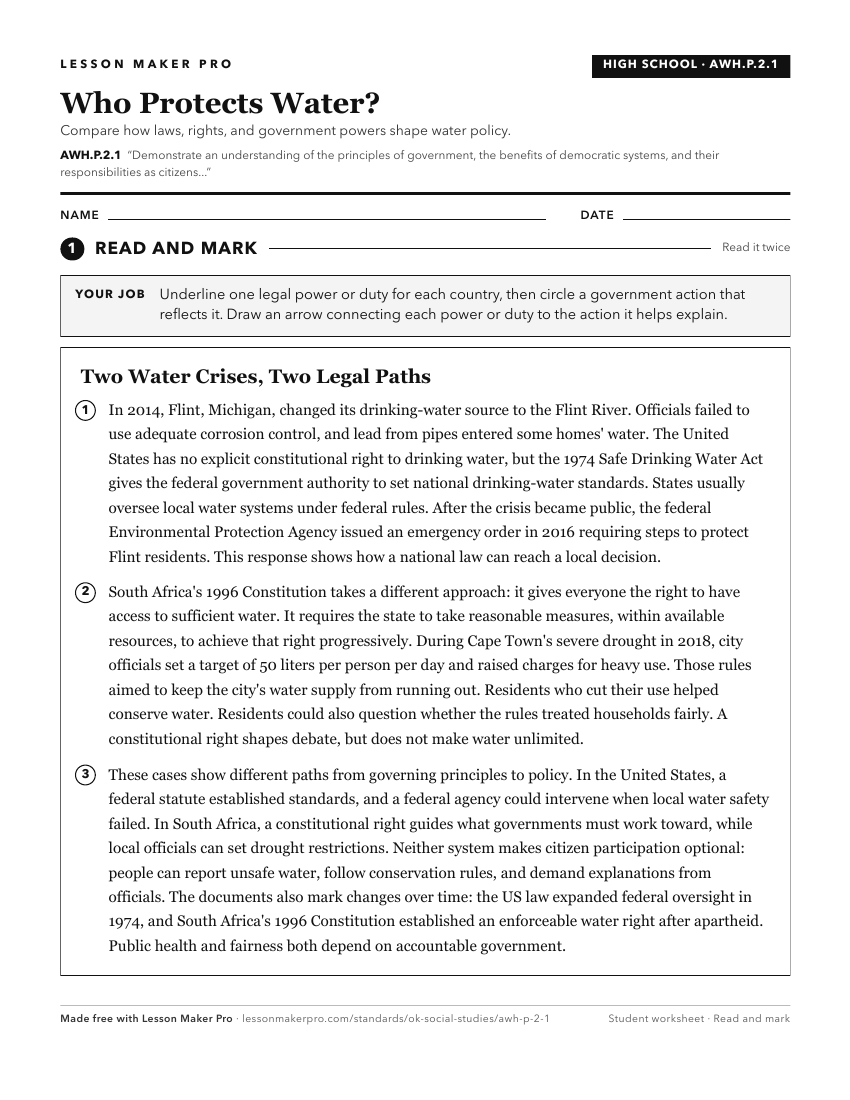
A ready-to-print activity worksheet aligned to AWH.P.2.1, with an answer key for the teacher on its own page. No account needed.
PDF, US Letter, prints cleanly in black and white.
Download the worksheetKeep exploring
Related Standards
- 5.P.2.1
Demonstrate an understanding of the principles of government, the benefits of democratic systems, and their responsibilities as citizens.
- MWH.P.2.1
Demonstrate an understanding of the principles of government, the benefits of democratic systems, and their responsibilities as citizens.
- 1.P.2.1
Demonstrate an understanding of the principles of government, the benefits of democratic systems, and their responsibilities as citizens.
- USH.P.2.1
Demonstrate an understanding of the principles of government, the benefits of democratic systems, and their responsibilities as citizens.
Turn this cluster into a lesson
Grade, subject, topic, and the complete cluster are prefilled. Create one free, no account needed.
Also for this cluster:Make a WorksheetMake a QuizMake a Sub Lesson