Oklahoma Social Studies 1.P.2.1
Standard Cluster
- 1.P.2
- Use interdisciplinary tools to acquire, apply, and evaluate content understanding of the four strands of social studies.
Demonstrate an understanding of the principles of government, the benefits of democratic systems, and their responsibilities as citizens. Identify democratic principles such as equality, fairness, and respect for the law. Identify responsibilities of people in authority in school and community settings. Describe the purposes of rules in various settings (e.g., family, classroom, school), how rules are made, and consequences for violating rules.
Oklahoma Academic Standards for Social Studies (2026) · 1.P.2
Cluster contents
Standards in This Cluster
1.P.2.1 is a cluster heading. These are the individual standards under it.
- 1.P.2.1.A
Identify democratic principles such as equality, fairness, and respect for the law.
- 1.P.2.1.B
Identify responsibilities of people in authority in school and community settings.
- 1.P.2.1.C
Describe the purposes of rules in various settings (e.g., family, classroom, school), how rules are made, and consequences for violating rules.
Teacher's field guide
What This Cluster Means
What Students Need to Do
- Students explain why homes, classrooms, and schools have rules, how people make them, and what happens when rules are broken. They explain that voting gives people a voice, but rules must treat everyone fairly. They name what teachers and crossing guards do and why people follow school rules and community laws.
What Mastery Looks Like
- A student can suggest a class rule, explain how the class could vote on it, and tell how it helps everyone. They can describe how a teacher or crossing guard helps people follow rules and give a fair response when someone breaks one.
Common Misconceptions
- Some students think a vote lets the most popular children make rules that leave others out. Others think adults can ignore rules or that breaking a rule always means punishment, with no chance to make things right.
How to Assess It
- Ask students to draw one playground rule the class could vote on. Have them finish: “It is fair because ___; it helps ___; if someone breaks it, ___; the teacher helps by ___.”
Lesson moves
Ways to Teach It
Give pairs picture cards of classroom problems, ask each pair to draw a fair rule, then vote on one rule to try.
Ask, “If most students vote to skip one child’s turn, is that fair?” Have partners explain their answers.
Play Rule Match: students pair picture cards of home, school, and park rules with reasons for each rule and fair responses when someone breaks it.
Show a photo of a crossing guard at work; ask what the guard does and which traffic rules drivers must follow.
Free download
Printable 1.P.2.1 Worksheet
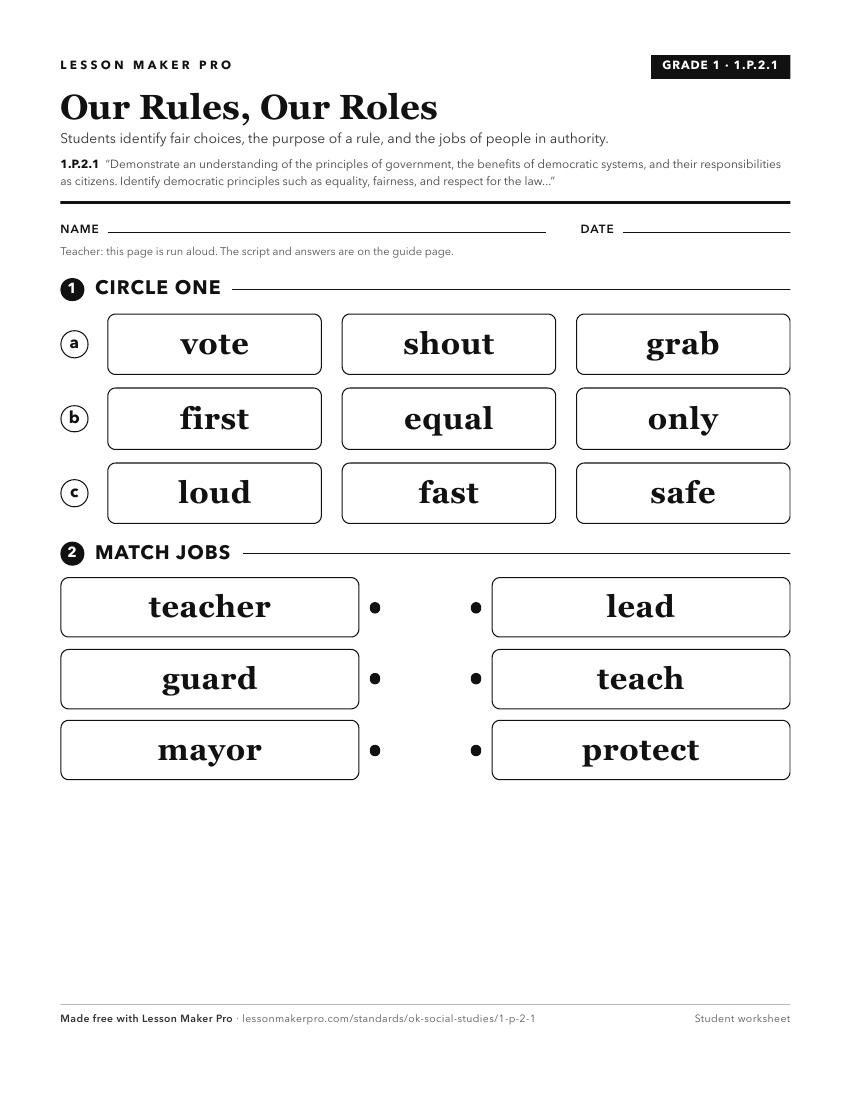
A ready-to-print activity worksheet aligned to 1.P.2.1, with an answer key for the teacher on its own page. No account needed.
PDF, US Letter, prints cleanly in black and white.
Download the worksheetKeep exploring
Related Standards
Turn this cluster into a lesson
Grade, subject, topic, and the complete cluster are prefilled. Create one free, no account needed.
Also for this cluster:Make a WorksheetMake a QuizMake a Sub Lesson