Oklahoma Social Studies USG.P.2.1.C
The Standard
- USG.P.2
- Use interdisciplinary tools to acquire, apply, and evaluate content understanding of the four strands of social studies.
- USG.P.2.1
- Demonstrate an understanding of the principles of government, the benefits of democratic systems, and their responsibilities as citizens.
Analyze the impact of constitutions, laws, treaties, and international agreements, by comparing how various governmental powers and responsibilities have changed over time.
Oklahoma Academic Standards for Social Studies (2026) · USG.P.2.1
Teacher's field guide
What This Standard Means
What Students Need to Do
- Students read short excerpts from documents written at different times. They identify who has the power to act, what each government must do, and what changed from an earlier document.
What Mastery Looks Like
- A student can explain that the Constitution let Congress levy taxes directly, unlike the Articles of Confederation. They can use a Voting Rights Act provision to show a stronger federal role in protecting voting rights. They can explain that NATO requires assistance, not an automatic declaration of war.
Common Misconceptions
- Students may think Congress could collect taxes directly under the Articles of Confederation. They may think a NATO treaty automatically sends the United States to war. They may confuse a law passed by Congress with an agreement between countries.
How to Assess It
- Give students excerpts from Article VIII of the Articles of Confederation and Article I, Section 8 of the Constitution. Ask: Who raises money under each, and what changed for the national government?
Lesson moves
Ways to Teach It
Give pairs excerpt cards from the Articles, Constitution, Voting Rights Act, and NATO Treaty; have them build a timeline and label shifts in federal power.
Ask students to write: How did the Voting Rights Act change the federal government's role in elections? Cite one provision.
Deal cards showing who collected taxes under the Articles, Constitution, and Sixteenth Amendment; partners match each document to the power it gave.
Place a 2015 Paris Agreement pledge beside a Clean Air Act rule; ask which sets an international commitment and which creates an enforceable U.S. rule.
Free download
Printable USG.P.2.1.C Worksheet
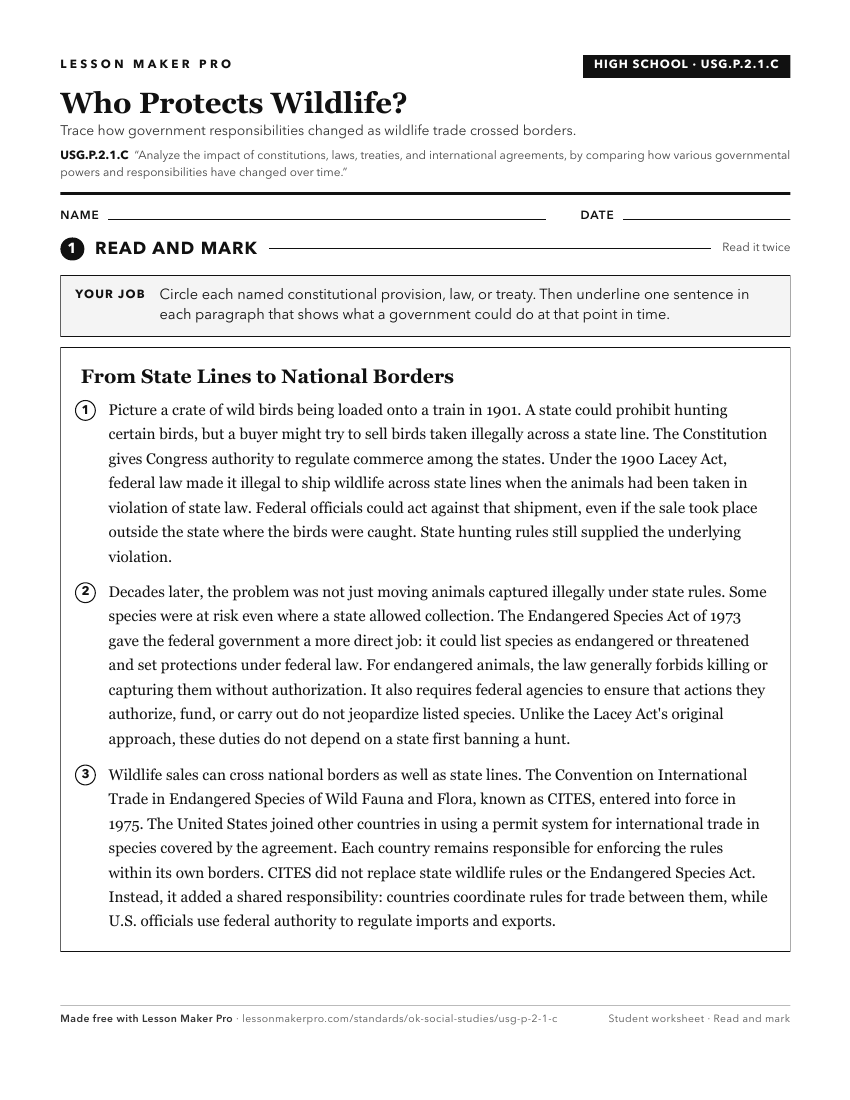
A ready-to-print activity worksheet aligned to USG.P.2.1.C, with an answer key for the teacher on its own page. No account needed.
PDF, US Letter, prints cleanly in black and white.
Download the worksheetKeep exploring
Related Standards
- USH.P.2.1.C
Analyze the impact of constitutions, laws, treaties, and international agreements, by comparing how various governmental powers and responsibilities have change...
- OKH.P.2.1.C
Analyze the impact of constitutions, laws, treaties, and international agreements, by comparing how various governmental powers and responsibilities have change...
- TOT.P.2.1.C
Analyze the impact of constitutions, laws, treaties, and international agreements, by comparing how various governmental powers and responsibilities have change...
- AWH.P.2.1.C
Analyze the impact of constitutions, laws, treaties, and international agreements, by comparing how various governmental powers and responsibilities have change...
Turn this exact standard into a lesson
Grade, subject, topic, and the complete standard are prefilled. Create one free, no account needed.
Also for this standard:Make a WorksheetMake a QuizMake a Sub Lesson